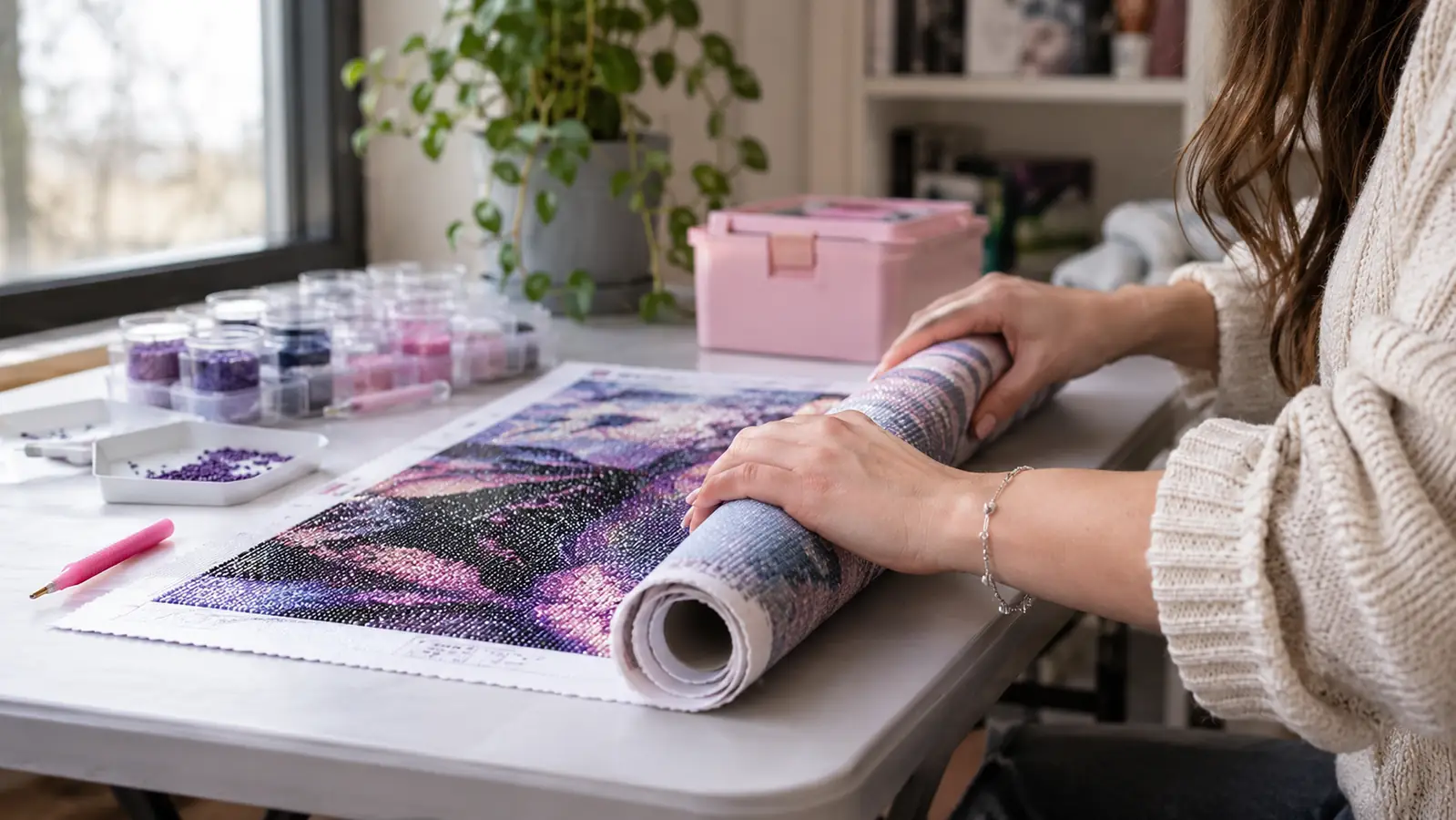
I pressed my finished sections flat with the heel of my hand for close to three years. When a row looked bumpy I laid a heavy hardback over it and left it there while I sorted the next colour, and when I came back the middle of the book's footprint was often still proud of the rest. Nothing ever fell off a canvas, so I told myself it was working. It stopped working around nine in the evening, when the arthritis in my right thumb started complaining, and it never really worked in photographs, where my rows had a gentle wave that other people's rows did not.
About a year ago I added the EastyGold roller pressing kit to the craft corner, in the same order as a new drill pen. I have rolled my way through a good many canvases since, including a 14 by 14 inch hummingbird that now hangs in the hallway. So here is the short answer. The EastyGold roller seats drills flatter, faster and more evenly across a large area. Pressing by hand wins on corners, on taped edges, on finding a high drill by touch, and on the plain fact that you already own everything it takes.
The longer answer depends on your hands and on the size of your canvases. I work at a folding table by a north-facing window, on full-drill kits that take me a couple of weeks each, and my thumb is the part of me that decides how long a session lasts. If that sounds like your setup, the roller is the better tool. If you finish small partial-drill designs in a night and then start something new, your palm is not really the weak link, and I would not talk you into a drawer full of gadgets.
| EastyGold Roller Kit | Pressing by Hand | |
|---|---|---|
| Speed on a full section | Two or three passes cover a section in under a minute | Several minutes of pressing with the palm, longer if the book comes out |
| Evenness across a big area | The same pressure down the length of every pass | Pressure shifts with how tired your arm is and where the palm lands |
| Thumb and wrist strain | You push a 4.72 inch handle with the whole hand | The heel of the palm takes the load, which is exactly what bothers my thumb |
| Seating a whole canvas before sealing | One steady overlapping pass over the full design | A book leaves hollow patches and a palm leaves waves |
| Feeling a high drill | You catch it by eye, tilting the canvas toward the light | Your palm finds it in about a second without looking |
| Corners and taped edges | A 3.7 inch rolling surface needs a clear run | Fingertips get into spaces the roller cannot reach |
| Cost of entry | One more tool to add to the drawer | Already in your kitchen and always has been |
| Storage | Takes a corner of a drawer, about 6.3 by 5.24 by 1.89 inches | Nothing to store, nothing to lose |
| Best for | Large full-drill canvases worked over weeks | Small pieces, quick finishes, tight borders |
Where the EastyGold Roller Wins
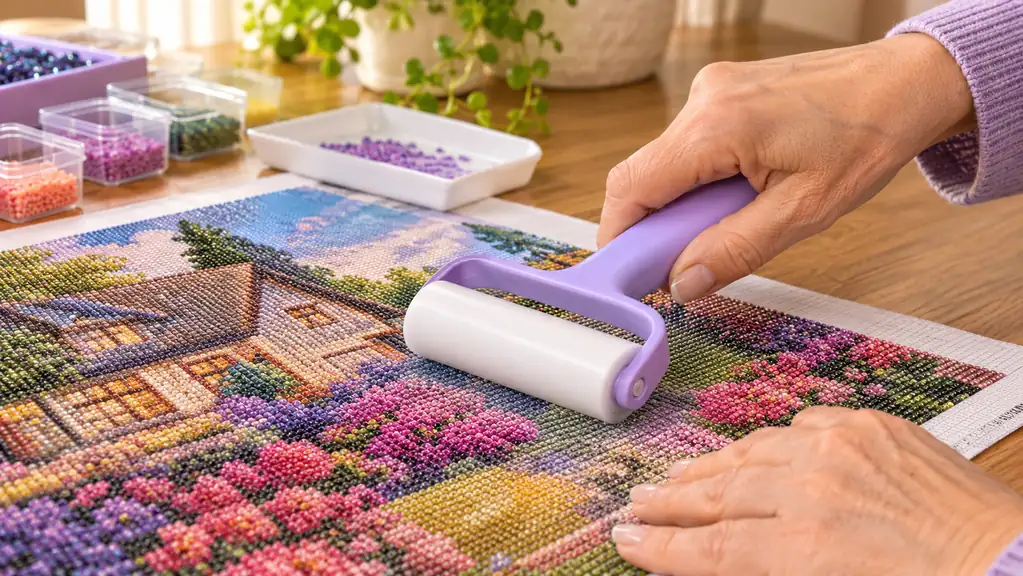
Start with what the thing actually is, because I expected something heavier. It is a hand-push tool, 3.52 ounces, with a 3.7 inch rolling surface and a 4.72 inch handle. The package measures 6.3 by 5.24 by 1.89 inches, so it takes less room in the drawer than my reading glasses case. The handle is the part I underestimated. I push with my whole hand instead of pressing with the heel of it, which moves the work from the joint that hurts to the arm that does not. The first evening I used it I rolled four finished sections and stopped because the light had gone, not because my thumb had. That had not happened in a long time.
The evenness is the part I did not expect. A palm presses where the palm happens to land, heavier at the base and lighter at the fingertips, and a hardback book presses wherever its weight falls. A roller delivers the same pressure down the length of the barrel and along the whole pass. On the hummingbird canvas I rolled each finished section as I went, and for the first time I could not see the seams between one evening's work and the next. The rows read as one surface instead of forty separate rows. My husband Ray stands close enough to a canvas to count drills, in the way of a man who has never taken up the hobby, and even he could not point to where Monday ended and Tuesday started.
The last place it earns its keep is the one nobody mentions, which is the end. Before I seal or frame a piece I lay the whole canvas on the folding table and roll it in overlapping passes from one edge to the other. Ten minutes under a book never got me a flat canvas. A couple of passes with the EastyGold roller does, and the drills sit level enough that a frame does not press one corner of the design lower than the rest. Before I had the roller I would lay a canvas under a book overnight and hang it anyway, and I could always see the ripple in the hallway light.
What the roller is not is fussy. The rolling surface is smooth and the whole tool weighs less than a paperback, so I wipe the barrel on my sleeve and put it back in the drawer beside the drill pen, and it has not picked up anything that transferred back onto a canvas. The listing calls it a pressing kit, and I will be honest that the roller itself is the part I use and the rest stays in the box where I can find it if I ever want it. If you already own a drill pen you like, that is fine. Buy the roller for the rolling and treat everything else as a bonus.
Two passes with the roller did what ten minutes of palm-pressing and a hardback book could not. The rows read as one surface instead of forty.
Where Pressing by Hand Wins
Corners, first. The rolling surface is 3.7 inches wide, which is wonderful in open country and useless in a tight corner. On the last inch of a canvas, or along a taped edge where I do not want to roll the tape up and take drills with it, my fingertips still do the work. I leave a narrow strip near the border for hand pressing and roll the middle. On the hummingbird the printed margin was about half an inch, and the roller never once touched it.
Second, and this surprised me, is feel. My palm finds a high drill in about a second and I do not have to look. The roller finds nothing. It flattens what is there and moves on, so if a drill has landed on its side and sits proud of the surface, I only catch it when I stand back and tilt the canvas toward the window. If you are the kind of person who works by touch with your reading glasses pushed up on your head, hand pressing keeps you in that mode. I have started doing a slow palm pass after the roller for exactly that reason, which sounds like doing the job twice and is really just checking my work.
Third, it is free and it is already there. No drawer space, nothing to wipe down, nothing to remember to carry to the kitchen table when a canvas is too big for the craft corner. There is a real advantage in a tool you cannot lose or leave in the wrong room. And on a small partial-drill design that I finish in two evenings, the roller is honestly more tool than the job needs. I still reach for it because it is sitting right there, but my palm would have done the work.
Where my palm still wins outright is the big canvas problem. My folding table takes a canvas up to roughly 14 by 18 inches before the edges hang off, so anything larger moves to the kitchen table, and the kitchen table is where the roller gets awkward. You are bent over a surface at the wrong height, pushing a tool with a 4.72 inch handle, and the overhead light throws a shadow right where you want to look. Pressing by hand at the kitchen table is no harder than pressing by hand anywhere else. Some of this is furniture, not tools.
If your thumb is the thing that ends the session, start here
The EastyGold roller kit weighs 3.52 ounces, with a 4.72 inch handle you push with the whole hand. Mine lives in the drawer beside the drill pen and took about a minute to learn.
Amazon Check Today's Price on Amazon →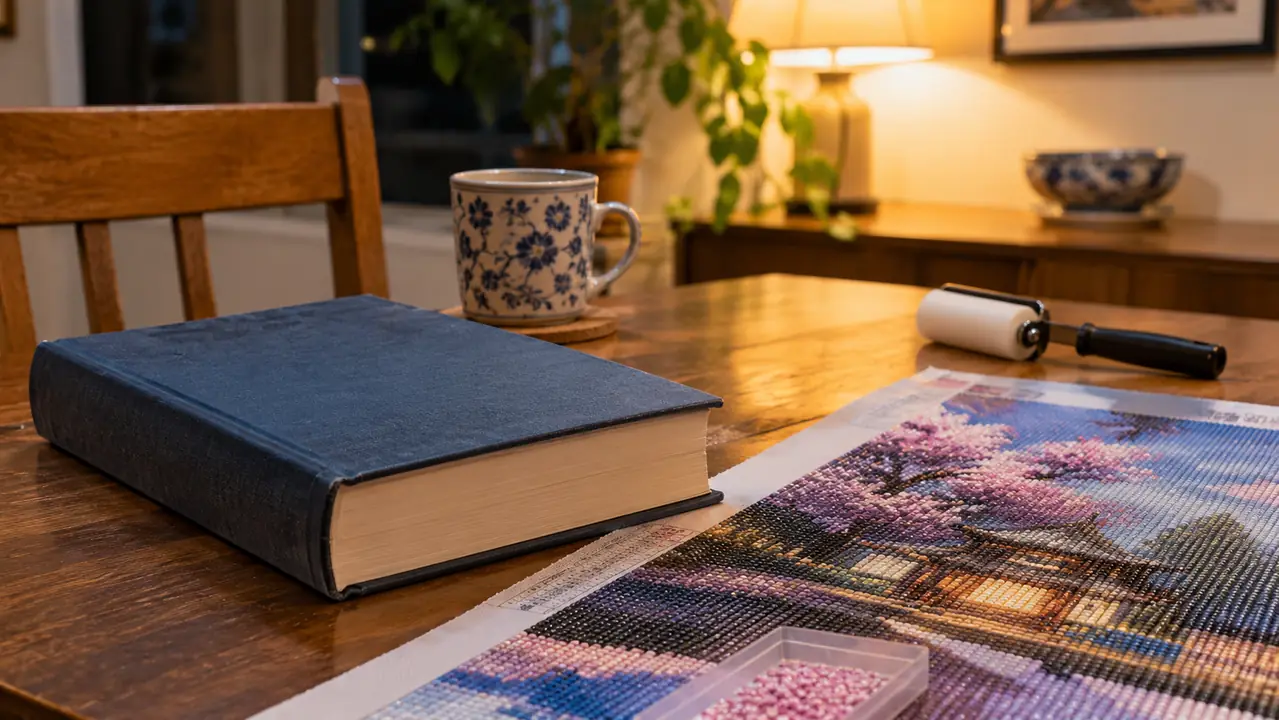
How I Roll a Finished Section Now
If you do buy one, the technique matters more than the tool. Work from one edge and move in straight overlapping passes, the way you would run a rolling pin, letting each pass overlap the last by about a third of the barrel. Do not scrub back and forth in one spot. The point is to lay the drills down level, not to grind them into the canvas. And do not lean on it. The whole tool weighs 3.52 ounces, and it is easy to press down as though you were flattening a wrinkle in a tablecloth, which is far more pressure than drills need.
Lift the roller at the end of a pass instead of dragging it sideways. Dragging is how you catch the edge of a drill and flick it across the table, which I did twice before I learned, once onto the rug and once into a tray of sorted drills where I then spent ten minutes picking one colour out of another. Leave the taped border alone. On a canvas with a printed margin, roll up to the tape and finish that strip with your fingertips, which is the one place your hand still beats the tool outright.
Then, and this is the habit that changed my finished pieces, roll the entire canvas once more before it goes into a frame or under a sealer. Whole thing, edge to edge, slow passes. The hallway hummingbird got that treatment and it hangs flat against the wall, with no ripple through the middle where a book used to leave a hollow. Ray noticed before I said anything, which for a man who teases me about my drill boxes is high praise. He asked whether I had ironed it. I have not taken up ironing at this stage of my life.
One more habit, and then I will stop. Roll before you take the canvas off the board, not after. If you pick it up first the edges curl, and a curled edge under a roller is a fight you lose slowly. I keep a thin board under every canvas I work on, slide the whole thing to the front of the table, and roll it there. It takes two minutes and it is the difference between a piece that hangs flat and a piece you keep meaning to redo.
Who Should Buy Which
Buy the EastyGold roller if your thumb, wrist or palm is the thing that ends a session, if you work large full-drill canvases that take more than a week, or if you seal and frame your finished pieces and want them flat before they go under glass. It is also the tool for anyone who has ever laid a dictionary on a canvas, come back an hour later, and found the middle still proud of the rest. At 3.52 ounces it is not much of a commitment, in space or in effort.
Stay with pressing by hand if your pieces are small and quick, if you work mostly in tight corners and along tape, or if you simply do not want another object in the drawer. Keep your palm for the borders either way. I have not stopped using mine. I stopped using it for the middle of a canvas, which was where it was doing the least good and hurting the most.
Most of us land in the middle, and that is where I have ended up after a year of this. The roller handles the open field of a design, my fingers handle the last inch, and the whole canvas gets one final pass before it is framed. Nobody has to pick a side. You just have to know which part of the job belongs to which tool, and stop asking your thumb to do the part it was never good at.
Seat the whole canvas before you frame it
3.52 ounces, a 4.72 inch handle, and a rolling surface that clears a section in two passes. Roll it once, edge to edge, and the frame sits flat.
Amazon Check Today's Price on Amazon →