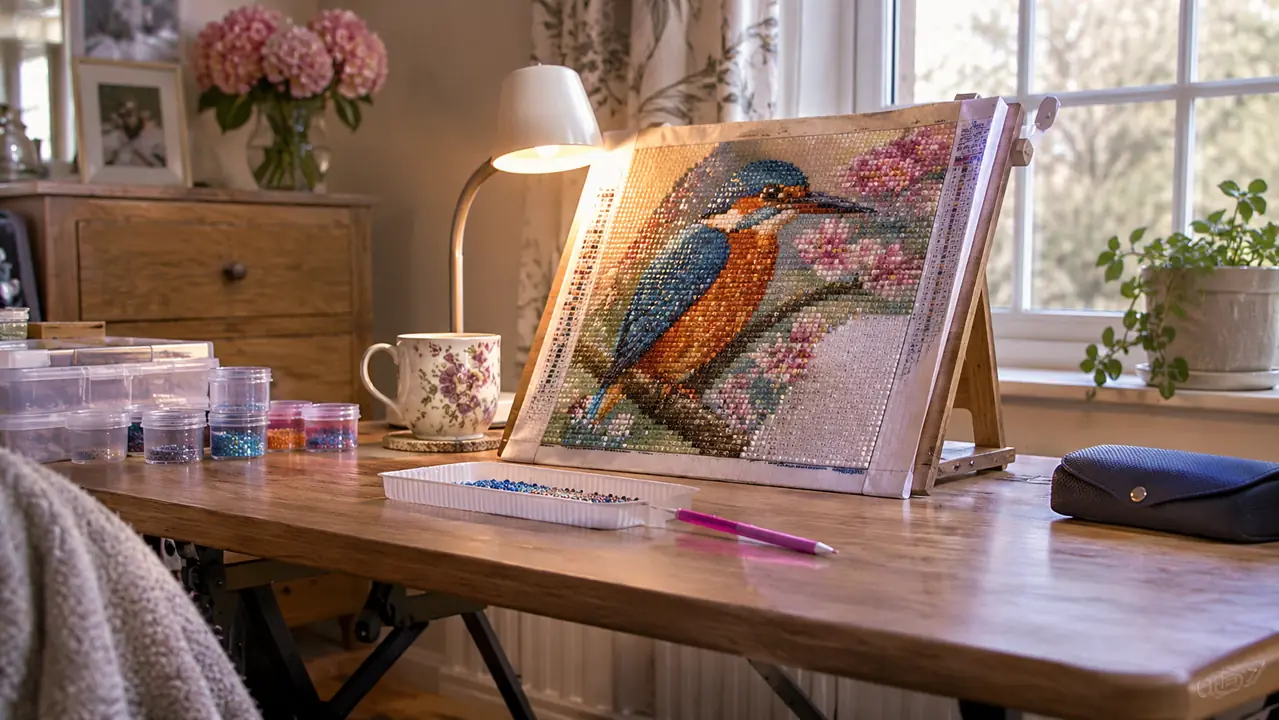
Three weeks is a long time to give one canvas when there is a shoebox of half-finished ones in the closet. I know about the shoebox. I have one. But the hummingbird canvas from SHICERNHJ stayed on my folding table for twenty-one evenings in a row this past spring, and that is about the strongest thing I can say about a diamond painting kit. I finished it. I framed it. It hangs in the hallway now, and my husband Ray has stopped asking whether it is level.
I am Delia, fifty-eight, a retired school librarian in Knoxville. I started diamond painting about four years ago after a hand surgery made knitting hard on me, and I have finished somewhere around forty canvases since. Most of them were landscapes and florals. This was my first bird, so I came to it with a fair idea of what a kit should do and very little patience for the things kits get wrong: symbols too small to read, drills that run short, canvas that will not lie flat.
The Quick Verdict
A complete 14 inch full drill canvas with readable symbols, matching drills and genuinely generous spares. The stock pen went in a drawer, but the canvas is the best bird design I have worked.
Amazon Check Today's Price →The canvas I actually finished, twenty-one nights running
Full drill, 14 by 14 inches, more than 30% extra drills in the box, and a one year warranty on the listing. I worked it with my own pen. I would again.
Amazon Check Today's Price on Amazon →How I've Used It
My craft corner is a folding table in the spare bedroom, under a north-facing window and an ARTDOT A3 light pad I have owned for about two years. I work roughly an hour most evenings, sometimes a little longer on a Sunday. That is how this canvas got twenty-one sessions rather than the three or four a lot of my kits get before they go into the shoebox with the others.
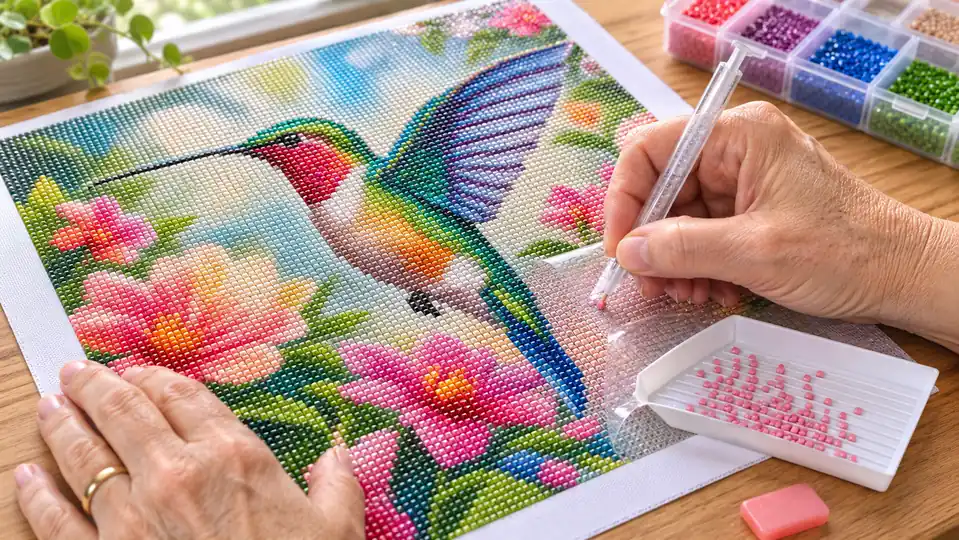
The routine never changes. I sort the drills into a 60 slot storage container before I start, because I once mixed two similar greens on the rug and spent an entire evening picking them apart by hand. I light the canvas from underneath, pick with the larger grip pen from my Praise V Do set, and place in runs of about a dozen. When a section is finished I roll it with an EastyGold roller to seat the drills flat against the glue.
So this is a review of the SHICERNHJ canvas, the drills and the wax. The kit does come with its own pen, tray, solid clay and ten plastic bags, and I will tell you plainly what I think of those. But my hands went to the tools I already trust, and I would rather say so than pretend a stock pen changed my life.
What Comes in the Box, and What I Swapped Out
The box holds a 14 by 14 inch canvas, one diamond pen, one tray, solid clay, ten plastic bags and the drills. The listing calls it a 5D full drill kit, which means the entire picture is covered, not just the bird. I have done partial drill kits and they are faster, but they look unfinished to me, like a coloring page somebody gave up on halfway through.
The stock pen is the thin plastic kind that comes free in nearly every kit on the market. If your hands are fine, it will do the job. Mine are not. I have mild arthritis in my right thumb, and a thin barrel has me aching after about half an hour. That is why the kit pen went into the drawer with the others and I worked the whole canvas with my own. This is not a knock on SHICERNHJ in particular. It is true of almost every kit at this level, and it is the first thing I would fix if I were them.
The tray and the clay I did use. The tray has the usual ridged interior for shaking drills face up, and it managed that without spilling. The solid clay held pickup well for the first two weeks. By the third week it had collected enough fuzz off the canvas edge that I scraped it clean and started a fresh surface, which is normal and takes about ten seconds.
The first evening is always sorting. Ten plastic bags sounds generous until you are looking at a hummingbird with dozens of shades that sit two apart. I dumped each color into a compartment of my own box instead, labeled against the legend with a strip of masking tape, and that took about forty minutes before I placed a single drill. Put a sheet of white paper down first if you sort at the kitchen table. Drills bounce, and a drill on a hardwood floor is gone for good.
The Canvas and the Symbols: How It Treated My Eyes
I wear reading glasses, and symbol size is the thing that decides whether I enjoy a kit or fight it. This one is printed clearly. The symbols are distinct from one another, the grid lines are visible without being heavy, and I never had the moment I have had with cheaper kits where two symbols look identical at arm's length and you only discover it three rows later.
The canvas is listed as acrylic and canvas, with the working size given as 14 by 14 inches and item dimensions of 13.8 by 13.8 by 0.15 inches. It arrived rolled rather than folded, which matters more than people think. A folded canvas creases along the fold and the drills sit slightly proud of that crease forever after. This one lay flat on the table after a night under a heavy book, and it stayed flat.
The printed area also has a decent margin. I have worked kits where the last row of drills sits right at the edge of the adhesive and the whole border looks ragged once it is framed. Here there is enough border that the finished piece sits inside a plain frame without clipping a single row.
Three Weeks of Drills: Coverage, Stick and the Last Row
The drills are what I judge hardest. The listing says each one has 26 facets, which is the standard cut, and they catch the light in a way that reads as sparkle rather than glitter. What matters more to me is consistency. In three weeks I did not find a batch of drills sitting higher than the rest, and I did not find a run of malformed ones, which is where cheap kits come apart.
Coverage was better than I expected. The listing promises more than 30% extra drills, and for once that was not creative arithmetic. I finished the final row with a comfortable pile left in the tray for every color, including the ones used in only a handful of spots. I keep a small jar of spares from every kit I finish, and this one added to it rather than borrowing from it.
One Tuesday in the second week I caught the tray with the back of my hand and sent a couple hundred drills across the table and onto the floor. I found most of them. The rest went into the vacuum, and I still had enough left to finish that color to the last row, which tells you something about the spare count. With a thinner kit that same clumsiness ends the project.
The adhesive held through the whole canvas. I worked top down and peeled the protective sheet back a section at a time, and by the time I reached the bottom the exposed glue still had grip. I did have one dry evening where a few drills wanted to lift when I rolled over them. I pressed them back down and they stayed. That is a Tennessee-in-March problem, not a kit problem.
What the Finished Piece Looks Like on the Wall
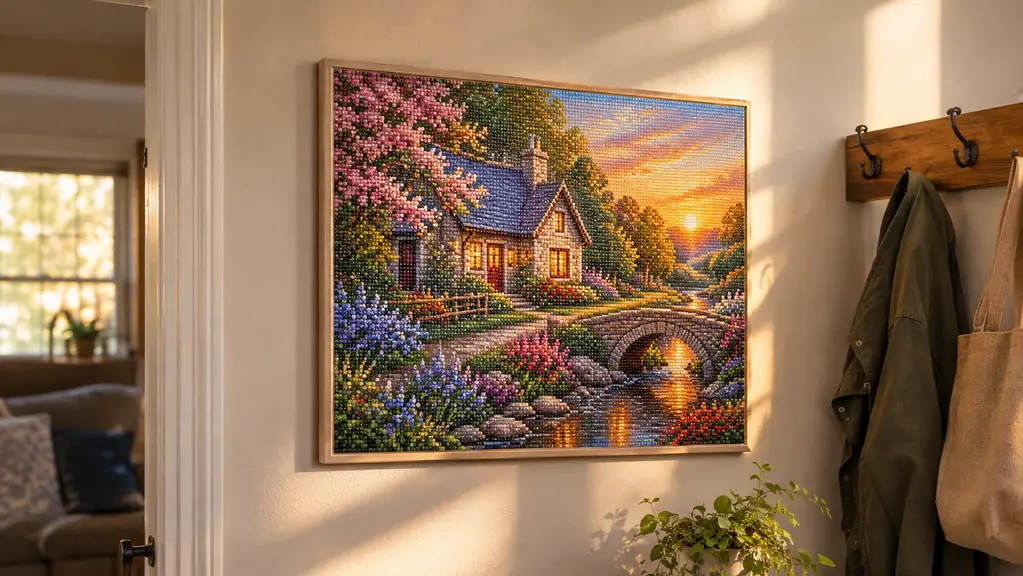
I rolled the whole canvas when I was done, the way I always do, and framed it in a plain 14 inch frame. It hangs in the hallway between the bathroom door and the coat hooks, which is not a gallery, but it is where the light from the front window hits it around four in the afternoon.
The frame is the kind with a thin lip that holds the canvas without glass. I measured twice before I bought it, because the canvas is 13.8 inches square and I did not want to trim a row of drills to make it fit. It did not need trimming. There is about an eighth of an inch of plain border on each side, just enough that the frame lip covers the edge of the adhesive and nothing else.
At a normal viewing distance it reads as a painting. Up close you can see the grid, the same way you can see brushstrokes up close on a real canvas. The facets do the rest when the light moves across them. Ray, who has lived with forty of these and has opinions about every one, said this looks like it was worth the three weeks. From him that counts as a rave.
Where It Fought Me
Two things. The first is the legend. The numbers and symbols are all there and legible, but the print is small enough that I found myself holding the canvas closer than is comfortable over a long session. If you do not work with a light pad underneath, budget for a brighter lamp or a magnifier, especially if you are past fifty like me.
The second is the size. Fourteen inches square sounds generous and it is, but a full drill canvas that size is real hours of work. A hummingbird is a lot of small color shifts in the body and the wings, which makes for a beautiful finished piece and a slow middle third. I did the background in a couple of evenings and then spent a week and a half in the bird alone.
How It Compares to My Usual Kits
I buy kits from a lot of sellers and they are more alike than the listings suggest. The differences that matter are the ones you notice in week two: whether the symbols stay readable, whether the drills match the legend, whether the glue holds to the end.
I finished a floral kit last fall where the printed chart and the drills disagreed on two shades that looked close on paper. I did not catch it until the bottom third, and unpicking meant lifting a few hundred drills with tweezers without tearing the adhesive underneath. I finished that canvas. I did not enjoy it. That is the exact failure this hummingbird avoided, and it is worth more to me than any accessory in the box.
On symbols and coverage, SHICERNHJ sits in the better half of what I have bought. The legend matched the drills with no color that turned out slightly off from the printed chart. That has happened to me twice in four years and cost an evening of picking each time. The extra drills here are real, not a rounding claim.
Where it lands in the middle is the accessories. A thin pen, a standard tray, clay and ten bags is a starter set and no more. If you already own a pen you like and some kind of sorted storage, you are paying for the canvas and the drills, which is exactly what I wanted. If you are starting from nothing, plan to add a pen with a thicker grip and a way to sort before you open the bags, or you will be working out of ten plastic bags on the kitchen table.
The listing carries a one year warranty. I have never had to use a warranty on a diamond painting kit and I did not use this one, so I cannot tell you how that process goes. I mention it because it is there, and because a seller offering one is at least thinking past the sale.
What I Liked
- Full drill coverage across the whole 14 by 14 inch canvas, so no bare patches in the finished piece
- More than 30% extra drills promised and the count actually held up on the last row
- Symbols and legend are clear and the drills match the printed colors
- Arrived rolled, not folded, and lay flat after one night under a book
- Enough border to frame without clipping the design
Where It Falls Short
- The stock pen is the thin plastic kind and it is hard on hands that ache
- Legend print is small enough that a light pad or magnifier helps on long sessions
- The bird itself is a slow middle third, not a weekend finish
- No sorting or storage beyond ten plastic bags and a single tray
I finished the final row with a comfortable pile left in the tray for every color, including the ones used in only a handful of spots.
Who This Is For
This is for the crafter who has finished a few kits and wants a full drill canvas that will not fight her. If you already work with a light pad and a pen you like, the SHICERNHJ kit is a straightforward yes. The symbols are readable, the drills match, the spares are generous, and the finished piece frames cleanly.
It is also a good gift for someone who already owns tools, because the design carries the box on its own and the kit is genuinely complete out of the package. If you are buying for a friend who has never done diamond painting, pair it with a grip pen and a small storage box and you will have made a convert.
Who Should Skip It
If you have never placed a drill, start somewhere smaller. Three weeks is a long time to be wrong about whether you enjoy a hobby, and a 14 inch full drill canvas is not a first project. Buy a small partial drill kit, finish it, and come back to this one with some idea of what your hands and eyes can take.
Skip it too if your hands ache and you are not willing to buy a thicker pen, because the stock one will not help you. And skip it if you want a finish you can hang by Sunday. This is an hour-a-night project for about three weeks, and the middle third asks for patience.
Twenty-one evenings, one framed bird in the hallway
Full drill, 14 by 14 inches, spares to the last row, one year warranty. Bring your own pen and a light pad and this canvas does the rest.
Amazon Check Today's Price on Amazon →