I have finished about forty diamond painting canvases and two paint-by-number canvases, and the question I hear most at the craft table is which one actually relaxes me. My short answer is the diamond painting kit, and the one I keep recommending right now is the SHICERNHJ hummingbird canvas I finished this spring. It is a 14 x 14 inch full drill kit, and it gave me the quiet, repetitive evening rhythm I want after a noisy day. Paint by number is not the loser in every category, though. I will get to where it wins in a minute, because pretending otherwise would be silly.
The difference comes down to what your hands and eyes are doing. Diamond painting asks you to pick up one drill and set it on a symbol. Paint by number asks you to load a brush, match a number, mix a shade if the pot is off, and stay inside a line. Both can be calming. But one has a drying clock and a water cup, and the other lets you stop in the middle of a row without ruining anything. That is why I reach for diamond painting on a weeknight and save paint by number for a long afternoon when I want a brush in my hand.
The Short Answer in a Table
| SHICERNHJ Hummingbird Kit | Paint by Number | |
|---|---|---|
| Getting started | Open the box, sort the drills, peel a section of canvas, and place drills on symbols. No color mixing. | Match numbered areas to paint pots, mix custom shades, and rinse brushes between colors. |
| Hand comfort | Placement is a repeated pinch and lift. I use my own larger grip pen because of arthritis in my right thumb. | Brush work lets the hand move more loosely, though fine details still ask for control. |
| Eye strain | Tiny symbols on a 14 x 14 inch canvas. I need my reading glasses and a light pad for evening work. | Numbers are often larger, but small detail areas still pull the eyes close. |
| Cleanup | Drills stay in a tray or storage box. A dropped drill is a small bead to sweep up. | Wet paint, brushes, a water cup, and the risk of a tipped jar. |
| Fixing mistakes | Lift the wrong drill and replace it. The adhesive stays usable. | Paint over a wrong number, but dark over light can show and blended edges are harder to undo. |
| Finished look | A textured, sparkly surface from 5D full drill drills with 26 facets. | A flat, matte, painterly surface that looks closer to a traditional painting. |
| Supplies in the box | Canvas, diamond pen, tray, solid clay, 10 plastic bags, and more than 30% extra drills. | Canvas, numbered paints, and brushes. Some kits need extra brushes or better paint. |
| Pausing mid-project | Stop in the middle of a row, cover the canvas, and come back. No drying clock. | Paint can dry, colors may need remixing, and brushes need washing if you stop. |
| Space needed | A flat table area for the 14 x 14 canvas, a tray, and a pen rest. | An easel or table, water cup, palette, and a safe place for a wet canvas. |
| Learning curve | One motion to learn: pick up a drill and place it. The symbols take a session to get used to. | Brush control, color mixing, layering, and staying inside small lines. |
| Warranty | The listing gives a 1 year warranty. | Varies by kit; many list none. |
| Best for | A low-mess, rhythmic evening craft with a sparkly finish. | A brush-in-hand session and a matte, painterly result. |
How I Tested Both
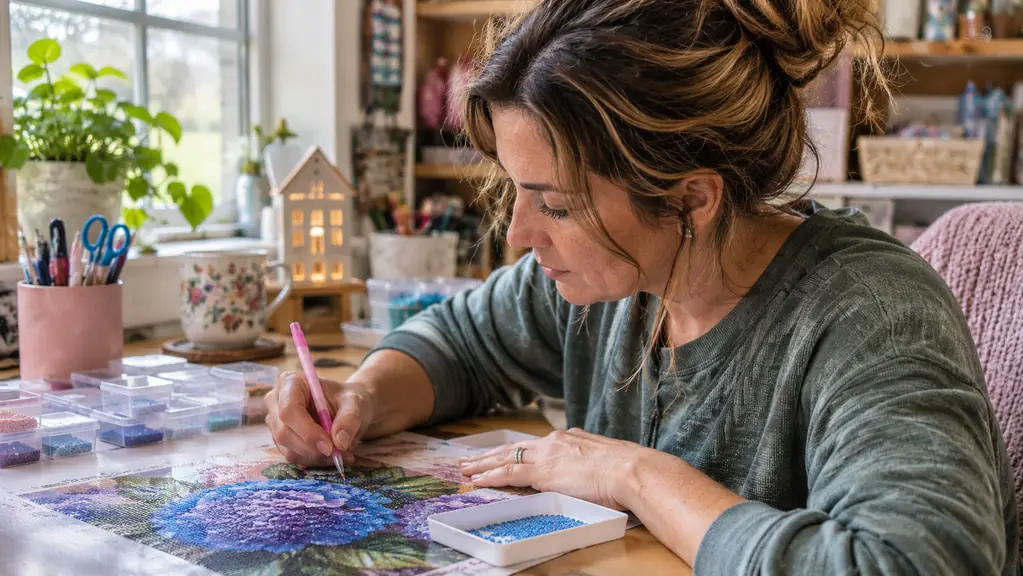
My paint-by-number experience is older. I did two canvases years ago, in the years before my hand surgery, when knitting was still my evening habit and a brush felt like a treat. Both were small landscapes. The first I finished in a weekend and felt foolishly proud of. The second stalled for a month, because I had mixed a custom shade of sky for the upper corner, used most of it, and come back on a Thursday to find the leftover pot had gone tacky and the exact shade was gone with it. I chased it for an hour with two other pots and a white and never quite got it back. I remember the pleasure of loading a brush and the annoyance of a water cup that got knocked over. Those two canvases are gone now, given away when we cleared out the guest room, and I have not bought another. That is not a knock on paint by number. It is a fact about my weeknights. I want a project I can pick up for forty minutes and leave without cleaning a brush.
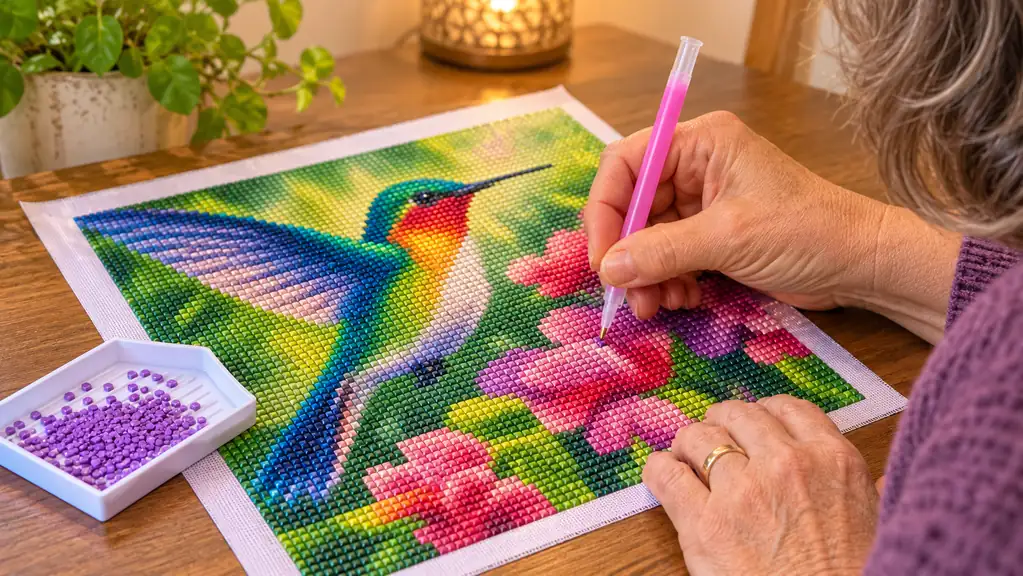
The SHICERNHJ canvas is my most recent diamond painting, a bird design I worked over about three weeks this past spring, roughly an hour most evenings. It is 14 x 14 inches, full drill, and the box included the canvas, a diamond pen, a tray, solid clay, 10 plastic bags, and more than 30% extra drills. I opened it on a Sunday afternoon and spent the first hour doing nothing but sorting. I tipped each bag into a slot in my ARTDOT storage box and set the box to my right, where I could reach it without looking away from the canvas. The first working session was short, maybe thirty minutes, because I was still learning which symbol was which. I used my own Praise V Do pen, my ARTDOT light pad, and my EastyGold roller, not because the kit is incomplete but because those tools are already on my table and they suit my hands. The kit's own canvas, drills, and solid clay did the real work. By the second week I was finishing a whole block of the wing in one sitting and stopping mid-row when Ray called me for supper.
The paint-by-number comparison is not a lab test. It is memory plus a fresh look at what each craft asks of me. I am 58, I have mild arthritis in my right thumb, and I wear reading glasses. Those facts matter more than brand loyalty. A craft that hurts after half an hour does not relax me, no matter how pretty the finish. That is the lens I used here, and it is why the table has a few rows where paint by number comes out ahead.
The Relaxation Difference
Relaxation is not the same as ease. Paint by number is more forgiving in one way: you can stand up and stretch, and the paint does not care. But it asks for cleanup at the end. Diamond painting asks for a different kind of attention. The symbols are small, and if you are tired you can put a drill in the wrong square. I did exactly that on a Wednesday in the second week, three squares off, in a run of two greens that looked nearly identical under the ceiling light. The fix is simple, though. I keep a pair of tweezers nearby, lift the drill, and set it where it belongs. There is no wet edge to repair and no shade to rematch. Twenty seconds and I was back in the row. With paint, that mistake would have meant a wet edge to blend and a color I might not get back at all. That is the whole difference in one sentence: one craft lets you undo, the other lets you paint over.
Rhythm matters, too. Diamond painting gives me a steady tick, tick, tick as the drills go down. After about ten minutes my shoulders drop. Paint by number gives me a longer, slower arc. I mix, I load, I brush, I rinse. It is satisfying, but it is a project with a beginning, a middle, and a cleanup. On a Tuesday night, I want the tick. On a rainy Saturday, I might want the brush.
More than 30% extra drills means I stopped rationing the last few of a symbol and just finished the row.
What I Would Change
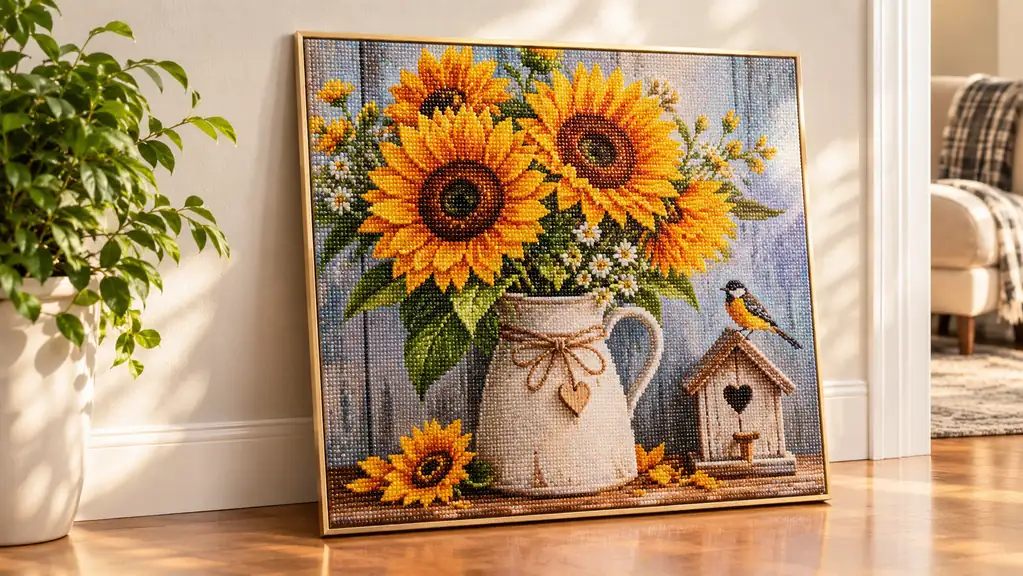
I would not change the canvas coverage or the drill count. The included list does not mention a frame or hanging hardware, so I used a simple frame I already had, a thin one I had bought for something else and never got around to using. It took me two tries to seat the canvas square, because the printed edge runs close to the design and I did not want to crease a finished row of drills while I fussed with the corners. I measured the frame opening against the 13.8 inch canvas twice before I pressed anything down. That is normal for diamond painting kits, but it is worth knowing before you finish and want the piece on the wall that same night. If you plan to frame, buy the frame before the last evening, not after it. I would also tell a beginner to plan for a larger grip pen if their thumb complains. The included pen is there, but I did not use it for long because I already had a pen that suits my hand.
The symbols are small enough that I needed my reading glasses and my ARTDOT light pad for evening work. That is not a flaw in the kit so much as a fact about the craft. If you have low vision or arthritis, set up the light and the pen before you start, not after your eyes are tired. The other thing I would change is the sorting routine. I sorted every bag into my storage box before I began, and it made the three weeks smoother. It also made the start slower. That is a trade I would make again.
Where SHICERNHJ Wins
The SHICERNHJ kit wins on the things that decide whether I finish a project. The mess is contained. Drills sit in the tray or in my storage box, and if one hits the rug it is a small bead to pick up, not a wet brush to rinse. I can stop in the middle of a row, cover the canvas, and walk away. There is no drying clock. For a weeknight hobby, that is the whole ballgame. The 14 x 14 inch size is big enough to feel like a real project and small enough to leave on the folding table by the north window between sessions.
The kit also wins on the small kindnesses. The box has a diamond pen, a tray, solid clay, 10 plastic bags, and more than 30% extra drills. I used my own pen, but I was glad to have the tray and the clay for the first session. The drills have 26 facets, so the finished canvas catches light from across the hallway. The listing gives a 1 year warranty, which is unusual enough that I noticed it. And the full drill coverage means there are no bare patches where a symbol was skipped. When I finished, I rolled the canvas with my EastyGold roller to seat the drills flat before framing.
Where Paint by Number Wins
Paint by number wins on the feel of a brush in your hand and on the final surface. If you want something that looks like a painting rather than a mosaic of drills, paint by number is the honest choice. The surface is flat, the colors are paint, and the texture comes from brushstrokes. That is a different pleasure. It is also a pleasure I miss sometimes, especially when I want to blend a sky or soften an edge. Diamond painting gives me sparkle and texture, but it does not give me brushwork.
It also wins on hand comfort for some people. Brush work can be looser than the pinch-and-place motion of a drill pen. When my right thumb is flaring, I can hold a brush differently. I cannot say the same for a pen. Paint by number also lets you cover a large area quickly, which feels good if you want visible progress in one sitting. The tradeoff is the water cup, the drying time, and the color matching. Those are real costs, and I do not want to pretend they are not.
If you want the low-mess weeknight version, start with the 14 x 14 hummingbird canvas
The SHICERNHJ kit comes with the canvas, pen, tray, solid clay, 10 plastic bags, and more than 30% extra drills. It is full drill, 14 x 14 inches, and it is the kit I reached for on the nights I wanted to quiet my hands.
Amazon See the Hummingbird Kit on Amazon →Who Should Buy Which
Buy the SHICERNHJ hummingbird kit if you want a complete 14 x 14 inch full drill project, you like a rhythmic craft you can pause, and you do not mind small symbols. It is a good fit for a weeknight routine, for someone who wants a sparkly finished piece, and for a crafter who already has a light pad or a grip pen. Skip it if you want a brush in your hand, if you dislike tiny symbols, or if you need a project that covers large areas quickly.
Choose paint by number if you want a matte, painterly finish, you enjoy mixing colors, and you have a spot where a wet canvas can sit. It is the better choice for a long afternoon, for someone who wants to practice brush control, and for a finished look that reads as a painting rather than a textured mosaic. Do not choose either one if you need a craft that takes zero focus. Both ask for attention. The question is which kind of attention leaves you calmer when you put it down.
The kit that got me back to the table after a long day
Full drill, 14 x 14 inches, with the tray, clay, bags, and extra drills in the box. If the table is where you unwind, this is the one I would hand you.
Amazon See the Hummingbird Kit on Amazon →