I bought the ARTDOT A3 LED Light Pad two years into diamond painting, after one too many evenings squinting at a canvas under the ceiling light. I started the hobby four years ago, after a hand surgery made knitting hard. I was 56 then, still working as a school librarian, and my right thumb had already started to ache from the thin stock pens that come in kits. The headaches were new. By the end of an hour, the symbols on dark sections turned into a blur, and I would take my reading glasses off and rub my eyes. The ARTDOT A3 was the first light pad I ever owned. I have used it under every canvas since, including the hummingbird piece that now hangs in my hallway. It has not fixed my thumb, because a light pad cannot do that, but it has made the evening hour at my craft table feel easy again. If you are sorting through light pads and wondering whether the A3 size is worth the space, this is what months of steady use have shown me.
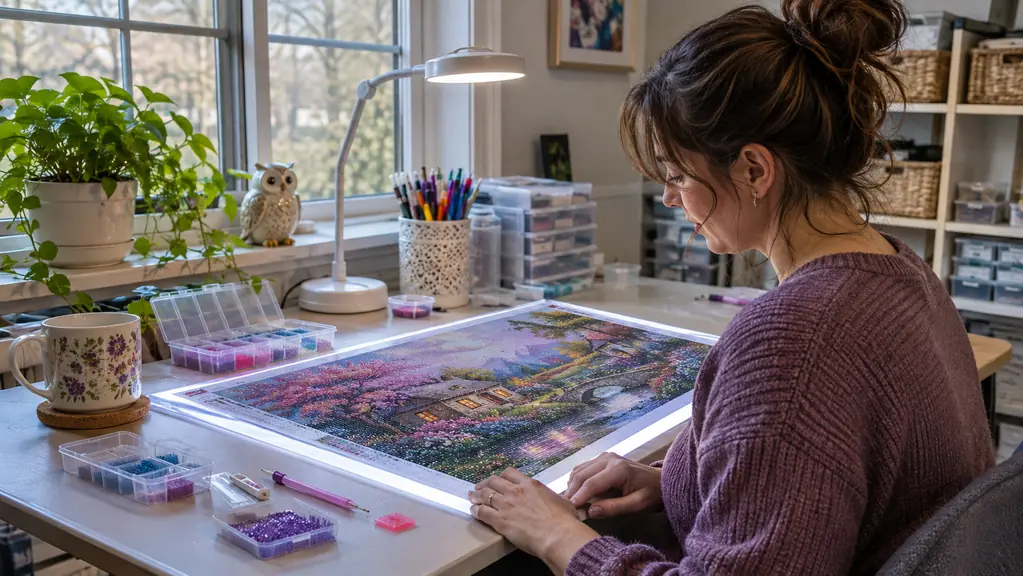
My craft corner is a folding table by a north-facing window in the spare bedroom here in Knoxville. In the evening, that window gives me nothing. I turn on the overhead light and a desk lamp, and I still lean closer to the canvas than my neck likes. The ARTDOT A3 sits on the table, under the canvas, and does the one job I need: it makes the symbols readable without turning the room into an operating theater. Ray, my husband, says I look like I am landing a plane. He is not wrong.
The Quick Verdict
A bright, thin A3 pad that made my evening diamond painting sessions easier on my eyes. It needs a USB outlet and a table with room, and the included extras are a bonus rather than the reason to buy.
Amazon Check Today's Price →The light pad that made my evening drilling hour quiet again
If dark symbols under a ceiling lamp send you to bed with a headache, the ARTDOT A3 gives you a lit surface instead. It runs from USB, the cable reaches 5 feet, and the A3 face covers most of a 14 by 14 canvas with a little overhang.
Amazon See the ARTDOT A3 Light Pad on Amazon →How I've Used It
I have owned the ARTDOT A3 for about two years. It stays on my folding table, and I pull it out for most evening sessions, usually an hour after dinner. I have finished about 40 canvases since I started, most of them landscapes and florals. I do not use the pad as a tracing table. I use it for diamond painting, which is what the listing recommends, and I use it under the canvas I am working on. The pad is 0.15 centimeters thick, so the canvas does not sit up on a wedge. I can rest my forearms on the table the way I always have.
The box came with two adjustable stands, four diamond painting pens, tweezers, and a storage case with 56 slots. I use the stands when I want the pad tilted a little toward me. I use my own pen, the Praise V Do I switched to after the stock pens made my thumb ache, but the included pens live in a drawer for guests. The storage case holds a kit's worth of drills, though my full collection is larger. Those extras are nice. The pad itself is the part I would replace if it ever died.
My routine is simple. I sort the drills for the section I am working on, set the canvas on the ARTDOT A3, and turn the pad on. I keep the soft setting for the first pass at night, then switch to the bright setting when I hit a block of dark symbols. When I finish a section, I turn the pad off and roll the drills flat. The pad does not do the work for me. It just removes the reason I used to stop early.
The hummingbird canvas was the test. It is 14 by 14 inches, my first bird design, and I worked it over about three weeks this past spring, roughly an hour most evenings. The pad sat under it for every session. I did not finish it faster than I would have without the pad. I finished it with fewer breaks and less rubbing my eyes, which is the better result for me. It hangs in the hallway now, and I still remember how clear the wing symbols were under the light.
What the A3 Size Changes at the Table
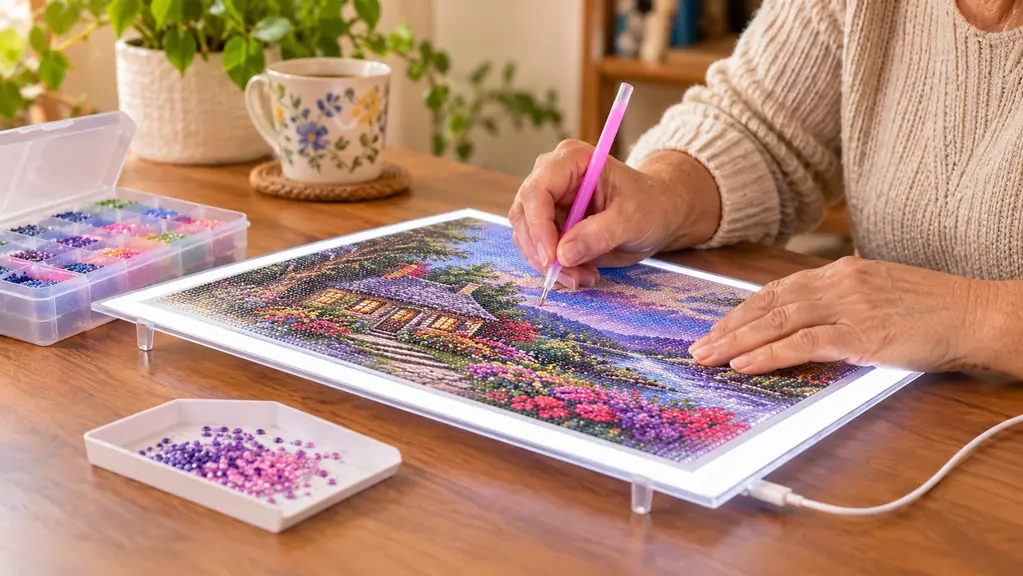
A3 is the reason I picked this pad over the smaller A4 size. I have never owned an A4, but I have stood at a friend's craft table while she worked on one, and I know how much of a larger canvas hangs off the edge. The ARTDOT A3 measures 17.32 inches long and 12.99 inches high. My hummingbird canvas is 14 by 14 inches, so one side overhangs by about an inch. That overhang is fine. The symbols I am actively drilling are almost always in the middle of the canvas, and the pad covers that middle with room to spare.
On smaller kits, the A3 feels generous. I can put the canvas down, set a tray of drills beside it, and still have lit space for my hand. On a 14 by 14 canvas, I shift the canvas once or twice as I move from row to row. That sounds like a hassle. It is not. I would rather shift a canvas twice than squint at the bottom corner because the pad is too small. The A3 size is the main reason this pad stayed on my table after the first week.
The pad is also thin enough to live under the canvas without changing the angle of my wrist. At 0.15 centimeters, it is thinner than the acrylic block I used to keep on the table for pressing. I slide it into the gap between the table and the wall when I need the whole table for a big canvas. That is not a feature the listing brags about, but it matters in a spare bedroom where every inch is spoken for.
Brightness, Eye Strain, and the Evening Hour
The brightest setting is 1500 lux. I do not have a light meter, so I cannot verify that number. I can tell you what it looks like on a dark navy block at 9 p.m. The symbols read. The color code reads. The grid lines read. I do not have to hold my reading glasses at a angle or lean in until my nose is near the canvas. That is the whole point of the pad for me, and it is why I stopped getting the evening headaches that used to follow a long session under the ceiling light.
I use the soft setting at night when Ray is watching television in the next room. The pad is not a lamp for the room. It lights the canvas, not the whole table, and the soft setting keeps the glow low enough that I do not feel like I am working in a spotlight. When I hit a section with dark symbols, I switch to bright. That back and forth is the only control I touch. I do not need anything more complicated. I turn it on, I work, I turn it off.
Eye strain is a personal thing. I am 58, I wear reading glasses, and I have mild arthritis in my right thumb. A light pad does not fix arthritis. It does not fix the need for glasses. What it does is remove one layer of strain, the layer that comes from poor light. After two years, I still notice the difference when I work on a canvas without the pad, which happens when I use the kitchen table for a big piece and leave the pad in the craft corner. Without it, I am tired in 20 minutes. With it, I can work for an hour and still read a book afterward.
The Stands, the Cable, and the Small Annoyances
The pad is USB powered, and the cable is 5 feet. My outlet is behind the craft table, so the cable reaches without an extension. If your outlet is across the room, you will need an extension cord. That is not a flaw in the pad. It is a fact of a USB device with a 5 foot cable. I mention it because I have moved furniture to reach an outlet more than once, and I would rather know before I set the table up.
The two adjustable stands are useful, but they are not a permanent stand. I set the pad at a slight angle when I am working on a small kit and want the canvas closer to my eyes. For a large canvas, I lay the pad flat. The stands fold away, and I keep them in the same drawer as the extra pens. The pad itself is thin and flat, and I forget it is there, which is what I want from a tool.
The acrylic surface shows dust and fingerprints. I wipe it with a microfiber cloth before I start, the same cloth I use on my glasses. If I skip that step, I see the smudges through the canvas, especially on light sections. This is a small thing, but it is the reason I keep the cloth in the storage case. The other small annoyance is the included storage case. It has 56 slots, which is fine for one kit. If you keep every color from every project, you will outgrow it. I use a larger box for my full collection and keep the included case for the kit I am working on.
Where It Still Falls Short
The ARTDOT A3 is not a work surface. It does not make a warped canvas flat, and it does not hold the canvas in place. I still tape my canvas to the table if the edges curl. I still use my roller at the end of a section. The pad lights the symbols and nothing else. If you are looking for a surface that will also keep drills from moving, this is not that. It is a light, and it is a good one.
The pad also needs a USB outlet. That sounds obvious, but it is the one thing that keeps me from taking it to the kitchen table every time. I have an outlet by the craft table and no outlet near the kitchen table, so the big canvases get worked under the ceiling light unless I move the pad and an extension cord. If your craft space is not near power, you will feel that limitation every time you want to work somewhere else. It is not a deal breaker. It is a reason the pad lives in one spot.
What I Liked
- A3 surface covers most of a 14 by 14 canvas, with only a little overhang on one side.
- 1500 lux bright setting makes dark symbols and color codes readable at night.
- Soft setting is low enough for evening work without lighting up the whole room.
- 0.15 centimeters thick, so the canvas does not sit up on a wedge.
- USB powered with a 5 foot cable, plus two adjustable stands, four pens, tweezers, and a 56 slot storage case.
Where It Falls Short
- Needs a USB outlet nearby; the 5 foot cable may not reach across a room.
- The acrylic surface shows dust and fingerprints and needs a wipe before each session.
- The included 56 slot case is small for a large drill collection.
- The pad lights the canvas but does not hold it flat or keep it from curling.
At 1500 lux, the symbols on a dark block read as clearly at 9 p.m. as they do at noon. That is the whole reason the ARTDOT A3 stays on my table.
Who This Is For
If you do diamond painting at a table that does not get good light, this pad is for you. It is also for the painter who works at night, the one who has tried a desk lamp and still leans in until her neck hurts. I would recommend the A3 size to anyone who works on canvases larger than a greeting card. The extra surface means fewer shifts and less squinting at the edges. If you have mild arthritis in your hands, the pad will not fix that, but it will let you see well enough to slow down and place drills without stabbing at the canvas. That is worth something.
Who Should Skip It
Skip the ARTDOT A3 if you only work on small 5 by 7 inch kits and your current lamp already does the job. Skip it if your craft table has no USB outlet and no way to add one, because a light pad you cannot plug in is a very thin tray. Skip it if you want a stand that holds the pad at a steep angle for tracing. The two adjustable stands are for a slight tilt, not a drafting table. And skip it if you expect the pad to keep your canvas flat. It will not. It is a light, not a work surface.
If your eyes are tired before the canvas is half done
The ARTDOT A3 gives you a lit A3 surface, a soft setting for late work, and a thin profile that stores against the wall. It is the tool I reach for before every evening session, and it is the reason I stopped working under the ceiling light.
Amazon See the ARTDOT A3 Light Pad on Amazon →