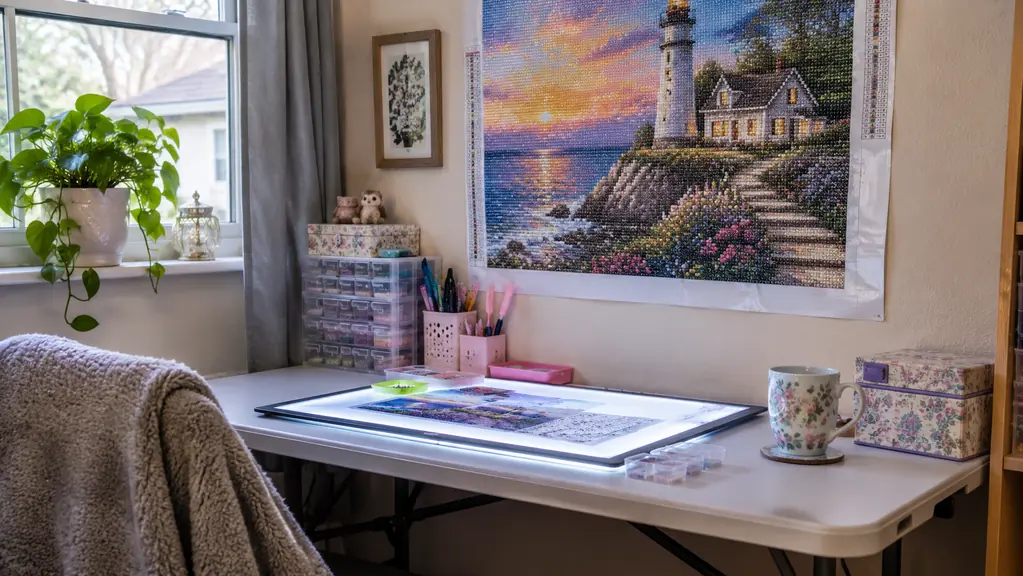
Short answer: if your diamond painting canvases are 14 inches or larger and you work at a table you can leave set up, buy the ARTDOT A3. If you only do small kits, or you pack your hobby into a drawer every night, the A4 is the kinder size. I am Delia, 58, a retired school librarian in Knoxville, and I have had the ARTDOT A3 under my canvases for about two years. I do not own an A4. I spent an afternoon with one in a friend's craft room and I have read enough listings to know what the smaller size can and cannot do. The difference is not about which pad is better. It is about how much canvas you need lit at once.
Here is what changes when you drop from A3 to A4. The working area shrinks, so a big canvas has to be moved. The pad takes less room on the table, which matters if your craft corner is also the kitchen table. The smaller surface is easier to store. The larger surface is easier on your eyes because you are not chasing symbols from section to section. The ARTDOT A3 measures 17.32 by 12.99 inches and is about 0.15 centimeters thick. It is acrylic, USB powered, and rated at 1500 lux at its brightest. Those numbers matter more than the label on the box.
| ARTDOT A3 | A4 light pad | |
|---|---|---|
| Working area | 17.32 by 12.99 inches, a full A3 sheet | A4 sheet, roughly half the surface |
| 14 x 14 canvases | Fits with room around the edges | You shift the canvas as you work |
| Small 8 x 10 kits | More pad than the kit needs | Easy to center and rotate |
| Portability | Thin, but wide, I leave it on the table | Slides into a tote or behind a shelf |
| Table footprint | Takes the middle of my folding table | Leaves room for drills and a lamp |
| Storage between sessions | Stays out or goes behind a door | Fits in a drawer or laptop sleeve |
| Light across a large canvas | 1500 lux at max, even across the A3 surface | Bright in the center, less coverage as you move out |
| Accessories in the box | Two adjustable stands, 56-slot case, four pens, tweezers | Pad only in the model I tried |
| Cable reach | 5 foot USB cable | Varies by model |
| Set up | Stand and pad take a minute to arrange | Set it down and go |
| Best for | Large canvases and long evening sessions | Small kits and tight craft spaces |
How I Compared Them
I did not run a lab test. I did what most of us do. I used the ARTDOT A3 on my own table for two years, then I took a 14 x 14 hummingbird canvas to a friend's house and worked the same kind of section on her A4. I paid attention to three things: how often I had to move the canvas, how my eyes felt after an hour, and how much table space was left for drills, tweezers, and a cup of tea. I also checked the ARTDOT listing against the pad in front of me. The 5 foot USB cable reaches the outlet behind my folding table. The soft setting is the one I use at night. The brighter setting is for dark color blocks and fine symbols.
My body is part of the test whether I like it or not. I have reading glasses and mild arthritis in my right thumb. I cannot hover over a canvas for two hours. I need the symbols to be clear without leaning in, and I need my forearms to have somewhere to rest. That is why size matters to me. A pad that is too small makes me move the canvas, and moving the canvas makes me reset my hands, my tray, and my place. A pad that is too large takes over the table. The right size is the one that lets you work for an hour without rearranging your whole setup.
Where the ARTDOT A3 Wins
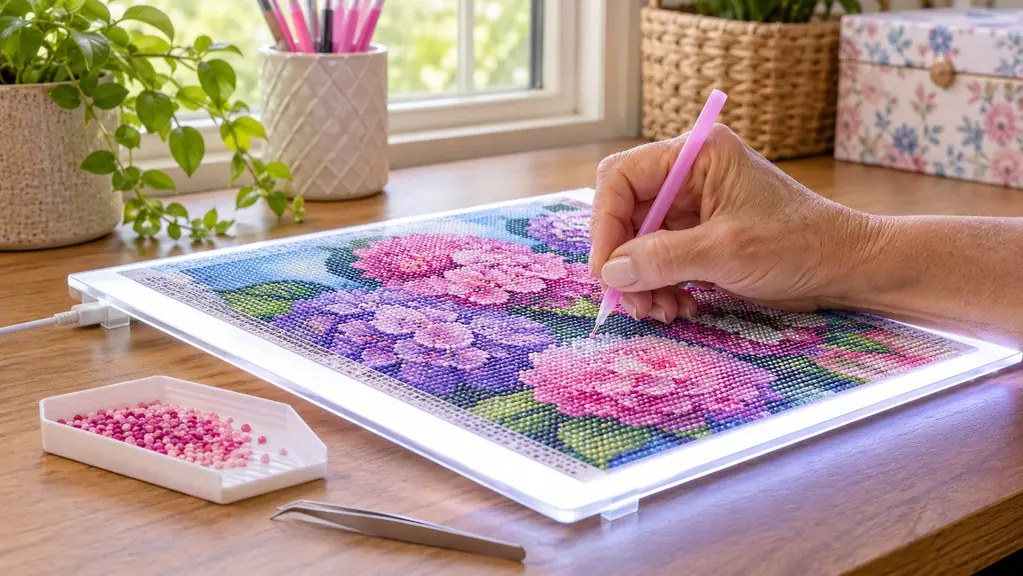
The first win is coverage. A 14 x 14 canvas fits on the ARTDOT A3 with room around the edges. I can see the whole design, not just the section under the middle of the pad. On a big canvas I am not sliding the canvas every ten minutes. I set it once, tape it if the edges want to curl, and work. The 1500 lux maximum is bright enough that the symbols stay crisp even through the clear cover some kits use. At night I switch to the soft setting. It is still readable, but it does not throw a white glare across the table. That is the setting I use most from November through February, when the north window goes dark by late afternoon.
The second win is the box contents. The ARTDOT A3 comes with two adjustable stands, a 56-slot storage case, four diamond painting pens, and tweezers. I use the stands more than I expected. They hold the pad at an angle, which means I am not flat over the table. My neck notices the difference after an hour. The 56-slot case is handy for the kit I am working on right now. I still keep my main drills in the ARTDOT 60-slot container, but the case that came with the pad is enough for the colors in a single canvas. The four pens live in a cup on the table. I use my Praise V Do pen most of the time because of my thumb, but the included pens are not junk. They are spares for when a kit's stock pen gives out or a friend comes over to try.
The third win is stability. The pad is thin, but it does not slide around on my folding table. The acrylic surface is flat and easy to wipe if a drill escapes. I set the pad down, put the canvas on top, and the weight of the canvas and my hands keeps it in place. I do not need to clamp it. I do not need to chase it across the table. That sounds small until you have worked on a pad that shifts every time you press down. Then it becomes the whole experience.
Where the A4 Wins
The A4 wins on footprint. In my friend's craft room, her A4 sat on the table with room to spare. There was space for her drill tray, her wax, her tweezers, and a mug. My A3 takes the middle of my folding table. I have learned to work around it, but if your table is small, the A4 is the easier guest. It also stores more easily. It can go in a drawer, behind a shelf, or in a tote. I leave my A3 out because I use it most days, but not everyone has that luxury. If you pack your hobby away every night, the smaller pad is less of a chore to put up.
The A4 also wins on small kits. If you work 8 x 10 or 10 x 12 canvases, the A3 is more pad than you need. The A4 centers the canvas nicely and leaves the rest of the table free. I tried a small kit on my friend's A4 and it felt neat. There was no wasted surface. I could rotate the canvas without hitting the edge of the pad. For someone who does a lot of small designs, or who takes a kit to a class or a friend's house, that matters. The A4 is the size that fits in a bag.
If your canvases are 14 inches or larger, stop sliding them around
The ARTDOT A3 gives you a 17.32 by 12.99 inch lit surface, 1500 lux at its brightest, a soft setting for night work, two adjustable stands, a 56-slot case, four pens, and tweezers. It is the size I have used for two years on every canvas, including my 14 x 14 hummingbird.
Amazon See the ARTDOT A3 on Amazon →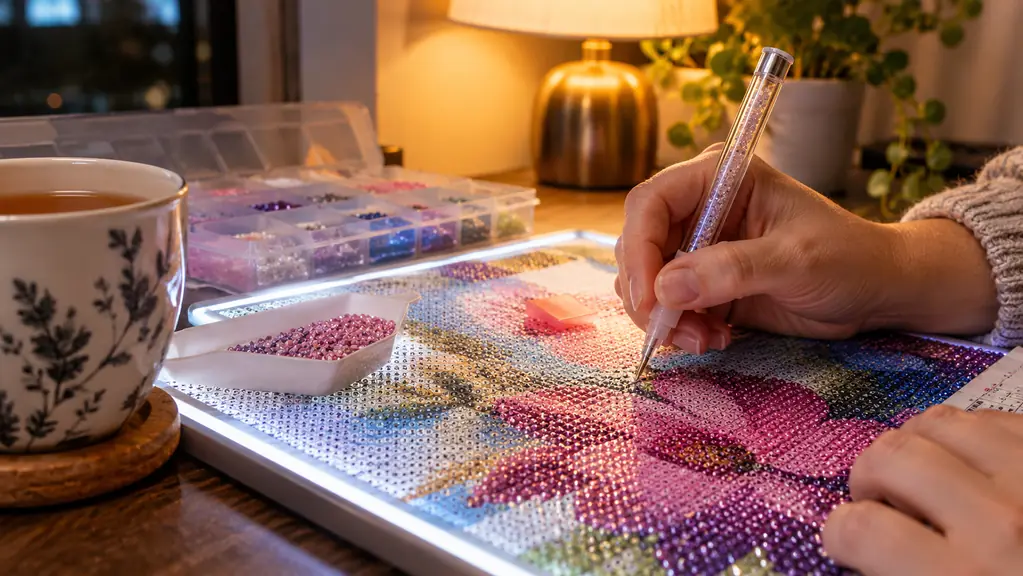
What Two Years on the ARTDOT A3 Taught Me
The biggest change was not speed. It was the end of the evening headache. Before the pad, I worked under the ceiling light and a desk lamp. By 9 p.m. my eyes were tired and my shoulders were up around my ears. The ARTDOT A3 did not fix my eyes. I still wear reading glasses. What it did was put the light under the symbols instead of behind my shoulder. I stopped squinting at dark color blocks. I stopped leaning in to tell a 3 from an 8. That meant I could work for an hour without feeling like I had done a shift.
The second thing I learned is that the stand matters as much as the light. I started with the pad flat on the table. It worked, but my neck paid for it. Then I set one of the adjustable stands at a low angle. The canvas tilted toward me. My hands rested on the table, not in the air. I could see the symbols without hunching. If you buy the A3 and ignore the stands, you are missing part of what the box includes. Set one up before your next session. Give it one evening. Your neck will tell you whether it is right.
I stopped leaning in to tell a 3 from an 8. That is what 1500 lux under the canvas bought me.
The Tradeoffs I Live With
The ARTDOT A3 is not a small object. It takes the center of my folding table, and when I work on the kitchen table it takes the center of that too. I have to move my drill tray to the side. I have to keep the cable from crossing my work area. The 5 foot USB cable is generous, but it still wants an outlet. If your table is far from a plug, you will notice. I did. I moved a small side table to hold the cable and my cup. That is not a flaw in the pad. It is the reality of a large lit surface.
The other tradeoff is that the A3 does not do the whole job. It lights the symbols. It does not pick up drills, press them flat, or keep my colors sorted. I still use my Praise V Do pen because the thin stock pens make my thumb ache. I still use the EastyGold roller to press finished sections. I still sort a new kit into the 60-slot container before I start. The pad is the foundation, not the whole workbench. If you buy it expecting it to make diamond painting effortless, you will be disappointed. If you buy it expecting to see the canvas better and stop hunching, you will be pleased.
Who Should Buy Which
Buy the ARTDOT A3 if you work on canvases 14 inches or larger, if you leave your craft table set up, and if your eyes or neck are the reason you stop after an hour. Buy it if you want the stands, the 56-slot case, the four pens, and the tweezers in one box. Buy it if you have a plug within reach of a 5 foot cable and a table that can spare the space. I bought mine after my second year of the hobby, when evening drilling under the ceiling light started giving me headaches. I would buy it again for the same reason.
Buy the A4 if you work mostly on small kits, if your table is small, or if you pack your hobby away every night. Buy it if you want a pad that fits in a drawer or a tote and leaves room for your drills. Buy it if you are new to diamond painting and you are not sure you will stick with it. The A4 is a good first size for small canvases. It is not the size I would choose for a 14 x 14 canvas, because I would spend half my evening moving the canvas. That is the honest line between them.
Two years in, the A3 is still the pad under every canvas
If you are tired of chasing symbols on a big canvas, the ARTDOT A3 gives you the lit surface to leave it in place. Check the current listing for the stand, case, pens, and tweezers, and measure your table before you commit.
Amazon Check the ARTDOT A3 on Amazon →