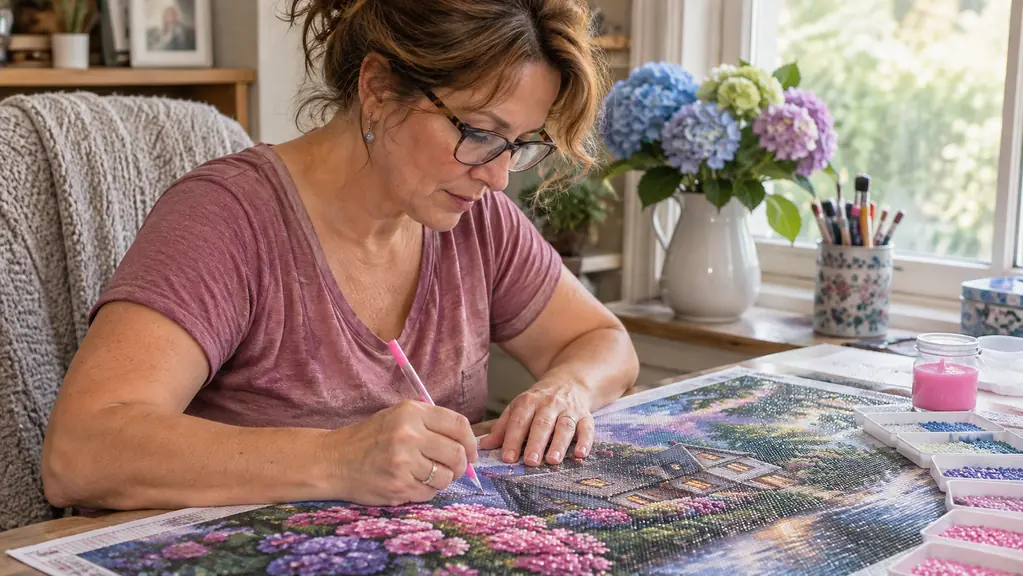
Row lines in diamond painting never look crooked while you are working on them. Up close, every drill sits where I put it. Then I stand back and see it: one row leaning left like a fence post in a windstorm. For my first three years in this hobby I blamed my reading glasses, then the ceiling light, then the canvas itself. It was none of those. The drills sit a fraction proud of the glue, and the flat of my palm moved as many of them as it flattened.
The EastyGold roller pressing kit fixed that in about a week. I have had mine for roughly a year, bought the same afternoon as a new drill pen, and it lives in the shallow drawer of my folding table by the north window in the spare bedroom. It is not complicated. A small roller on a handle, 3.7 inches wide, that you push across finished sections. Here are ten reasons I keep reaching for it, in the order they actually mattered to me and not the order a listing would put them in.
The 3.7 inch roller that ended three years of crooked rows
EastyGold roller pressing kit: 3.7 inch rolling surface, 4.72 inch handle, 3.17 ounces. Small enough to keep in the table drawer so it actually gets used.
Amazon Check today's price on Amazon →It seats the drills that are sitting proud of the canvas
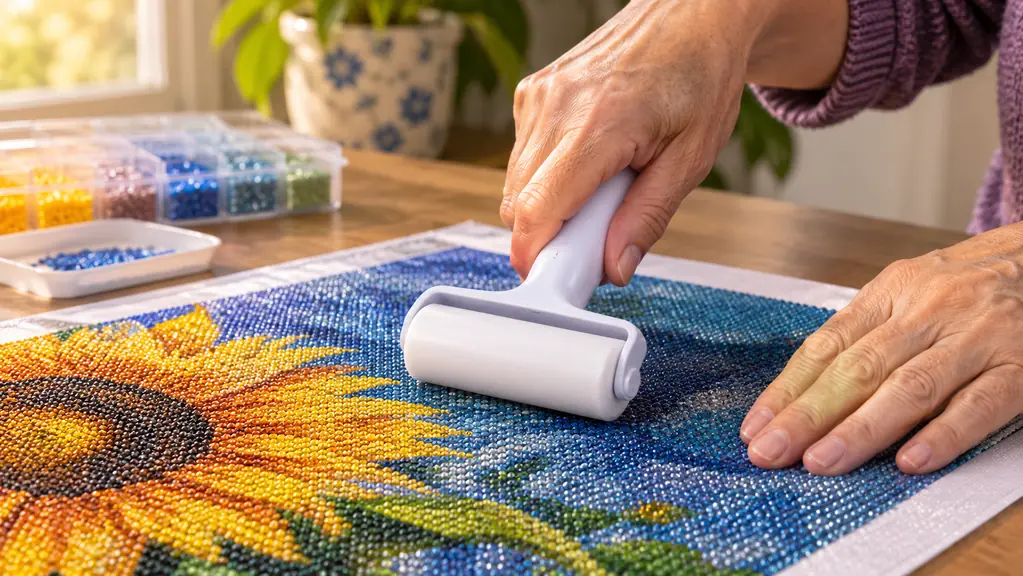
A drill that stands a hair above its neighbors catches light differently, and that tiny shadow is what makes a finished canvas look uneven from across a room. Running the roller over a section presses those high drills down level with the rest. I do it after every color block now, before I move on to the next symbol. It takes seconds, and it is the difference between a surface that looks smooth from three feet away and one that looks like a gravel driveway.
It catches a drifted row before you seal anything
Here is the thing about sealing a canvas. Once it is done, whatever you did is what you have. The EastyGold roller gives me a reason to look closely at a section while I still can. Rolling forces my eye along the whole row, and I spot the drift early. Twice on my hummingbird canvas I found a row that had crept half a drill off, and I nudged it back while the glue was still tacky. That is not a repair I could have made a week later.
It takes the work out of my right thumb
Arthritis in my right thumb is the reason I am in this hobby at all. Hand surgery made knitting hard four years ago, and diamond painting was what I could still do. Pressing rows flat with the flat of my palm meant leaning weight through that thumb, and after an hour it ached into the evening. Rolling is a push, not a press. My whole arm does the work. I have done three hour evenings on the kitchen table with a big canvas and not paid for it the next day.
It covers a whole section in two or three passes
The rolling surface on the EastyGold is 3.7 inches wide, wider than I expected for something that fits in a drawer. I can run it down a section in two or three passes. On a 14 by 14 inch canvas that is maybe a minute for the entire thing. My old method was grab, press, shift, press with a hardback book, for twenty minutes, and it was never even. I am not a patient person about the tidy-up end of a project, so speed is not a small feature to me.
The handle fits a whole hand, not just fingertips
Handle length is 4.72 inches and the tool weighs 3.17 ounces. Those read like small numbers on a listing, but they are exactly why this one gets used and the little roller that came with my pen kit stays in its case. The small one feels like holding a pencil stub. This one I can wrap my hand around, so the pressure comes from my arm instead of my fingertips. On a long evening that difference is everything.
Rolling is a push, not a press. My whole arm does the work, and my thumb does not pay for it the next day.
It is small enough to leave on the table
The package measures 6.3 by 5.24 by 1.89 inches, so it drops into the shallow drawer of my folding table next to the trays and the wax. That sounds like nothing. It is not nothing. Tools that live in another room do not get used, and I have a drawer full of proof. Because this one is always within reach, I roll a section without thinking about it, the way I would wipe crumbs off the table.
It presses down instead of dragging drills sideways
The rolling surface is smooth, and that matters more than I expected. A book edge grabs. My palm grabs. The roller glides across the top of the drills and pushes straight down. In a year of use I have not had it pull a drill out of place or scoot one into its neighbor. I still glance at the edges of each section afterward, out of habit, but I have stopped finding problems there.
It makes the last stretch of a canvas less of a slog
The end of a large canvas is where I lose interest. Rows done, sealing ahead, and I want it on the wall. Rolling the finished piece with the EastyGold takes a couple of minutes, so I actually do it instead of telling myself it is probably fine. That one change has altered how my finished pieces look, and not because I got better at placing drills. I got better at finishing, which is a different skill and an easier one to fix.
It gives one consistent finish across three weeks of work
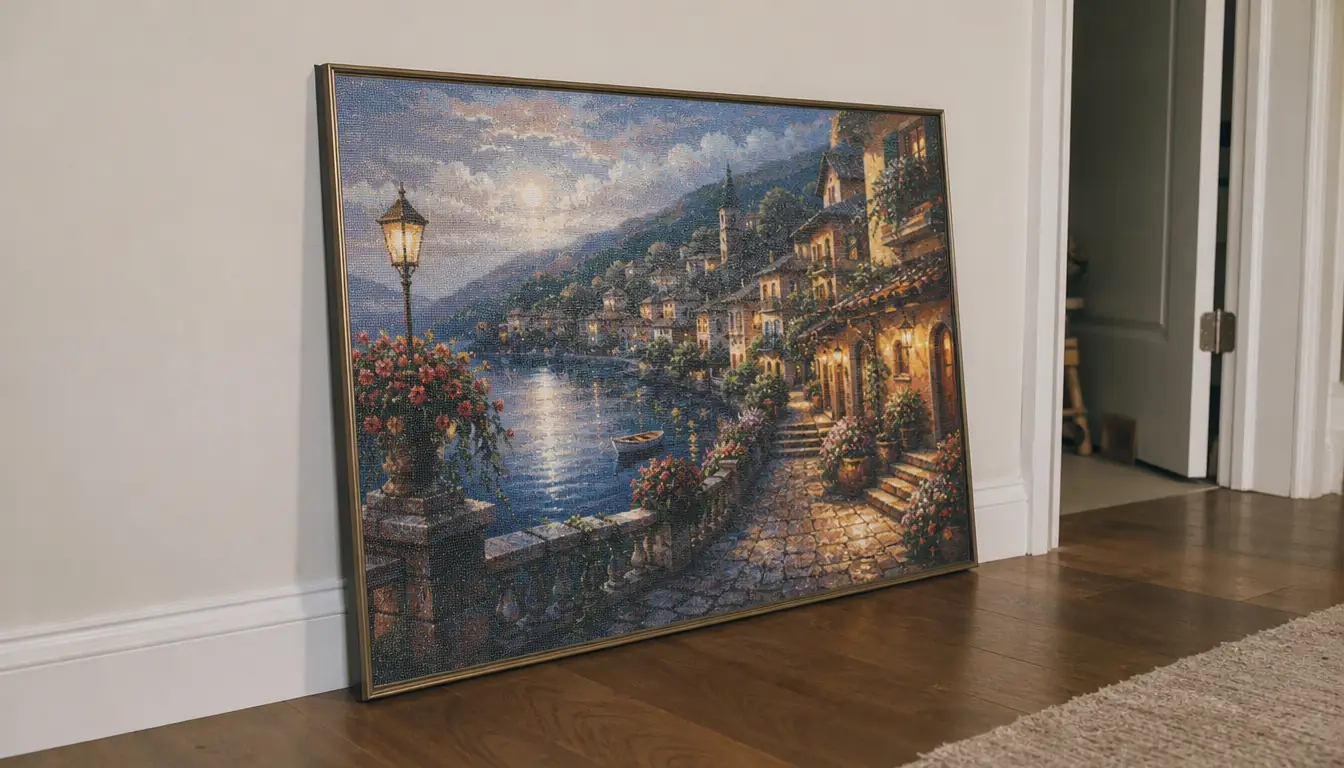
Different sections get different amounts of hand pressure. That is just true of human beings. Some nights I am careful, some nights I am tired and leaning on the table. The roller evens that out, because the same tool does the same thing to every section. When I framed the hummingbird piece and hung it in the hallway, the surface looked like one piece of work rather than three weeks of different moods.
It replaced the heavy book with no downside I have found
For three years my method was the flat of my hand and a hardback from the shelf. It worked, sort of. It was slow, uneven, and unkind to my thumb. Nothing about this roller is dramatic. It is a small tool that does one narrow job every week without complaint, and after a year I cannot point to anything it does worse than the book did. That is a high bar for a craft accessory, honestly.
What I'd Skip
Two honest notes before you decide. First, the EastyGold roller will not rescue a canvas that is already sealed crooked. It presses what is there. It does not realign a row that has drifted, and if you try to force it you will just mash the drills. Check your rows before you seal, not after. Second, if you only ever work small partial drill kits on the coffee table and you never seal or frame anything, the flat of your palm is genuinely enough. This roller earns its place for me because I finish and hang full drill canvases and I care how they read from across a room. If that is not you, I would not tell you to hurry. It is a small tool with a narrow job. It happens to do that job very well.
If you finish and frame your canvases, this is the last step worth skipping
One year with the roller, roughly 40 canvases in the hobby, and the roller is still the tool I reach for at the end of every session. 3.7 inch rolling surface, 4.72 inch handle, 3.17 ounces.
Amazon See the EastyGold roller on Amazon →