I finished my fortieth canvas this spring, and I still remember the surprise of the very first one, which is that the last step is not the last step. You peel the paper back, you set the drills, you sit back to admire the thing, and then the window light catches a few hundred drills at a slightly different angle than the rest of the row. The whole piece looks quilted instead of flat. And once you have seen it, you cannot unsee it.
For about three years my finishing method was the flat of my palm and whichever hardcover was closest to the table. It worked, mostly. It left a faint grid pressed into the cover of a book I should have treated better, and it left my right thumb aching, which is a real consideration when the thumb has arthritis in it. Then a year ago I bought the EastyGold roller pressing kit in the same order as a new drill pen, and the last step stopped being a chore at the very end and became something I do as I go. I have used it on every canvas since, including the hummingbird piece that hangs in my hallway now. Here is what a year of that has looked like.
The Quick Verdict
A small hand push roller that flattens finished sections in a few overlapping passes and earns its place in the pen tray. It presses what you already placed correctly. It will not straighten crooked rows, and it is not the tool for one pass across a huge canvas.
Amazon Check Today's Price →The five minutes between finishing and framing
The EastyGold roller measures 3.7 inches across and weighs 3.17 ounces, small enough to keep beside the pens so it actually gets picked up. If your finished areas look bumpy under a lamp, this is the piece that settles them.
Amazon Check Today's Price on Amazon →How I've Used It
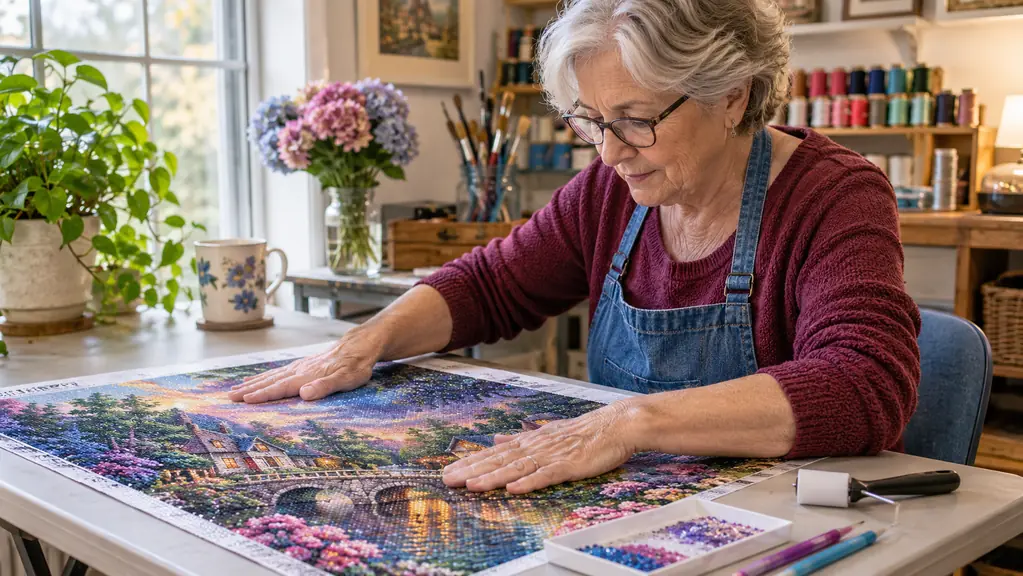
My craft corner is a spare bedroom with a folding table under a north-facing window, and when a canvas is bigger than that table allows, it moves to the kitchen table and I work around Ray's crossword. I am 58, I wear reading glasses for the symbols, and my right thumb has arthritis that announces itself around the forty minute mark if I am holding something thin. That is the entire reason I care about the shape of a handle.
The roller lives in the shallow tray where I keep the pen and the wax, which is the main reason it gets used at all. Tools that live in a drawer do not get used. My routine is to work a section of canvas, maybe a four inch square of symbols, then set the pen down, pick up the roller, and go over what I just finished with a few overlapping passes. Press, lift, shift over, press again. Then back to the pen. A full drill canvas gets rolled the whole way at the end as well, before it goes into the frame.
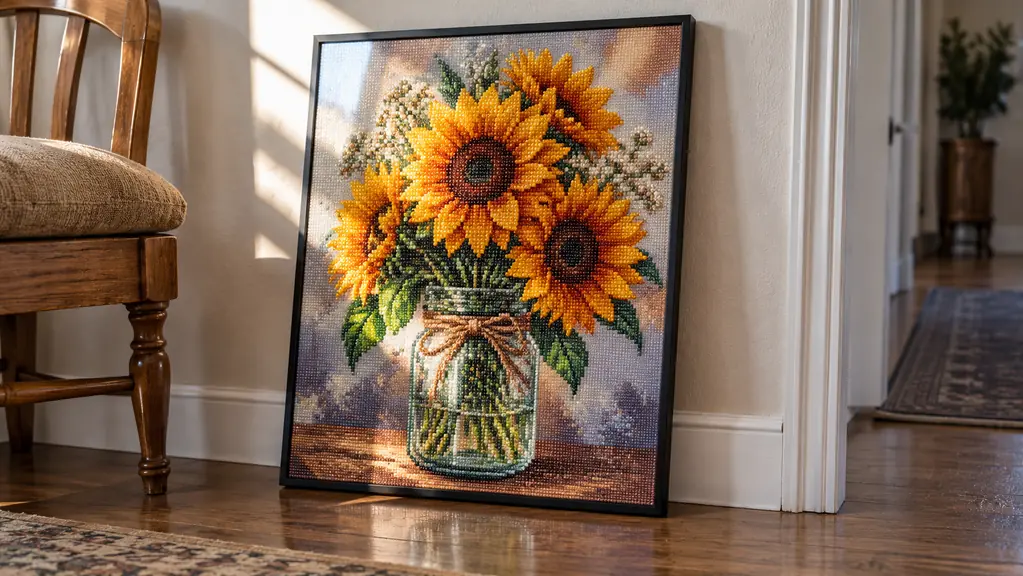
The hummingbird canvas turned into the test I did not plan for. Fourteen inches square, full drill, three weeks of evenings at roughly an hour a night. I rolled it in sections as I went, then rolled the whole thing once more before framing. The drills sat level enough that the glass did not press any of them when I closed the back of the frame. That had not been true of the florals I finished in my palm and book years, where a few drills near the middle always stood proud enough to catch.
What the EastyGold Roller Actually Is
The listing measures the roller at 9.4 centimeters across, which is 3.7 inches, with a handle 12 centimeters long, or 4.72 inches. Net weight is 90 grams, 3.17 ounces, and the packed weight is 3.52 ounces in a box of 6.3 by 5.24 by 1.89 inches. In the hand it reads as a small hand push tool, about the length of a glue stick and roughly as heavy as a deck of cards.
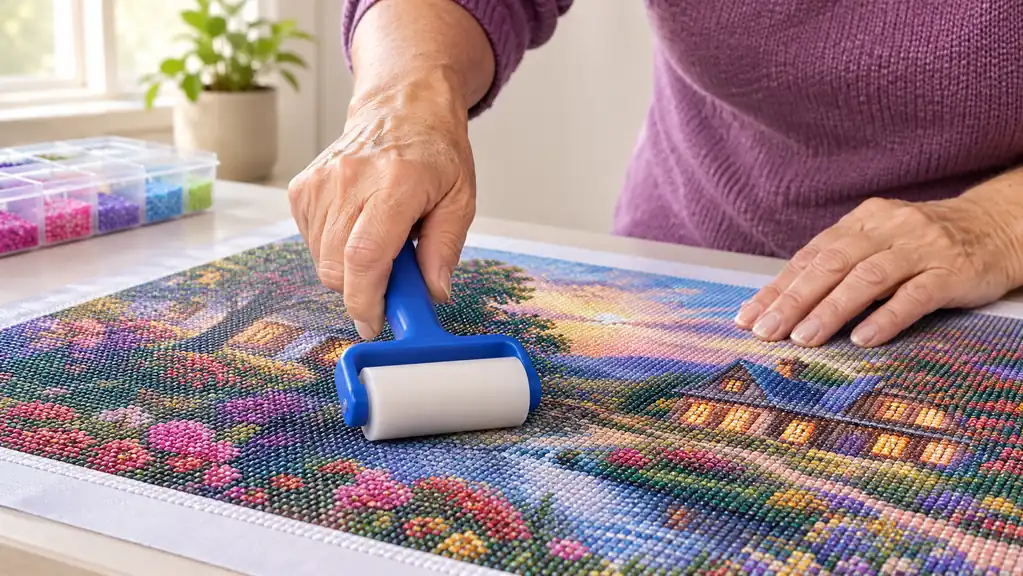
The design is a hand push, and that is the part that matters for my thumb. There is nothing to squeeze and nothing to grip hard. You lay your palm over the handle and push the wheel across the canvas, and the wheel has a smooth rolling surface that the listing describes as sitting flush to the work. After a year of weekly use mine still rolls without a catch or a flat spot, which is more than I expected from something this light.
Small is the point. A 3.7 inch wheel fits between rows and runs along the border of a canvas without wandering off onto the margin. On a partial drill design with wide bare patches, the size stops being a virtue, because you spend half your passes in the air. On full drill, which is what I work, it is the right size almost all of the time.
Rolling a Section, Step by Step
None of this is complicated, which is why I put it off for a year assuming there had to be more to it. Start at one corner of the finished area, set the wheel down, and push away from you with steady pressure. Lift, overlap the last inch, push again. Work in lanes the width of the roller, the way you would mow a lawn. Corners and edges get a second pass with the wheel turned slightly, so the rim catches the drills sitting half under the border.
How much pressure is a feel thing. Too light and you have accomplished nothing except moving dust around. Too much and the roller drags and the canvas shifts under your hand, which is worse than a proud drill. My rule is enough pressure that the handle pushes back a little, no more. Three canvases in, you will not think about it again.
Timing matters more than pressure. Rolling a section the same evening you place it works better than waiting until the end, because the adhesive is still doing most of the holding and the drills have not had a chance to settle at odd angles. I learned that with the hummingbird, which I rolled as I went, compared with a landscape from two winters ago that I only pressed by hand at the end and could not bring fully flat no matter how many passes I gave it.
The drills sat level enough that the glass did not press any of them when I closed the back of the frame.
A Year of Rolling: What Actually Changed
The obvious change is speed on framing night. That used to mean twenty minutes of palm pressing and a book. Now it means five minutes of rolling and no book. The less obvious change is that I stopped dreading the finish. When pressing flat was a separate job, a finished canvas would sit for a week or two before I dealt with it. Now the canvas is flat when the last drill goes down, so it goes into the frame the next day.
The second change is my thumb. Pressing with the heel of my hand and then leaning on a book is exactly the motion that sets off the arthritis. The EastyGold handle is long enough that I can wrap my fingers around it and push from the shoulder instead of jabbing down from the wrist. That sounds small. Over a fourteen inch canvas it is the difference between finishing in one sitting and finishing over two nights.
The third change I did not expect. Rolling each section as I go catches the drills that went down slightly high before the next section covers them, and it flattens the ridge where two sections meet. My rows look straighter now, even though the roller does not move a single drill sideways. It just stops neighboring rows from sitting at different heights, and height was what my eye kept reading as crooked.
How It Has Held Up
A year in, the roller looks like a tool that gets used, which I mean as a compliment. The wheel still turns freely and the surface is still smooth. No flat spot, no wobble, nothing loosened or cracked. I dropped it once, from the folding table onto the carpet, and it landed without incident. I wipe it with a dry cloth after each canvas, mostly to keep stray wax off the wheel, since wax on a roller turns a flattening pass into a smearing one.
The only maintenance note I have is to keep it out of the sun on a hot afternoon. I left it on the table by the window in July and the handle was warm and slightly tacky when I picked it up an hour later. It cooled off and went back to normal, no harm done, but I keep it in the tray now out of habit rather than necessity.
Where It Falls Short
Three point seven inches is not much coverage. The wide landscapes I did in my first two years were broader than my folding table, and rolling one of those takes several minutes of steady lanes, plus a stretch break in the middle. That is fine. It is not fine if you want to be done in one pass with something wide, because this is a small tool and it never pretends otherwise.
The honest limit is that a roller presses what is already there. It does not straighten a row you placed crooked. It does not lift a drill that is sitting on a piece of grit. It does not close a gap where you miscounted symbols. If your problem is placement, no tool in this hobby solves it except slower counting. If your problem is that a correctly placed canvas still looks bumpy under a lamp, this is exactly the thing for it.
What I Liked
- Flattens a finished section in a few overlapping passes
- 3.7 inch wheel fits between rows and along the border
- Hand push handle with nothing to squeeze, easier on an arthritic thumb
- 3.17 ounces, so a full canvas does not tire your wrist
- Still rolls smoothly after a year of weekly use, no flat spot
Where It Falls Short
- Narrow wheel means many lanes on anything larger than fourteen inches
- Presses drills flat but will not correct crooked placement
- You supply the downward pressure, so a light pass accomplishes little
- Very little use on partial drill designs with wide bare areas
What I Compared It To
For three years my comparison was my own palm and a hardcover, and the book was better than the palm and still worse than the roller. A book presses the whole canvas at once, which means every drill that is slightly high gets pushed down while the ones beside it get nothing. A roller works one narrow lane at a time, so the pressure lands where you are actually looking.
I also own a smaller roller that came in a pen kit, and I want to be fair to it. It stays in its case. The wheel is narrower, the handle is shorter, and for a person with a sore thumb the difference in grip is the whole decision. I reach for the EastyGold one every time, not because the other is bad, but because this one fits my hand and my canvas size better.
Who This Is For
If you finish a canvas and it looks quilted under a lamp, this is your tool. If you frame your work, seal it, or give it away, the flat finish matters more than you would guess, because glass shows every high drill and a photograph of the piece shows them worse. It is also for anyone whose hands complain after a long session, since pushing is gentler on a thumb than pressing with the heel of the hand.
It suits a weekly crafter who works in sections and finishes a canvas every few weeks. That rhythm is where the roller pays for itself, because you are rolling a small area often rather than a whole canvas once a season.
Who Should Skip It
Skip it if you are three canvases into the hobby and still deciding whether you like it. A roller is a finishing tool, and you can finish your first few pieces with the flat of your hand and a book and never know the difference. Skip it too if your real complaint is crooked rows, because that is a placement problem and this will not touch it. And if you already own a wide roller you like, this adds very little.
The tool that made framing night short
If your finished sections look bumpy under the window light, the EastyGold roller is the last five minutes of the project. Small, light, and short enough to keep in the tray where you will actually reach for it.
Amazon Check Today's Price on Amazon →