I have finished somewhere around forty diamond painting canvases, and for most of that time my finished sections looked like a lawn that had been mowed in different directions. I pressed each row flat with the palm of my hand, then set a heavy book on the canvas overnight and hoped for the best. The drills still sat at slightly different heights, and under the light pad the uneven ones threw small shadows that made the whole picture look rumpled. About a year ago I bought the EastyGold roller pressing kit at the same time as a new drill pen, mostly because it was small and I thought it might be easier on my thumb than leaning my weight onto the canvas. It turned out to be the first tool in this hobby that fixed a problem I had already given up on.
Here is what the roller actually is. It is a hand push tool with a smooth rolling surface and a small handle, and the idea is that you roll it across the finished sections of a canvas. The roller is about 3.7 inches wide, the handle is about 4.7 inches long, and the whole thing weighs around 3.2 ounces. That width matters more than I expected. It is narrow enough to stay inside the section I am working on and wide enough that I am not chasing one row for ten minutes. I go left to right with a slight overlap, the way I would roll a wall.
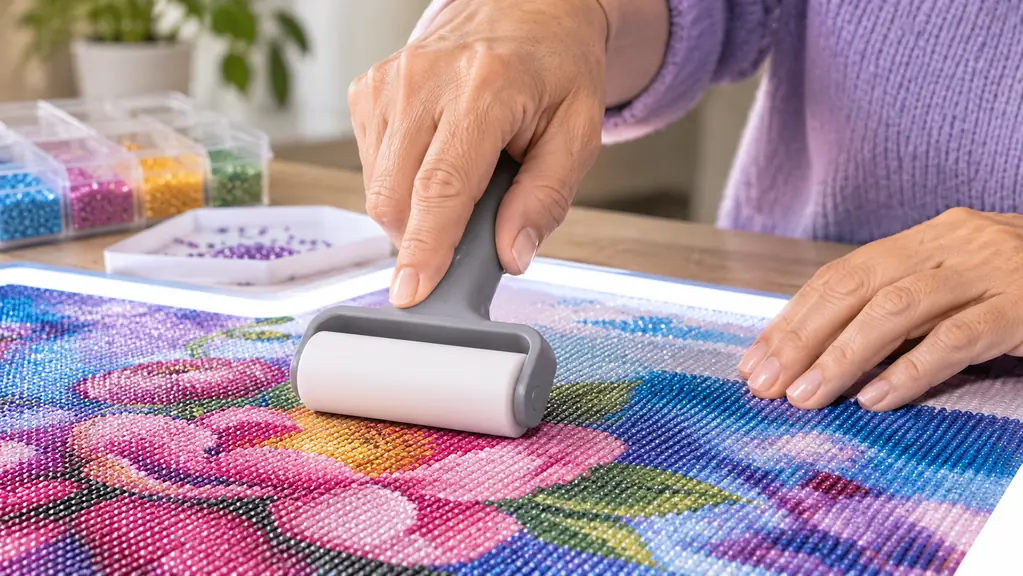
The first canvas I used it on had a lot of single color background, which is exactly where I used to get lazy. I had been pressing that background with my palm and calling it good. The roller pushed those drills down level in a fraction of the time, and I noticed the difference the moment I switched the light pad on. No shadow ridges, no high spots catching the light. The drills sat flat, wax and all. I used to think the bumpiness was just the nature of the drills. It was not. It was me.
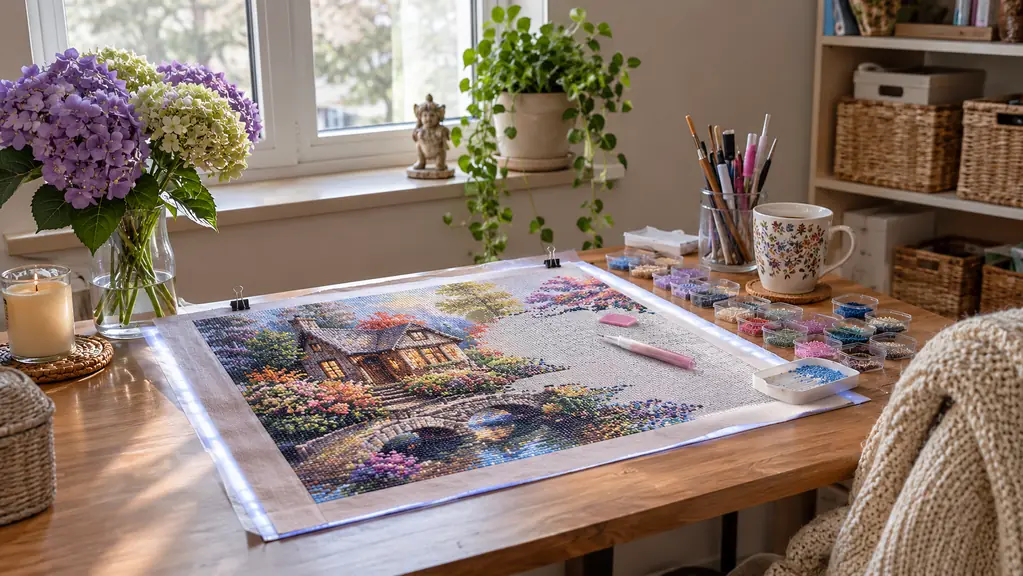
I want to be honest about the size. The package is roughly six by five by two inches, so it takes up very little room in a drawer, and it does not feel like serious equipment when you first pick it up. That is the point of it. It lives in the shallow drawer beside my folding table in the spare bedroom and it comes out every time I finish a section.
No shadow ridges, no high spots catching the light. The drills sat flat, wax and all. That is what I had been trying to get from a heavy book for three years.
The tool I reach for before anything gets sealed
Small, easy on the hand, and it presses a finished section level in one pass. It lives in the drawer now and it comes out on every canvas.
Amazon Check Today's Price on Amazon →My routine now goes like this. I finish a section, I roll it, then I move on to the next one. At the end of a canvas I roll the whole surface in overlapping passes before it gets sealed or framed. The hummingbird piece I finished this spring, a fourteen by fourteen inch full drill canvas I worked for about three weeks, got rolled twice. Once before the sealant, once after it had cured with a sheet of parchment between the roller and the canvas. The second pass was probably not necessary. I did it anyway.
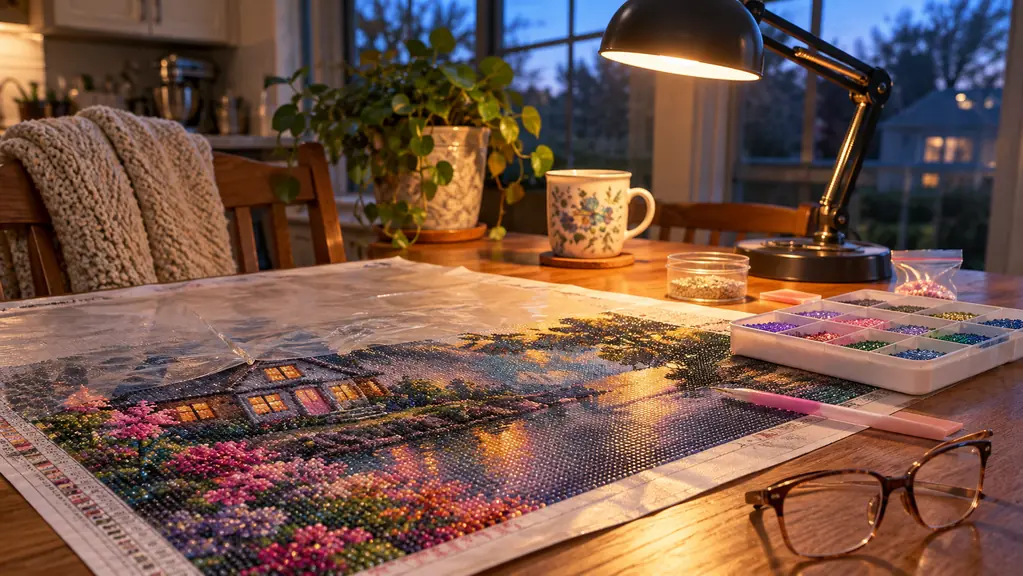
The roller does not place drills. If you want to speed up the placing itself, that is a pen question, and I use a larger grip pen because the thin plastic ones that come free in kits make my right thumb ache after about half an hour. The roller is for what happens after the drills are down. It also will not rescue a canvas where drills are already lifting because the adhesive is weak. It seats what is there and presses it level. If a kit has poor glue, no tool at the end is going to fix that.
The EastyGold roller stays in the shallow drawer with the pen. The drills live in a sixty slot container that I fill before I start a kit, and the canvas sits on a light pad that lights the symbols. Those three things, sorted drills, a pen I can hold, and a roller, are most of the reason I can work for an hour in the evening without my shoulders creeping up around my ears.
Ray thinks the tool drawer is excessive. He is retired, he has a garage full of screwdrivers he has not touched since 2011, and he teases me about the storage boxes, so I let the comment pass.
What I'd Tell You If We Were Sitting at My Kitchen Table
Here is what I would tell you if we were sitting at my kitchen table with a half finished canvas between us. Buy the small things before you buy another kit. Kits are the fun part and I have bought plenty of them, but the tools are what keep the hobby comfortable when your hands are fifty-eight years old and your thumb has opinions. If pressing by hand already works for you, keep doing it. I did it for three years. But if your finished sections look uneven and you have been blaming your eyes, roll one section before you decide the whole canvas is ruined. The EastyGold roller is one small tool, and it is the reason my last few pieces look like somebody who knows what she is doing made them.
If your rows look the way mine used to, start here
Roll one finished section, then turn the light pad on and look at it straight down. You will know in about a minute whether this is the thing you have been missing.
Amazon See the Roller Kit on Amazon →