
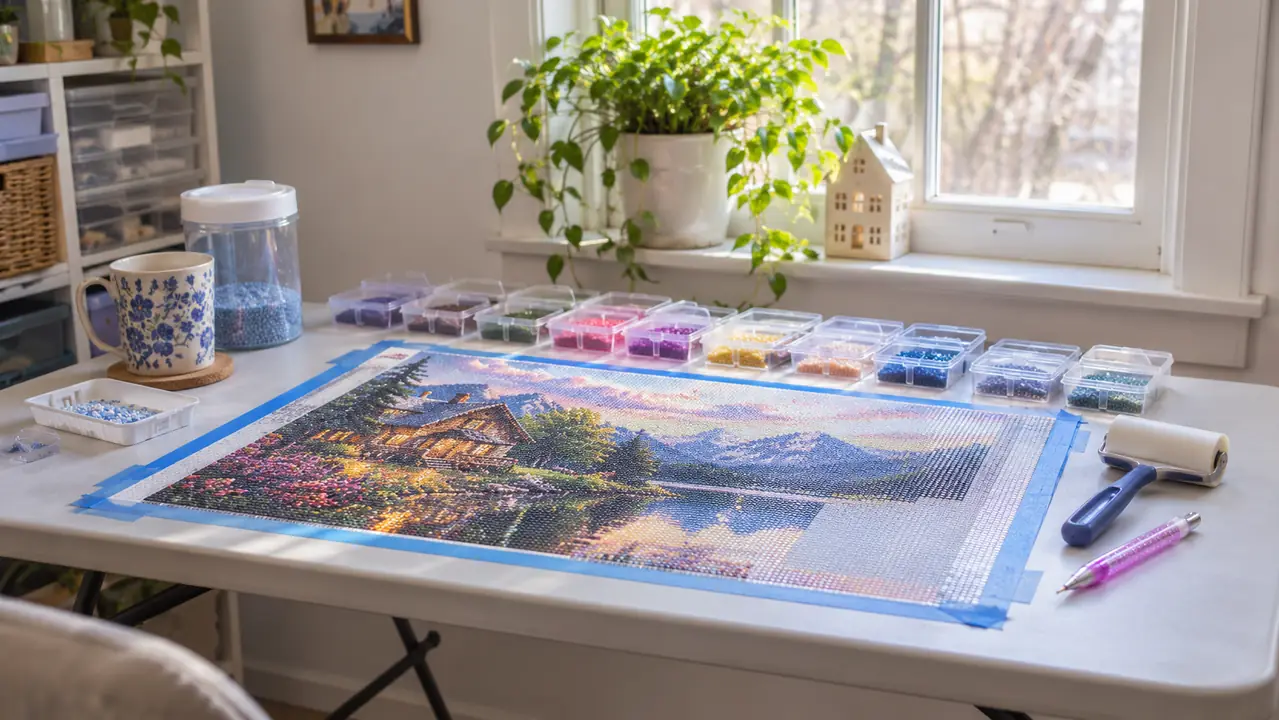
I put off buying a roller for almost three years. My finished canvases looked fine from across the room and a little lumpy up close, and I had decided that was simply how diamond painting went. Then a friend handed me her EastyGold roller at her kitchen table, I ran it over a row of drills I had just placed, and I heard them settle down into the glue. That small sound is most of this review. The rest is me being honest about what a roller will and will not do, because I have used mine for about a year now and I have complaints to go with the praise.
Here is the short version. The EastyGold roller pressing kit is a small, single-purpose tool. It seats drills flat and it takes the work out of the heel of your hand. It will not flatten a warped canvas, it will not rescue drills you pressed unevenly two months ago, and it will not read the symbols for you in bad light. What follows is the long version, including the three things that annoy me and the situation where I think you should leave it in the drawer.
The Quick Verdict
It does one job and does it well: finished drills sit flat in seconds and your hand stops aching. It will not fix a warped canvas, and the short handle means long sessions need a break.
Amazon Check Today's Price →The tool that finally made my finished canvases sit flat
A 3.7 inch rolling surface on a 4.72 inch handle, 90 grams, nothing to assemble and nothing to plug in. I roll each section before I close the box for the night.
Amazon Check Today's Price on Amazon →What You Actually Get
The package is small. The listing gives the dimensions as 6.3 by 5.24 by 1.89 inches and the item weight as 3.52 ounces, so it takes up less room than a coffee mug and it will not fight your drill storage for space. What you are buying is the roller itself: a 3.7 inch, or 9.4 centimeter, rolling surface on a 4.72 inch, or 12 centimeter, handle, with a net weight of 90 grams. Nothing needs assembling. There is no battery, no cord, no setting to choose.
That width matters more than you might expect. On my 14 by 14 inch hummingbird canvas, a full pass across one band of drills takes four overlapping runs. On something larger, say 20 by 30 inches, it takes more. That is not a flaw exactly, but it is the reason I roll as I go instead of saving it all for the last evening. This is a small hand tool, not a wide paint roller, and it does not pretend otherwise.
The rolling surface feels smooth and even in the hand, which is what the listing promises, and there is no wobble in mine after a year of use and no flat spot on it. The handle is a hand-push design, so you grip it and push forward, and at three ounces you are not fighting the tool while you work. That much I can vouch for. What I cannot tell you is how the surface holds up over five years of daily work, because I have only had mine for one.
How I Use It, Start to Finish
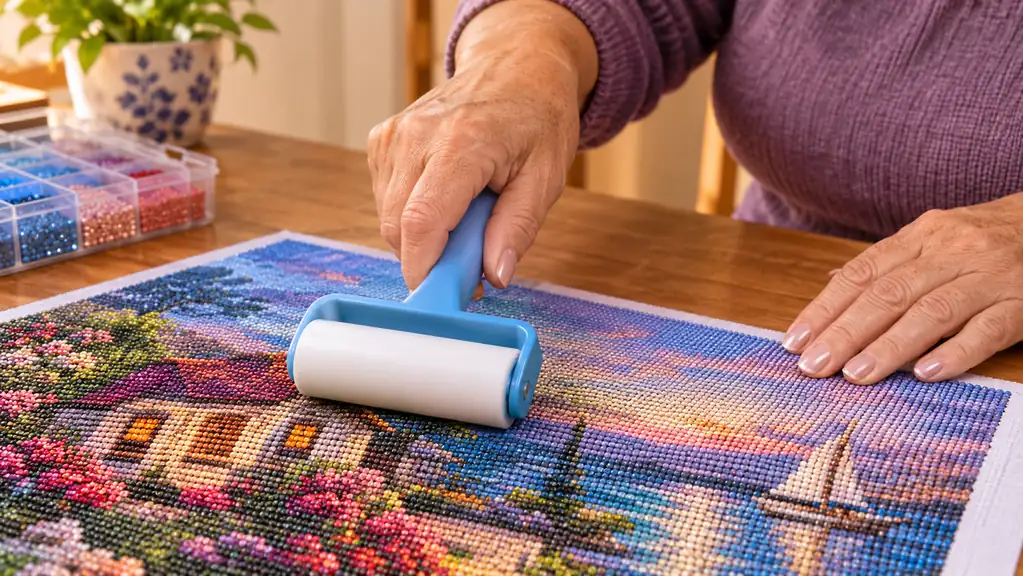
My routine is the same most evenings. I work a section of the canvas, maybe six by six inches, and before I close the box I run the roller over what I finished. Two or three passes, checking that the surface is level. Then I set the canvas under the folding table by the north window and go to bed. Doing it nightly means I press drills while the glue is still open and grabbing, which is when they seat best.
Once the whole canvas is done I give it a full pass, band by band, edge to edge. That final pass is the one that changed how my finished pieces look in a frame. Before the roller I used the flat of my palm and then a heavy book laid over the canvas for an hour. The book worked, but only where the book reached and only if I remembered to move it. The EastyGold roller is faster and I can feel the drills go down as I push.
My right thumb has mild arthritis, and that is really why I bought the roller in the first place. Pressing drills down with a thumb, row after row, for an hour is how I used to end up with an aching hand and a bad attitude. With the roller I push with my arm and shoulder instead. My thumb still does the placing. It just does not do the pressing anymore, and that trade has been worth the drawer space.
Rolling Versus the Palm and the Heavy Book
Before the roller I used two things. The flat of my palm, which was free but left my hand aching and never got the drills quite level, and a heavy hardback book laid over the canvas for an hour, which worked but only in the area the book covered. Both required me to remember to deal with them. Neither gave me any feel for whether the drills had actually gone down until much later.
The roller is better for one reason, and it is not speed. It is feedback. I can feel the drills seat underneath it. A high drill gives a tiny bump as you pass over it and you learn to go back over that spot. With the book you find out an hour later, when you lift it and the light rakes across the canvas. With my palm I never really knew at all. The book still has a place in this house, because a night under a board helps with curl and the roller does not.
What Nobody Tells You
Rolling works best in the first day or so after you place the drills. The glue on a canvas stays tacky for a long while, and a drill sitting a little high will drop into place under the roller if it has not fully set. On a section I finished three weeks earlier, the roller does much less. It levels a drill that is slightly proud. It does not re-seat one that is wedged in crooked, no matter how many passes you give it.
It will not flatten a warped canvas, and I want to be plain about that because I have seen rollers described as though they will. Canvas warps because of how it is stored, the humidity in the room, and the weight of the drills themselves. Rolling the front does nothing about the curl. What fixed my curled corners was storing the work flat under a board and then framing it tight. This tool seats drills. It does not flatten paper.
Roll before you seal, not after. I seal my finished canvases with a brush-on sealer, and once that is dry the roller has nothing left to press. Rolling a sealed canvas just polishes the surface. If you work with release paper still covering part of the canvas, lift it back before you roll, or the roller presses the paper into the drills and you will be picking fibers out of your wax for the rest of the evening.
Watch the loose ones. If a drill is sitting on the canvas without really sticking, the roller will drag it rather than seat it, sometimes half an inch from where you put it, sometimes clean off the edge. Now I run my fingers over a section before I roll and press down anything that moves. Thirty seconds of checking saves me crawling under the table hunting for a stray drill with my reading glasses on.
One more thing, and this is the part that surprised me. The roller changes how the canvas looks, not just how it feels. Drills sitting a fraction high catch the light at an angle and read as a slightly different shade from their neighbors. Once they are seated flat, the color evens out across a whole band. I noticed it first in the sky of my hummingbird piece. Same drills, same canvas, flatter finish, and the block looked more even than it had any right to.
Where It Earns Its Place
Large areas of one color are where the roller earns its keep. My hummingbird canvas had a wide sky section in a single shade, several hundred drills placed in one sitting. Pressing that by hand is a chore and my thumb knows it. Rolling it took under a minute and the whole band came out level. If you work big blocks of one color, you will feel the difference the first evening you use it.
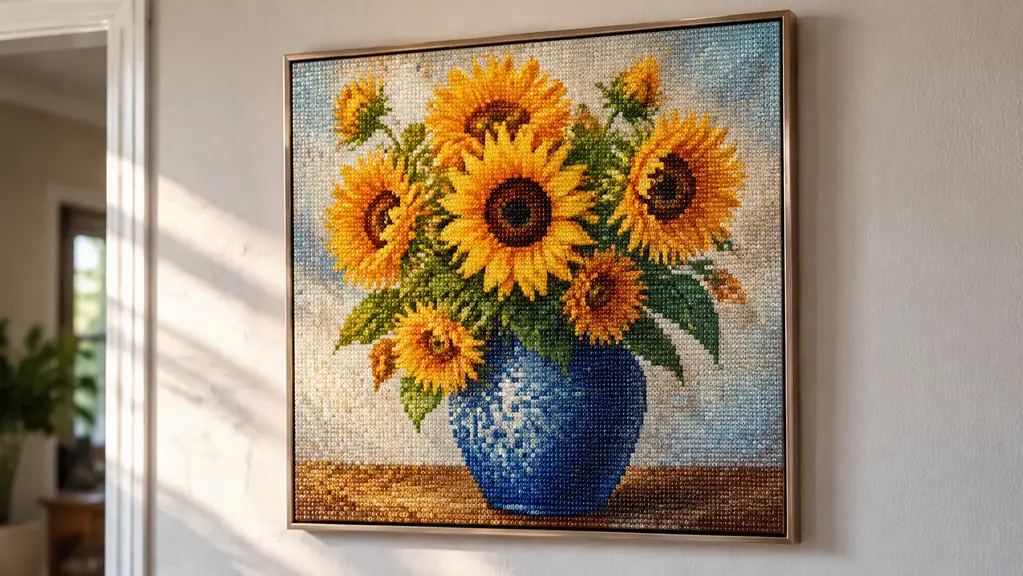
It also earns its place right before framing. A framed piece shows every high drill. Daylight rakes across the glass and the lumps show up as small shadows, and once you have noticed them you cannot unsee them. That final full pass, then a night flat under a board, gives me a surface I am happy to hang in the hallway where people stand close and look.
And it is quiet work. No noise, no setup, nothing to plug in. I keep mine in the drawer with my pen and my wax and I take it out the way I take out a pencil. Tools that need a ritual before they can be used do not get used in my house. This one gets used, which is the most honest thing I can say about any gadget on my table.
The Parts That Annoy Me
The handle is short. At 4.72 inches my hand wraps most of the way around it and my fingers have nowhere to go but the very end. For a few passes it is fine. For a full pass over a 20 by 30 inch piece my hand cramps and I have to stop and shake it out. If the handle were an inch longer I would have no complaint here at all, and I would probably have given this a higher score.
The 3.7 inch width means a lot of overlapping runs on a big canvas. Four passes for a 14 inch piece, more for anything bigger. It is not difficult work, just repetitive, and repetitive is the exact thing a tool is supposed to reduce. A wider roller would cover more ground, though it would also be harder to control near the border drills, so I understand the trade even while I grumble about it.
There is no storage and no guidance in the box. Mine lives in the drawer and that works fine, but if you keep your tools in a case with your pens you will need to find a home for a six inch object that does not fit a pen slot. Ray has opinions about how many boxes and drawers my hobby occupies, and adding one more object that needs a home did not help my case at the supper table.
What I Liked
- Seats drills flat in seconds with far less hand pressure than pressing by thumb
- You can feel a high drill under the roller, so you know when to go back over a spot
- Small and light at 3.52 ounces, so it lives in a drawer and comes out every session
- Nothing to assemble, no battery, no cord, nothing to charge
- Makes a real difference on large blocks of a single shade
- The final pass before framing gives a noticeably more even surface
Where It Falls Short
- The 3.7 inch width means four overlapping passes on a 14 inch canvas
- The 4.72 inch handle is short for long sessions, especially with hand or thumb trouble
- It will not flatten a warped or curled canvas, no matter how many passes
- It can drag a drill that is not properly stuck and move it off its symbol
- No storage and no instructions included
Four overlapping passes on a 14 inch canvas, about ninety seconds, and every drill in that band sat level. My palm used to take ten minutes and ache for the rest of the evening.
The Small Roller That Came in My Pen Kit
I bought a drill pen kit about a year ago and it came with a small roller of its own. I used it twice and put it away. In my hand it never felt like a real tool, more like something added to the box so the box could list one more item. It lives in its case now and I do not take it out.
Having both has actually been useful, because it taught me what I want from a roller. I want a grip my whole hand can wrap around, a surface wide enough to cover ground, and nothing else I have to think about. The EastyGold roller is the one I reach for every evening. The small one in the case is a spare for the day mine goes missing, and that is the whole of its job.
Who This Is For
This is for the person who has finished a few canvases and noticed that the drills do not sit flat. If you press with your thumb and your hand aches after an hour, this is for you. If you seal or frame your work, the final pass is worth having all by itself. If you work large areas of one color, or haul big canvases out to the kitchen table, you will use it every single session.
It also suits anyone with hand or wrist trouble, because it moves the pressure from your fingers to your arm and shoulder. That was my reason for buying one and it remains the best argument for the tool. It is not a hobby changer. It is a small thing that removes a small annoyance, and small annoyances are most of what makes a craft evening pleasant or not.
Who Should Skip It
If you are brand new and still deciding whether you like the hobby, skip it for now. The stock pen that came in your kit and your own palm will get you through the first few canvases, and you will not know what you want from a roller until you have felt a lumpy finish you actually care about. Buy drills and a light source first. This can wait.
If your canvases already come out flat, skip it. Some people place drills with a light hand and their work sits even without anyone pressing anything. And if your real problem is a curled or warped canvas, this is the wrong tool entirely. Buy a board to store your work flat, and come back to the roller when your complaint is about the surface rather than the shape of the paper.
Mine stays in the drawer and comes out most evenings, which is the plainest recommendation I know how to give. The EastyGold roller has one job, it does that job without fuss, and after a year I would buy it again. I would just buy it sooner, back when I was still telling myself that lumpy was normal.
Ninety seconds a section, and my palm stopped aching
A 3.7 inch rolling surface, a 4.72 inch handle, 90 grams, and nothing to set up. Roll the section you just finished, then give the whole canvas one last pass before you frame it.
Amazon Check Today's Price on Amazon →