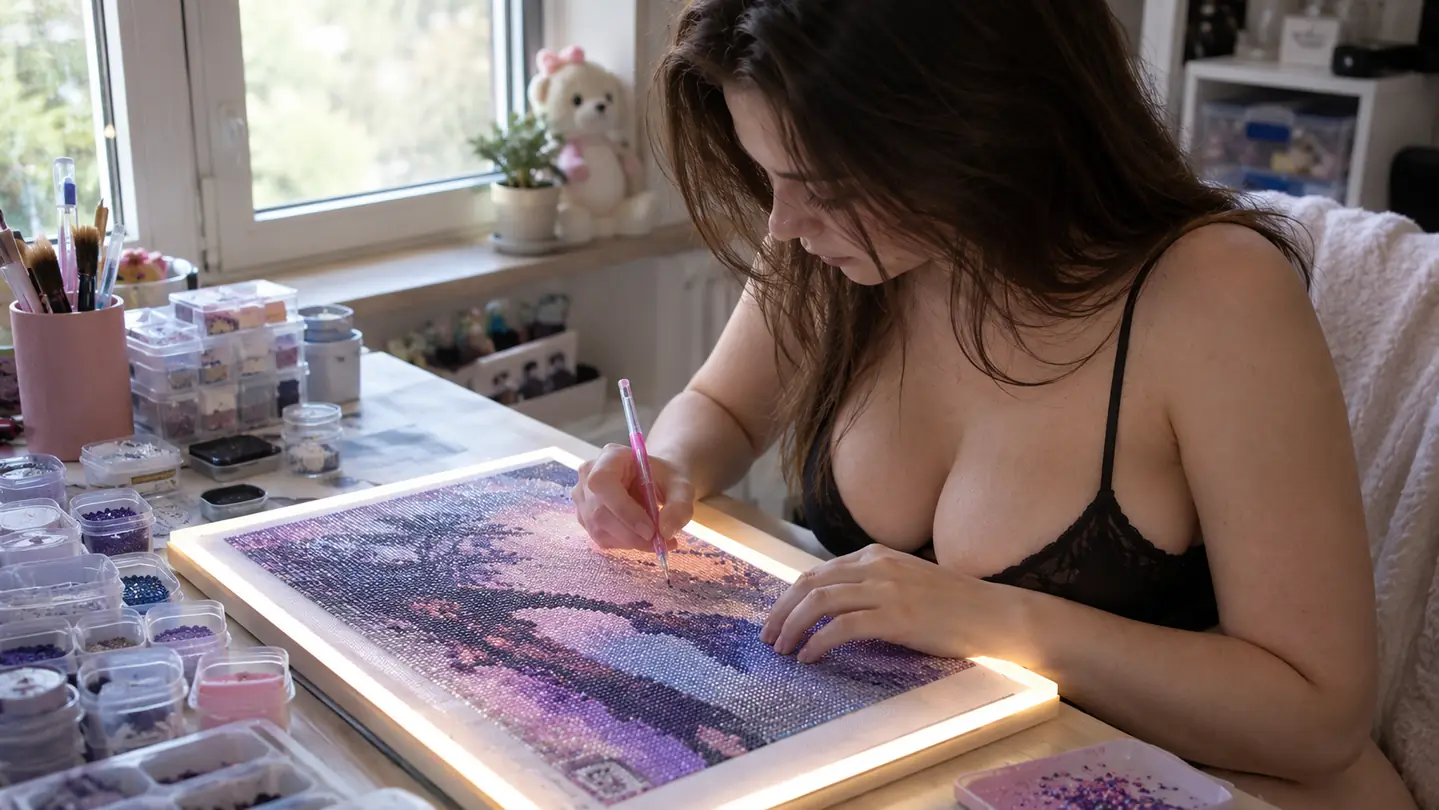
For the first two years I did diamond painting, I assumed sore eyes were part of the hobby. I worked under the ceiling light with a desk lamp aimed at the canvas, and somewhere around the forty-minute mark the symbols would start to swim. I would take off my reading glasses, rub my eyes, and blame my age. I was 56 then. I am 58 now, a retired school librarian in Knoxville, and I have finished about 40 canvases. The change came when I stopped treating light as background and started treating it as equipment. About two years ago I bought the ARTDOT A3 LED light pad, and it did more for my evenings than anything else on my craft table.
This is not a review of the pad, though I have opinions about it. It is the routine I built around it: five steps, in order, that let me work an hour or two without the headache I used to get every night. If your eyes ache after a session, or two similar symbols blur together on a dark canvas, one of these five is probably the piece you are missing.
The one change that ended my 9 p.m. headaches
A slim panel under the canvas, a USB cable, and no shadow from your own hand. Mine has been under every canvas I have worked for two years.
Amazon See today's price on Amazon →A Five Step Routine for Tired Eyes
None of this needs more than the pad, a chair, and the willingness to stop after twenty minutes. I do these in the same order every time I sit down. When I skip one, I feel it before the hour is out.
Step 1: Put the light under the canvas, not over your shoulder
Here is the part nobody explains when you buy your first kit. A ceiling fixture and a desk lamp both shine down onto the top of the canvas, which means your hand and your head cast a shadow exactly where you are trying to look. So you lean closer. Then closer. By the end of the evening your neck is bent and your eyes have spent ninety minutes fighting a moving shadow.
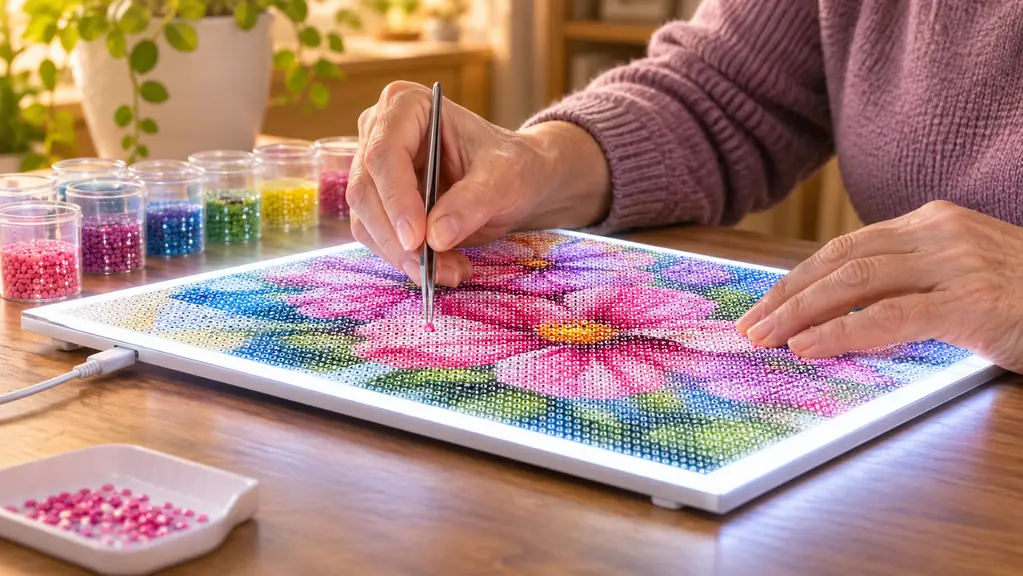
A light pad fixes that by moving the light behind the canvas. The ARTDOT A3 sits on the table, the canvas goes on top of it, and the light comes up through the fabric so the printed symbols read the way a page reads on a tablet. There is no shadow from your hand, because your hand is not between the light and the thing you are looking at. The first evening I used it, I noticed something odd about ten minutes in: I had stopped leaning forward. My back was against the chair.
For the first month I tried everything except the pad. I moved the desk lamp to my left, then to my right, then behind my shoulder. I slid two paperbacks under it to raise the shade. I even tried taping a strip of foil to the inside of the shade to push more light down. None of it solved the basic problem, which is that a light source above the canvas and a head above the canvas want the same space. I wish I had spent that month drilling instead.
Setup is a USB cable and the wall. The pad measures 17.32 by 12.99 inches, so a standard 14 by 14 inch canvas sits on it with room to spare, which covers most of what I work on. It is acrylic and thin, thin enough that it does not really change the height of my table. The cable is five feet, which reaches the outlet under my folding table without an extension cord. That is the entire installation.
Step 2: Tilt it up and sit back
Flat on the table works for a while, but a flat pad means you are looking at the canvas from a shallow angle, and a shallow angle flattens the difference between two symbols that are nearly the same. The pad comes with two adjustable stands. I use one under the far edge, which tilts the canvas up toward my face by roughly fifteen degrees.
The angle matters more than people expect. When the canvas is tipped toward you, both eyes get the same view of the symbol instead of one eye doing the work while your head tilts to compensate. I notice it most on large canvases with dense color blocks, the ones where two neighboring symbols look identical until you squint. On those, flat is miserable and tilted is fine.
The stand itself is nothing clever. Two adjustable legs came in the box, and what matters is that you use one, and that you set it once and then leave it alone. I fiddled with mine for a week, raising and lowering it, before I settled on a height and stopped thinking about it. The canvas has been at the same tilt ever since, and my neck has stopped noticing the table at all.
The second half of this step is the harder habit: sit back. If you can read the symbol from a normal seated position, read it from there. Move the pad toward the edge of the table instead of moving your face toward the pad. I keep the near edge of my folding table about four inches from my chair, and I pull the whole pad forward rather than hunching over it.
Step 3: Match the brightness to the room, not to the clock
A light pad that is too bright in a dim room is its own kind of strain. So is a pad that is too dim in a bright room, because then you are squinting at contrast that is not there. The ARTDOT is rated to 1500 lux at its brightest, and I almost never work there.
What I actually do: in the evening, with only the lamp on behind me, I use the soft setting. Midday, with the north window open and daylight coming across the table, the bright setting, because otherwise the daylight wins and the symbols wash out. Very dark fabric with dark symbols, bright again no matter the hour, because that is the combination that makes me lean in and shorten my focus.
One evening last winter I actually tested it instead of guessing. I worked the same dark green section of a landscape for twenty minutes at bright, then the next twenty at soft, and wrote down how my eyes felt on the back of an envelope. Bright was faster. Soft was easier. The answer turned out to be neither setting for the whole evening, but switching between them as the light in the room changed, which in my craft corner it does all afternoon.
One thing I did not expect to care about: on the soft setting, the pad does not light up the whole room. My husband Ray watches television in the next room and has never once said anything about a glow coming through the doorway. If you share a house or work in a room with someone else in it, that is worth knowing before you buy.
The pass after a break is always faster than the last ten minutes before it, because I am not hunting for symbols my eyes can no longer resolve.

Step 4: Work in twenty-minute passes
Eye strain in this hobby is not really about brightness. It is about holding your focus at the same distance for a long stretch. The muscles that do that work have been clamped at fourteen inches since you sat down, and they do not stretch themselves.
So I work in passes. Twenty minutes of placing drills, then I look up and find something across the room, the bookshelf, the window, the clock on the wall, and hold it for twenty seconds. It sounds too simple to be worth writing down. It works, every time, and it costs nothing.
I use the timer on the stove for this, which sounds fussy and is not. Twenty minutes is short enough that I do not resent stopping and long enough to finish a color block. On the hummingbird canvas I finished this spring, a 14 by 14 inch piece that took me about three weeks at roughly an hour most evenings, twenty minutes was usually one wing or one flower. Breaking it up that way also meant I never once worked through the point where the symbols went soft on me.
Two small habits that go with it. I cover the unworked part of the canvas with the backing paper or a clean cloth, so the only thing in my field of view is the section I am on. And I sort the drills for that section into my storage container before I sit down instead of pawing through bags mid-row. Hunting for a color is when my eyes work hardest and my thumb complains loudest.
Step 5: Take the tension out of your hands
This one sounds unrelated to your eyes and it is not. When your grip is uncomfortable, everything upstream tightens. Your shoulders creep up, your neck shortens, your face drifts closer to the canvas, and your eyes take the bill.
The thin plastic pens that come free in kits made the base of my right thumb ache within half an hour. I have mild arthritis in that thumb and it does not forgive much. A year ago I switched to a pen with a wider, softer grip, and the difference was not subtle. I could work a second hour without the ache that used to send me to the kitchen for an ice pack.
What surprised me was the second effect. Within a week of changing pens, I stopped rubbing my eyes at the end of a session. The ache in my thumb had been making me shift and tilt and crowd the canvas, and crowding the canvas is what my eyes were actually paying for. Fix the hand and the head follows it back into a better position without any willpower at all.
The other half of this step is wax and release. If a drill sticks to the pen or slides off the canvas, you will pick at it, and picking means your face is six inches from the canvas with your eyes doing close work at double speed. Change the wax before it quits on you. Roll your finished rows flat so the drills seat evenly, because drills sitting at different heights catch the light at different angles and read as visual noise that your eyes then have to sort out.
What Else Helps
The light pad is the big one, but it is not the only one. These are the other changes I made that stuck.
Get your eyes checked on schedule, and tell the optometrist what you actually do with them. I mentioned diamond painting and the distance I hold a canvas, and my reading prescription came out slightly different that year. The pad was part of the fix, not the whole fix. If your eyes are gritty by nine o'clock every night, that is a conversation for a professional, not for a hobby blog.
Keep the table clear. A busy work surface means your eyes re-focus on background clutter every time you lift them, and clutter beside the canvas pulls your attention sideways. I clear my folding table down to the pad, the canvas, the pen and the container. Everything else goes back in the box until the canvas is finished.
Watch where the window is. Daylight falling across the surface of the canvas can wash out the printed symbols no matter how bright the pad is, and a bright window at your back puts a reflection on the acrylic that you end up looking through all evening. I turn my chair so the window sits to my left and slightly behind the canvas rather than straight in front of me.
Winter air in east Tennessee is dry enough to make my eyes feel like paper by the second hour. A humidifier humming in the corner and a bottle of lubricating drops in the drawer did as much for my evenings as anything else on this list, and neither of them cost much.
And take an evening off when your eyes ask for one. I work about an hour most nights. If my eyes feel sandy on a Tuesday, I skip Tuesday and read instead. Forty canvases in four years says I am not falling behind anyone.
A light pad is not a cure for tired eyes. It is a way of removing one specific cause that you can actually control.
Start with the light, since that is the part you can fix tonight
The ARTDOT A3 has been under every canvas I have worked for two years, including the big ones I have to spread across the kitchen table. My eyes noticed within a week.
Amazon See today's price on Amazon →