
Three weeks of evenings, roughly an hour at a time, and a hummingbird now hangs in my hallway in a plain frame I already owned. That is the short version of the Hummingbird diamond art kit from SHICERNHJ. It is a 14 by 14 inch full drill canvas with a bird on it, and I finished it this past spring.
But the short version is not much use to anyone deciding whether to buy one. What I want to tell you is the part that never makes it onto a product page: where the canvas fought me, where the drills were better than I expected, and the one habit from my own craft corner that made the whole thing easier. I have finished about forty kits in four years. This was my first bird and my first canvas from SHICERNHJ, so I came to it with habits already formed and a healthy amount of skepticism.
The Quick Verdict
A clearly printed canvas with generous drills and a bird design that holds up at arm's length. The stock pen and the small tray are the weak links, and 14 inches runs out faster than the listing photos suggest.
Amazon Check Today's Price →A 14 inch bird canvas that actually reads as a bird at arm's length
Full drill coverage, distinct symbols, and enough extra drills that I finished with leftovers of every shade. See today's price and the listing photos on Amazon.
Amazon Check Today's Price on Amazon →How I've Used It
I worked this canvas over about three weeks in March and April, sitting at my folding table by the north window in the spare bedroom. Most sessions were an hour, sometimes ninety minutes if a section was going well. I did not use the pen that came in the box. I used my Praise V Do grip pen, which I switched to a year ago because the thin stock pens make my right thumb ache after about half an hour. The kit's own pen went into the drawer with the others.
I did use the kit's drills, its canvas, its wax, and its tray, so what I am describing is genuinely the kit and not my own setup layered on top of it. When I say the drills were good, that is the kit. When I say the tray was frustrating, that is also the kit. I want to be clear about which is which, because a review that credits a product for the reviewer's own tools is not much of a review.
The wax is the solid clay type, one pot, and it lasted the whole canvas with maybe a third left over. The ten little plastic bags are for holding drills if you pour them out, and I did use them, mostly for the leftovers at the end. The canvas is 14 by 14 inches, which is on the small side of what I normally work, and it is full drill, meaning every square of the grid takes a drill. The listing gives a one year warranty, which I never needed to test.
One note on size before anything else, because this is the thing nobody mentions. The listing says 14 by 14 inches, and the item dimensions read 13.8 by 13.8 by 0.15, so the printed area sits a little inside that. On a bird with fine feather detail, that is not a lot of room. What looks like a generous canvas in the listing photos is a piece that will hang comfortably above a small console table, not over a sofa.
On the first evening I did what I always do. I unrolled the canvas, laid it flat under a heavy book overnight, and sorted the drills into my storage container before placing a single one. Sorting took about forty minutes. That is not the kit's fault, it is the honest cost of a design with this many shades, and I would rather pay it up front than stop mid-section to hunt for a colour. I started in the top left corner on the sky and worked the wing down toward the body. The chest I saved for the sessions where I had the most patience. The eye I did on a Saturday morning with a fresh coffee, because the eye is the part that either works or quietly ruins the whole bird.
What Nobody Tells You About a Full Drill Bird Design
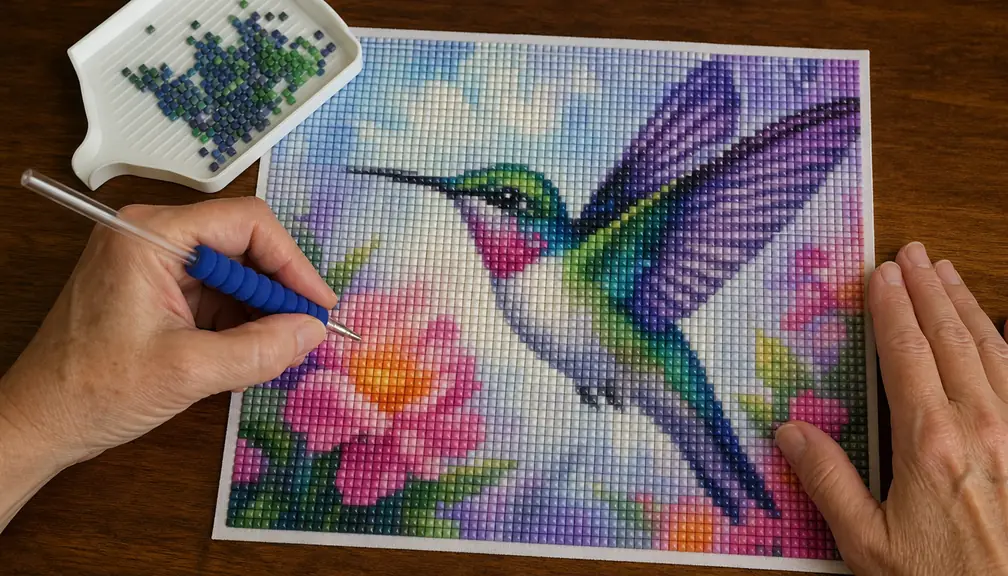
Full drill means no bare canvas showing through. Every symbol gets a drill, so the finished piece is all sparkle and no matte background. On a landscape that is lovely. On a bird, it means the feathers, the beak, the eye and the throat are all made of the same shiny material, and the design has to do every bit of its shading through drill placement rather than through any change in finish.
SHICERNHJ handles that better than I expected. The chest has a real gradient worked into it, and the wing feathers are separated enough that from three or four feet away you read them as feathers. Up close, at reading distance, you can see the grid, same as any diamond painting. That is not a flaw in this kit, it is the nature of the craft. But if you are hoping for something that holds up under close inspection beside your acrylic work, adjust that expectation now rather than in week three.
The other thing nobody says out loud: a 14 inch full drill canvas runs to many thousands of drills, and that is a real amount of time. Three weeks of evenings for me. If you are a person who likes a project you can finish in a weekend, this is not that project. If you like the thing where a canvas lives on the table for a few weeks and you visit it after supper, this is exactly that project.
Here is a number that helped me plan, and I pass it along because nobody puts it in a listing. In an hour of steady evening work, with a pen I like and the light pad on, I could cover a patch about four inches square, a little less when the symbols were crowded. The canvas is 14 inches across, which is 196 square inches of grid. Do that arithmetic before you start and decide whether it sounds restful or daunting. For me it was restful. I liked knowing exactly how much was left on any given night. A friend of mine who does kits in a single weekend would look at the same number and pick something smaller.
The Canvas, the Symbols, and My Reading Glasses
The symbols are printed clearly and they are legible, which sounds like a low bar until you have worked a kit where two symbols are nearly the same shape and you spend a whole evening second guessing yourself. I had no such evening with this one. There are a lot of symbols, because a hummingbird with a gradient needs a lot of shades, and a few of them sit close together in value. The symbol shapes themselves are distinct. With my reading glasses on and the canvas under my light pad, I never once had to guess.
SHICERNHJ prints the legend along the edge of the canvas, and I spent the first ten minutes with it, which is time worth spending. I go through a legend with a pen and mark the shades I expect to confuse, then I keep those out of the tray at the same time. On this canvas the two I flagged were both in the chest area. Working them in separate sittings, one and then the other, meant I never had to hold both in my head at once. That is a habit I picked up after a bad evening years ago with two greens that looked identical in artificial light, and it has saved me dozens of hours since.
That is where I should mention my ARTDOT A3 light pad, which I have owned for about two years and which sits under every canvas I work. It is not part of this kit and I am not pretending it is. But it matters for this review, because a dense gradient with small symbols is exactly the case where a light pad earns its place. If you are working this canvas under a ceiling light in the evening, you will feel the difference. Two of the shades in the chest area are close enough in value that I checked my own work twice.
The canvas came rolled, not folded, and I appreciate that more than I can properly express. A folded canvas leaves creases that show up in the finished piece as lines of shadow where the drills sit slightly proud. Rolled, it lay flat on the table after one night under a heavy book. I did not have to iron it, and I did not have to weight it for days. That single decision says something about how this kit was put together.
The wing area catches the hallway light and shifts as you walk past it. That is the part I did not expect from a kit at this level.
The Drills and the 26 Facets
The listing says each drill has 26 facets. I cannot count facets on a bead that small without a magnifier, so take that as the listing's claim rather than my measurement. What I can tell you is what the drills do in the light, and the answer is that they catch it well. The finished piece changes as you move past it. In my hallway, where the light comes from one side, the wing area reads almost as though it is in motion.
On quality, I sorted the drills into my 60 slot storage container before starting, which is my habit with every new kit. I found very few misshapen or fused pieces, maybe a dozen across the whole canvas, and those went into the discard bag. A handful were stuck together in twos and needed separating. That is normal for this end of the market and it was on the low side of normal here.
Drill size consistency matters more than people realize, because a bead sitting proud of the grid catches the pen on the next pass and drags a neighbour out of place. These sat flush. I rolled each finished section with my EastyGold roller before moving on, which is my habit, and almost nothing popped up or shifted. The few that did, I pressed back down with the flat of my thumb and they stayed put. When the whole canvas was done I rolled it corner to corner, left it overnight, and framed it the next morning. Nothing has lifted in the hallway since.
The extras matter more than people realize. The listing promises more than thirty percent extra drills, and I finished with a small bag of every shade left over, which is exactly what you want. Running out of a shade four hundred drills from the end of a section is the most demoralizing thing that can happen in this hobby, and it did not happen here.
One more honest note on the drills. Because the design leans on value rather than on finish, the piece rewards good light and punishes bad light. Under the ceiling fixture on a gray afternoon it looks flatter than it does under my light pad or in the hallway by the window. If you can only work in the evening under a single lamp, plan for that, because a full drill gradient is unforgiving of poor light in a way a blocky cartoon canvas never is.
The Tools That Came in the Box
Here is where I stop being complimentary. The pen is the thin plastic stock pen that comes free in nearly every kit on the market, and if you have arthritis in your hands it is going to hurt. Mine started complaining at about the half hour mark, which is the whole reason the Praise V Do pen exists in my life. The kit is complete in the sense that you can start the moment it arrives. It is not complete in the sense that you will enjoy the third week of it with that pen.
The tray is small and the ribs are shallow, which means you cannot shake out a generous pour without drills jumping the wall. I used my own tray for most of the work and the kit's tray only for the last few shades when I had a small amount out. The solid clay wax, on the other hand, is fine. Genuinely fine. I used it instead of my own because I wanted to test it, and it picks up cleanly without leaving residue on the canvas.
The ten plastic bags are the other small thing worth mentioning, because they are exactly the right size for a shade you have poured out and not finished. I labeled mine with a marker and kept the leftovers in them rather than tipping them back into the box slots, since a partly used shade mixed back in with a full one is how you end up with a slot that is a little of everything. When the canvas was done I had ten small bags of leftovers in a drawer, and I know from experience they will get used on some future kit as emergency stock.
So my honest recommendation is this. The canvas, the drills and the wax are where the value sits, and they are good value. Budget for a grip pen and a larger tray if you do not already own them, because you will want both by the second evening. If you already own a pen you like, you are set and you can ignore the pen in the box entirely.
What I Liked
- Dense gradient printed clearly, with symbols that stay distinct under a light pad
- Full drill coverage with generous extras, I finished with leftovers of every shade
- Canvas arrived rolled, so it lay flat without ironing or weighting
- Drills catch light well, with very few fused or misshapen pieces
- Solid clay wax picks up cleanly and lasted the whole canvas with some to spare
Where It Falls Short
- 14 inches leaves little room for feather detail, smaller than the listing photos suggest
- The included pen is the thin stock type and my thumb ached within half an hour
- Small tray with shallow ribs, easy to spill a generous pour
- Close shades in the chest area need good light to keep straight
Who This Is For
This is for the diamond painter who wants a bird, already owns a light pad and a pen they like, and wants a canvas that will finish in about three weeks of evening work. It works as a second kit or a fiftieth. What it is not is a gentle starter kit, because the gradient is dense and the size leaves no slack. If you have done a handful of kits and you want to try a bird with fine detail, the canvas here is well printed, the drills are generous, and SHICERNHJ has clearly put the money into canvas and beads rather than accessories.
Who Should Skip It
Skip it if you want a large piece for the wall over a sofa, because 14 inches will not fill that space. Skip it if you do not own a pen you like and you are not prepared to buy one, because the pen in the box will wear on you by the second evening. Skip it if dense, similar symbols strain your eyes and you work without a light pad, because the chest and wing areas ask a lot of you. And skip it if you want a weekend project. This is about three weeks of evenings, and it is honest about that only once you open it.
A well printed bird canvas, if 14 inches suits your wall
The canvas, the drills and the wax are worth the money. The pen is not. If you already have a grip pen and a light pad, this one can go on the table tonight.
Amazon Check Today's Price on Amazon →