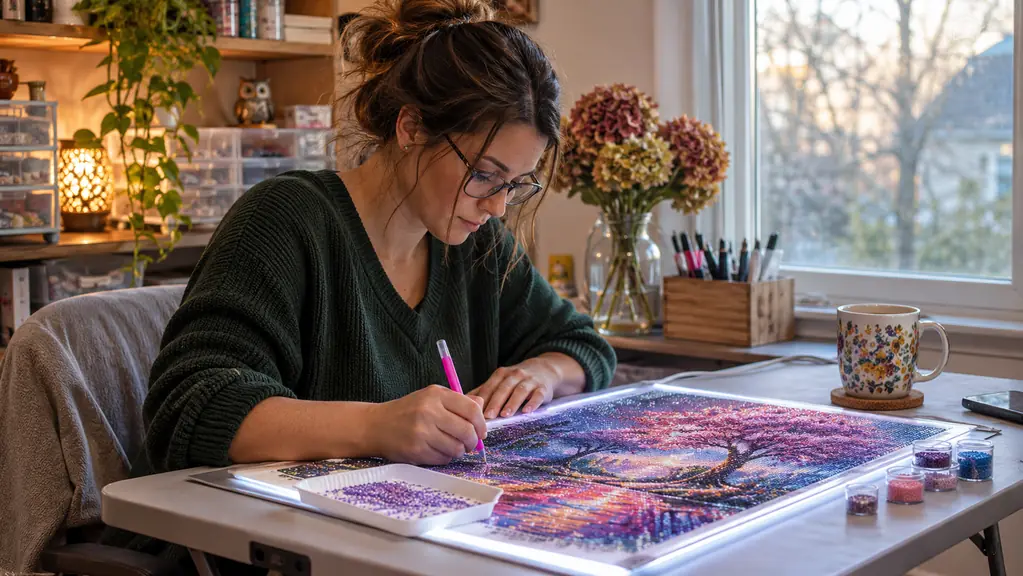
I bought the ARTDOT A3 LED Light Pad about two years ago, at the end of an evening that left me with a headache behind my eyes and two greens mixed together on the rug. This is not the review I would have written in the first month. It is the one I can write now, after about twenty canvases on top of it, and it starts with the parts a listing photo cannot show you. The pad is good. It is also narrower in what it does than the product photos suggest, and knowing that going in is the difference between a tool you use every night and one that ends up behind the sofa.
A little about how I work, so you can tell whether your evenings look like mine. I am 58, retired from school libraries, and I live in Knoxville with my husband Ray, who thinks my drill storage is a personality flaw. I have mild arthritis in my right thumb and I wear reading glasses. Diamond painting is my evening wind-down, about an hour at the folding table in the spare bedroom, and dark color blocks are the thing that slows me down. For my first two years in the hobby I worked under a ceiling fixture and a desk lamp and thought that was plenty.
The Quick Verdict
The most useful tool I own for reading symbols on dark canvases, and the least useful for everything else. Two years in, I would buy it again tomorrow.
Amazon Check Today's Price →If dark symbols are the part you keep putting off, start here
The ARTDOT A3 lights the canvas from underneath so a navy block stops swallowing the print on top of it. Two adjustable stands, a 56-slot case and tweezers come in the box.
Amazon Check Today's Price on Amazon →What Nobody Tells You About a Light Pad
The first thing nobody tells you is that a light pad does not brighten your room. It lights the canvas from underneath, which is a different job entirely. My ceiling light still does the room. The ARTDOT pad does the one thing the ceiling light cannot do, which is put light behind the printed symbols so a dark navy block stops swallowing the letters sitting on top of it. That is the whole mechanical idea, and it is worth understanding before you buy anything, because it tells you exactly which evenings it will help with and which it will not.
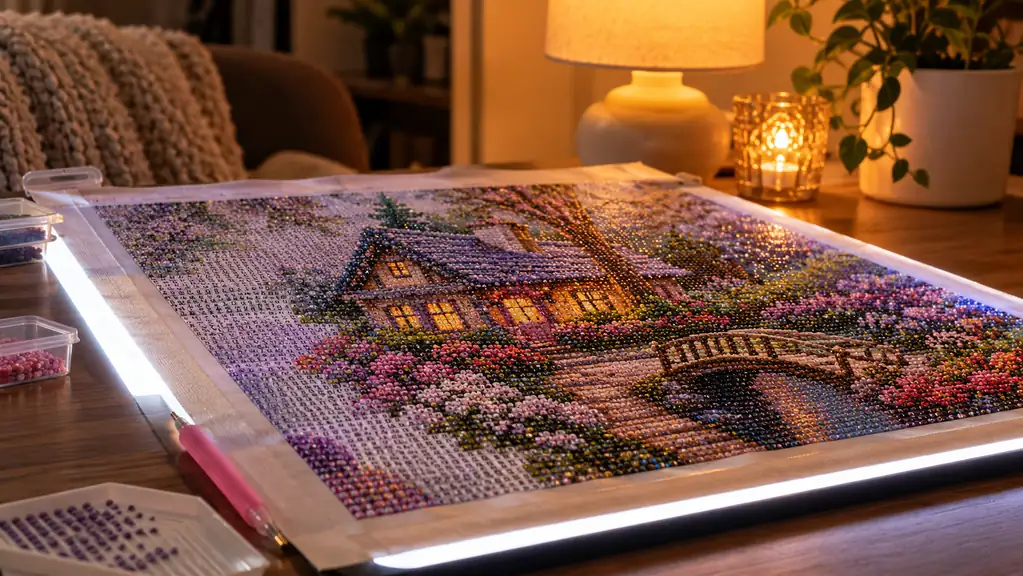
The second thing is the odd one. Light coming up through the canvas also comes up through the empty grid between drills you have already placed. On a full drill canvas those little gaps glow, and the grid lines of the canvas become obvious. Some people love that, because their rows suddenly look straighter than they felt. I found it distracting for about a week, then stopped seeing it. If you are the sort of person who cannot walk past a crooked row on a shelf, expect to notice the glow before you stop noticing it.
The third thing is the one I most wish someone had said out loud to me. It is a reading aid, not a second pair of hands. The pad does not hold the canvas flat, does not tilt itself toward you, and does not keep your drills sorted. It lights the work. The pickup, the placement, the counting, the straight lines, all of that is still you and your pen. If the thing slowing you down is your thumb or your back, a light pad is not the answer to that problem and no amount of brightness will make it one.
That sounds like I am arguing against it. I am not. Two years in, this is the tool I would replace first if it died tomorrow. But the honest version of a review has to start with what the pad actually is, because the fantasy version, where your sessions speed up and your eyes stop aching and your lines come out perfect, sets you up to be disappointed by a very good tool.
Two Years In, What Actually Changed at the Table
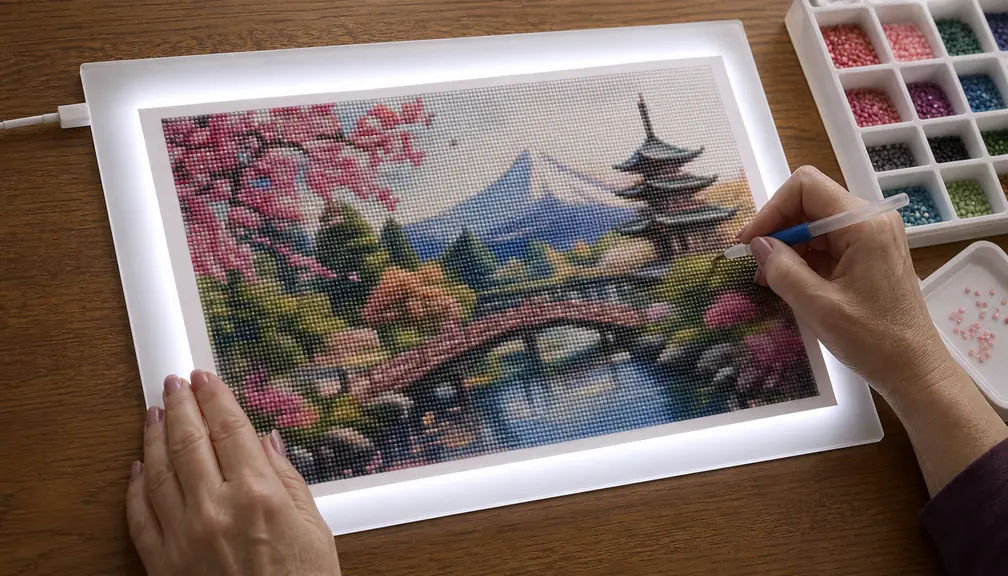
I bought the pad at the start of my third year in the hobby, mostly to stop saving dark sections for daylight. The change was not dramatic. It was specific. I stopped holding the canvas up to a lamp to read a symbol. I stopped leaning in until my reading glasses nearly touched the paper. The headaches I had been getting after long evenings faded over a couple of months, though I cannot prove the pad did that and I will not pretend I can. What I can tell you is that a canvas with a lot of black 3371 in it stopped being the canvas I put off.
The pad is A3, listed at 17.32 by 12.99 inches, and it takes almost my whole folding table. On a big night the canvas sits on the pad, the tray of drills moves to the windowsill, and my coffee ends up on the floor. That is not quite a complaint. It is the trade I made to see the symbols. But if your craft space is a corner of a kitchen counter, measure first. The A3 size is the reason my rows are better and the reason my table is full.
It runs on USB, and the cable is 5 feet. That number matters more than it sounds. Five feet decides where your chair goes, and for the first month I was working sideways to reach an outlet behind the sofa. I moved a power strip under the table and the problem disappeared in ten minutes, but I would rather you knew before you order than after. Plan for the pad to live near a socket, not across the room.
At full brightness the listed maximum is 1500 lux, and full brightness is a lot. On a pale canvas with pale symbols, the top setting washes the print out and makes it harder to read, not easier. Most evenings I work on the soft setting and only push it up for dark blocks and the detailed corners. The soft setting is the one that lets me work at nine at night in a room that still has a lamp on, which is most of what I wanted from this in the first place.
How a Normal Evening Goes
My sessions run about an hour. I set the canvas on the pad, plug it in, drop the brightness to soft, and pull the colors I need for the next section into the 56-slot case. Then I work in roughly two inch blocks from the top left, the way I always have. The pad stays on the whole time. I turn it up only when I hit a block of dark blue or the fine detail in a corner, and back down when I come out the other side.
The part that surprised me is that I check the canvas less. Under the desk lamp I was constantly tilting the canvas to catch the light, and every tilt is a chance to nudge a row out of line. With light coming from underneath, I set the canvas down once and leave it alone. My rows are straighter for a reason that has nothing to do with my hands, and that is the sort of thing no product photo can promise you.
The Extras in the Box, Honestly
The box is closer to a starter kit than a single tool. Mine came with the A3 pad, two adjustable stands, one storage case with 56 slots, four diamond painting pens, and tweezers. That is a lot to sort through, and after two years I have a clear opinion on every piece of it.
The two adjustable stands are the surprise. I did not expect to use them and now I use them every session. They prop the back edge of the pad so the surface tilts toward me, and on the kitchen table, where a big canvas has to go, that tilt is the difference between sitting up and hunching over the work like a gargoyle. If you take the stands out of the box and put them in a drawer, you are doing the pad a disservice.
The 56-slot case deserves its own note, because I also own the ARTDOT storage container and I do not want to blur the two. The case in this box is what I use for the colors currently in play on a canvas, the ones I have pulled and do not want to keep opening the big container for. The full sorted set lives in the container. If you are starting from nothing, the case in this box will carry you through a kit or two before you want more room.
The four pens went into a drawer in the first week, and that is not a knock on them. I switched to a larger grip pen about a year ago because the thin stock pens made my thumb ache after half an hour, and I was not going to go back for the sake of using what came in the box. If you have no pen at all, four is a generous start. The tweezers, though, I use constantly, for the drill that lands crooked and for the one that picks up lint off the canvas.
The Parts I Do Not Love
Brightness is a double-edged setting. At the top end this pad is bright enough that I look away when I switch it on in a dark room, and on light canvases the highest setting does the opposite of what you want. It flattens the contrast between a pale symbol and a pale background. That took me a while to figure out, and it is the reason my pad spends most of its life on the softer setting.
The size cuts both ways too. 17.32 by 12.99 inches is a serious footprint. My 14 inch hummingbird canvas overhung the short side by about an inch, and I turned the canvas as I worked so the section I was on always sat over the lit area. The corners of a canvas that hang past the edge get no help at all. If you mostly work large full drill pieces, know that the pad lights what sits on it and nothing beyond.
The cable is the third annoyance, and it is a small one you can solve with a power strip. But it is worth saying plainly: this is a plugged-in tool. It is not something you carry to the couch, and it is not something you use on a lap tray unless there is a socket within reach. For me that is fine, because my table is where I work. For someone who drills in three different rooms, it will be a nuisance.
The last thing is that it is another object on the table. My craft corner now holds the pad, the container, the pen, the roller and a small tray, and on a folding table that is a crowd. I would still make the same choice. I just want you to picture the table full before you decide, instead of picturing a clean surface with one glowing rectangle on it.
What I Liked
- Lights symbols from underneath, so dark color blocks stop hiding the print
- The soft setting is dim enough for evening work in a room that already has a lamp on
- Two adjustable stands tilt the pad toward you and save your neck on a kitchen table
- Two 56-slot cases and a pair of tweezers that I genuinely use
- Two years of near nightly use and the panel still lights evenly across the whole surface
Where It Falls Short
- Full brightness washes out pale symbols, so I work on soft most nights
- 17.32 by 12.99 inches takes almost my entire folding table
- USB only, with a 5 foot cable, so the nearest socket decides where you sit
- Four pens in the box went straight into a drawer because I already had a grip pen I liked
- A canvas larger than the pad only gets lit where it overlaps
I stopped saving the dark color blocks for daylight. That is the entire change, and it was worth the space on my table.
What It Did Not Fix
It does not flatten a canvas. A piece that has spent a month rolled in a tube still curls at the edges, and light does not press anything down. I roll finished sections with a separate roller, and at the end of a piece I go over the whole thing before it gets framed. The pad helps me see whether the drills are sitting flat. It does not make them sit flat.
It does not fix your hands. My right thumb still aches after about forty minutes, and the pad has nothing to do with that. It does not fix your back either, though the tilt from the stands helps more than I expected. If you are shopping for relief from aching hands, buy a pen with a thicker grip first. The pad solves one problem well, and it is a real problem. It is not a cure for the hobby.
And it does not sort your drills, hold your canvas, or keep you from mixing two greens on the rug. I did that once, before the containers, and I spent an evening picking drills apart by hand with the pad glowing the whole time. It was no help at all.
Who This Is For
If you drill in the evening, in a room with one ceiling light, and you find yourself skipping the dark sections or carrying the canvas to a lamp to read a symbol, this is the tool that fixes that specific problem. It is also for anyone whose eyes are not what they were. I wear reading glasses and I am 58, and the pad bought back the hours after dinner that I had been losing to bad light.
It also suits a table where you can leave it set up. Mine stays out, plugged in, with the stands already tilted. If you can give a 17 by 13 inch panel a permanent home, the ARTDOT pad stops being a gadget and becomes part of the furniture, which is exactly what you want from a tool you reach for most nights of the week.
Who Should Skip It
Skip it if your canvases are small and mostly pale, because the ceiling light is already doing enough and the pad will not add much. Skip it if your table is genuinely full, since a light pad that lives in a closet does nothing for you. Skip it if what actually bothers you is your thumb, your neck, or the sheer number of drills, because none of those are light problems and this is a light.
And skip it if you want a tool that makes you faster. I am not faster. I am more comfortable, and I finish dark sections in the evening instead of saving them for a sunny Saturday. After four years and about forty canvases, that is the change I actually cared about.
The tool I would replace first if it died tomorrow
Two years in, the ARTDOT A3 is the one piece of gear that sits under every canvas I work on. If dark symbols are what slows you down, this is where that problem ends.
Amazon Check Today's Price on Amazon →