
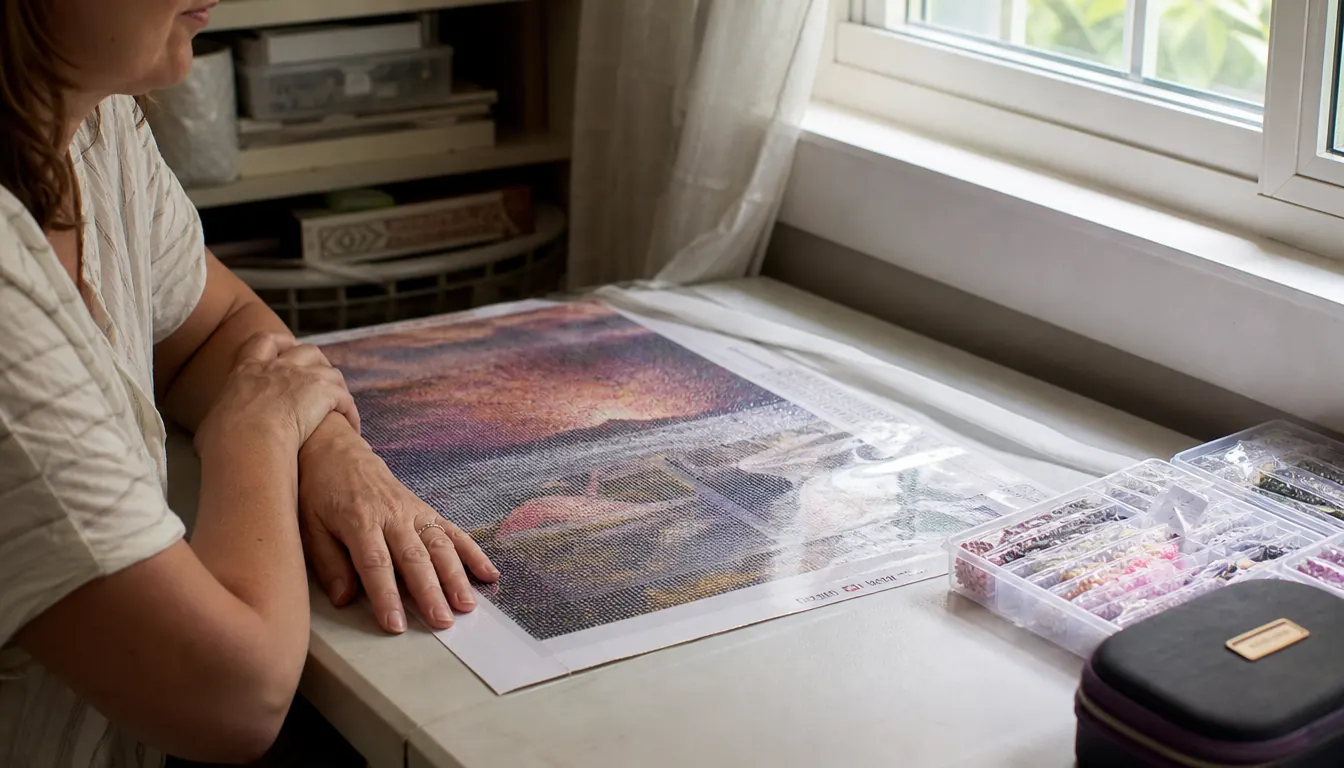
My right thumb starts complaining about twenty minutes into a row of drills. It is a small hot spot at the base of the joint first, then a stiffness that makes me grip the pen tighter instead of looser, which is exactly the wrong response. I have mild arthritis in that thumb. I have been diamond painting for about four years now, somewhere around forty canvases, most of them finished at a folding table in the spare bedroom here in Knoxville that I call my craft corner.
For the first three of those years I used the thin plastic pen that comes free in every kit. It works, and I will not pretend it does not. It is also about as kind to a sore thumb as holding a pencil the wrong way for an hour. About a year ago I switched to the Praise V Do drill pen kit, mostly because a friend at the craft table let me hold hers for one row. The difference was not dramatic that first night. It was dramatic the next morning, when my thumb did not ache when I picked up my coffee.
The pen I reach for before I even sit down
The Praise V Do drill pen kit is one pen, six screw-in stainless steel tips and a roller in a case small enough to live on the table between sessions. It is the first thing I would replace if mine walked off, because it is the thing that bought my thumb its mornings back.
Amazon Check Today's Price on Amazon →Five Steps, in the Order I Actually Do Them
Step 1: Set the Canvas Up So Your Hand Is Not Fighting Gravity
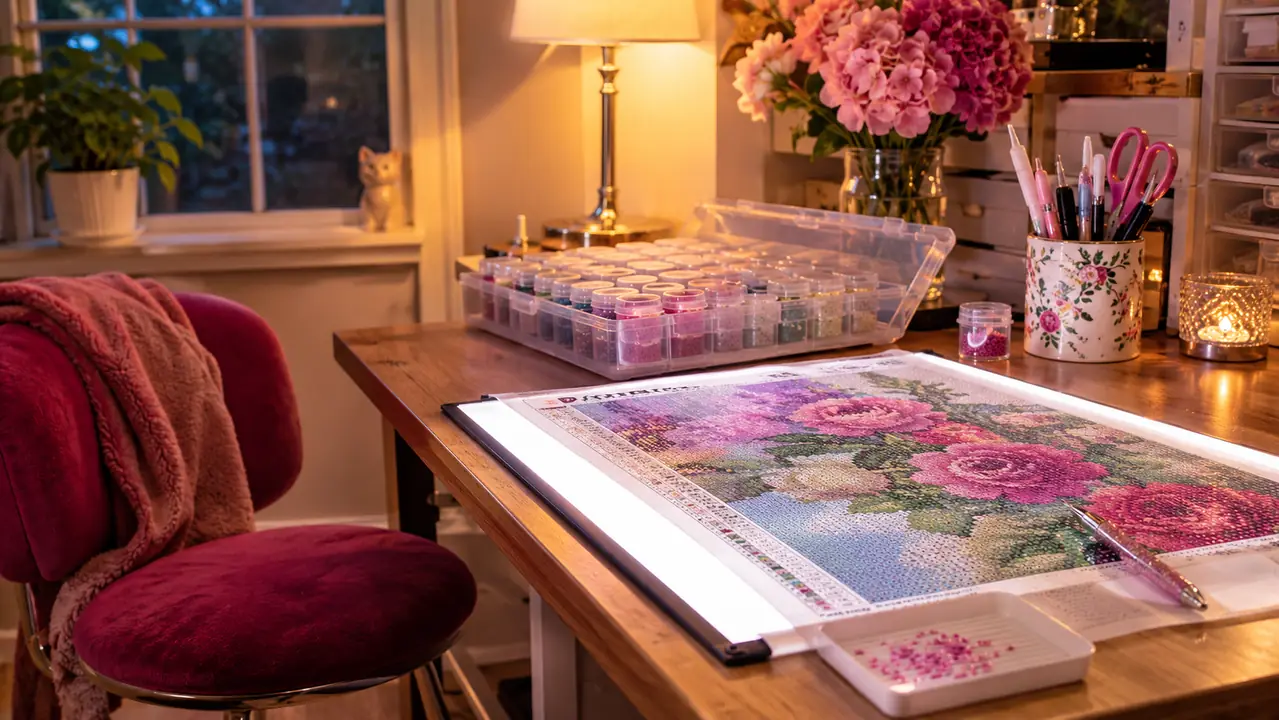
The first fix was not a tool. It was where I put my hands. For two years I drilled under the ceiling light with the canvas flat on the table and my chin tucked down toward it, and I would end an evening with a headache behind my eyes and a cramped right hand. I bought the ARTDOT A3 LED light pad after that second year, and it has sat under every canvas since.
The pad throws light up through the canvas instead of down over my shoulder. I can read the symbols without leaning in. My reading glasses stay on the chain around my neck, and with the pad on I mostly need them for the legend at the edge of the chart rather than the squares in the middle. That single change did more for my neck than any tool I have bought.
The rest of the setup is boring and it matters. I keep my forearms flat on the table. I pull the canvas close to the edge so I am not reaching across it. I sit square to the work instead of angled, feet flat, both elbows down. When a canvas is bigger than the folding table, which is most of them, I move everything to the kitchen table where I can get my whole forearm resting. Ray teases me about the stack of drill boxes in the corner. He does not tease me about the light pad, because the evening headaches stopped.
Step 2: Retire the Pen That Came in the Kit
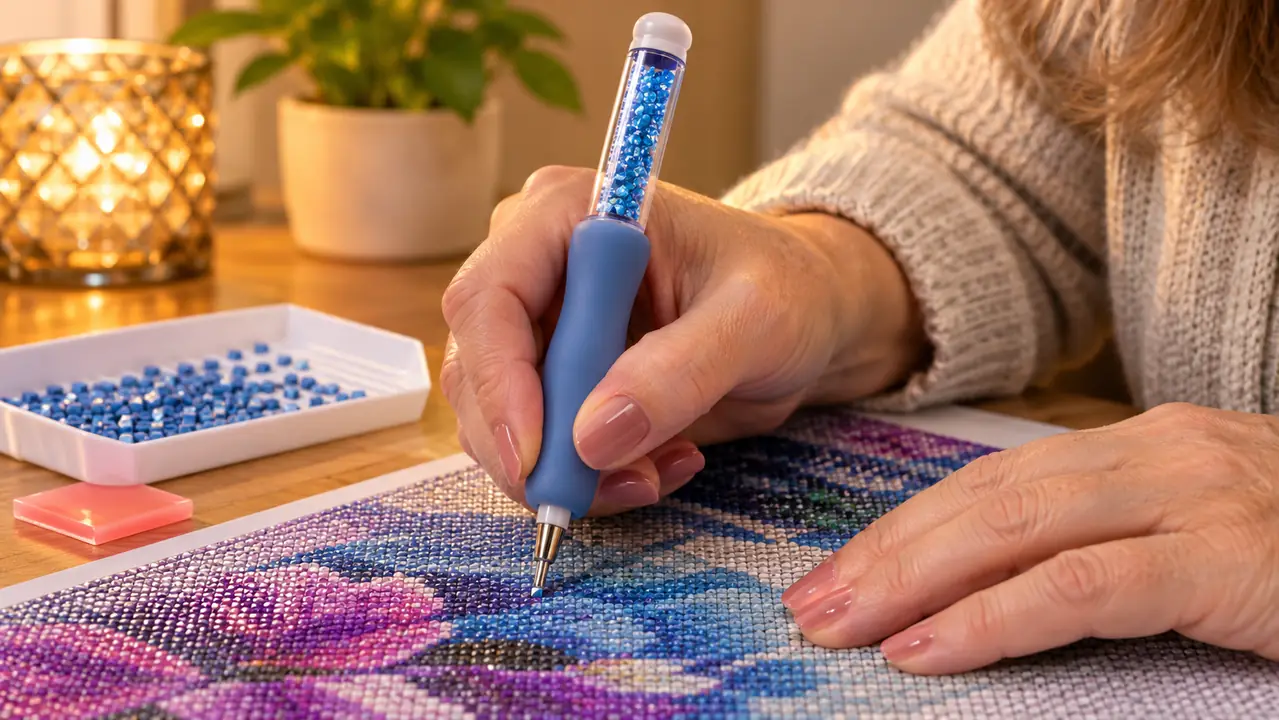
The pen that comes in a kit is a hollow plastic tube a few inches long. You hold it like a pencil, pinched between thumb and index finger, and the pinch is the whole problem. Thirty minutes of pinching and my thumb joint was done for the night. I would push through it anyway, because you do, and then I would pay for it the next day when I could not hold a pen at all.
The Praise V Do pen is fatter through the barrel, so my hand closes around it instead of pinching it. That sounds like a small thing. It is the entire thing. The kit comes with the pen, six stainless steel tips that screw into the barrel, and a roller, all in a case that measures 6.69 by 3.35 by 0.59 inches. It sits on the table beside my tray without taking over the corner of a canvas.
Honest caveats, because every tool has them. It is acrylic, so there is more weight in the hand than a kit pen has, and the first row or two with it felt strange. The tips screw in, which means they can work loose. The manufacturer warranty runs thirty days from purchase, so open the case and check the tips while that window is still open. And no pen picks the drills for you. Mine buys me time before the ache starts. It does not buy me an unlimited evening.
Step 3: Learn the Screw-In Tips Before You Start a Row
The six tips are stainless steel and they screw into the barrel of the pen. I check that the tip is snug at the start of each session, because I have had one work loose halfway along a row. It does not fall out on the floor. It starts clicking hollow, and the drill drops back into the square you just left, and you do not notice until you are three rows past it and have to pick the whole run out.
Before I start a new canvas I screw a tip in and test the pickup on the wax in the lid of the kit. If the wax is old and stiff, a drill will not pick up cleanly no matter which tip is in the pen, and I would rather learn that on a scrap than on row four of a border. Change the wax. It is the simplest fix in this hobby and the one people skip.
One tip lives in the pen and the other five stay in the case. I have never had to swap tips in the middle of a row, and that is the point of a pen built to hold them properly rather than friction fit them. When the pickup goes sloppy I check the wax first, the tip second, and my hand last.
Thirty minutes of pinching a kit pen and my thumb was finished for the night. With the Praise V Do in my hand I worked the hummingbird canvas an hour at a time, three weeks running.
Step 4: Work in Twenty-Minute Blocks, Not Until It Hurts
This is the step nobody wants and it is the one that matters most. Twenty minutes on, then stand up. Not forty. Not until the section is finished. Twenty. I set the clock on the stove, and when it goes off I stand, roll my shoulders back, and open and close my right hand a few times before I sit down again.
At each break I change one thing. Chair height. Whether the tray sits on my left or my right. Whether I rest my wrist on the edge of the table or hold it clear. Small changes keep the same joint from carrying the whole load for two hours straight, which is how a hobby quietly turns into a problem. It takes about thirty seconds and it is worth more than any grip on the market.
The pen made longer sessions possible, but nothing outruns a two-hour sit. When I worked the hummingbird canvas, a 14 inch square and my first bird design after years of landscapes and florals, I did about an hour most evenings in short blocks and it took three weeks. It hangs in the hallway now in a simple frame. Forty-odd canvases in, I have stopped believing that finishing faster is the point.
Step 5: Press Finished Sections Flat and Put the Drills Away Before You Stand Up
Finished drills sit slightly proud of the canvas. Before I seal or frame anything I press them flat. I use the EastyGold roller, which I bought the same week as the pen kit, and I roll each finished section as I go and then the whole canvas at the end.
For years I pressed with the flat of my palm and a heavy book on top. That works, and it is also exactly the kind of pressing that makes an arthritic thumb worse. The roller lets me put my weight through my arm and shoulder instead of through the joint. It is the least interesting tool on this list and the one I would argue with you about.
The Praise V Do kit includes its own small roller. Mine stays in the case. There is nothing wrong with it. I already had the EastyGold, and it is the one my hand reaches for without thinking, so the second roller never got a fair trial.
Then the drills go back in the box before I stand up. I use the ARTDOT 60 slot storage container and I have had it about eighteen months. Before that it was ziplock bags in a shoebox, which worked right up until two greens that looked identical in baggies ended up mixed on the rug and I spent an evening sorting them by hand under a lamp. Now every new kit gets sorted into the box before I place a single drill.
Where Most People Go Wrong
The mistake I made for two years was buying the canvas and nothing else. A kit gives you the canvas, the drills, the wax and a pen, so it looks complete. Then you sit with that thin pen for an hour and wonder why your hand hurts, and you decide the problem is your hand rather than the tool. In my case it was partly my hand. The rest was a pen that forced a pinch grip for two hours at a stretch.
The other mistake is chasing a finished canvas instead of a comfortable hour. If you drill until the ache starts, you have taught yourself to associate the hobby with pain, and the half finished canvas is the one that ends up in the closet. Stopping at twenty minutes with a section unfinished is not a failure. It is how the section gets finished tomorrow.
How Long Before Your Hand Notices
With the pen, the difference showed up in about a week, and it showed up in the mornings rather than at the table. I would wake up, pick up my coffee, and realise my thumb had not complained. At the table the change was subtler. I was not faster. I was still working at the forty minute mark instead of packing up at twenty-five.
The twenty-minute rule takes longer to become habit, maybe a month, and you will break it. I break it whenever a section is nearly done and I can see the end of it. The trick is not to be perfect about it. It is to notice that you broke it and stop at the next break instead of the one after.
What Else Helps
Light and magnification come first, because they protect your hands indirectly. If you cannot see the symbol, you lean, and if you lean you crowd the canvas, and if you crowd it you grip harder. The light pad fixed most of that for me and my reading glasses cover the rest. If your eyes are worse than mine, a magnifier on a stand is a reasonable next purchase, and it takes strain off your neck rather than your thumb.
Smaller canvases are kinder than you would guess. The 14 inch hummingbird was a gentler project than the big landscapes I did early on, not because the work was easier, but because I could reach every part of it without stretching across a table. If your hands are the limiting factor, a 12 by 16 or 14 inch canvas finished and framed beats a 20 inch one still rolled in its tube.
Keep the wax fresh, keep the tray close, and keep the drills sorted. Half the hand pain in this hobby is reaching, and the reaching is usually for a colour you already own but cannot find. Sort the kit into the box first. It costs one evening at the start and it saves a hundred small stretches later.
And give yourself permission to work an hour and stop. I know women who finish a large canvas in a week and I am genuinely glad for them. I get a hallway full of framed birds and florals, three weeks at a time, with a thumb that still opens jars. That trade has been worth it every single time.
Start with the pen, not the canvas
If your thumb is the reason you stopped halfway through a canvas, the Praise V Do drill pen kit is the simplest fix on this list after fresh wax. One pen, six screw-in stainless steel tips, a roller, and a case that lives on the table.
Amazon See the Praise V Do Drill Pen Kit on Amazon →