

Half an hour into a session, my right thumb would start to ache. Not a sharp pain, just a dull steady throb that ran from the joint into the meat of my palm and made me set the pen down every few minutes to shake it out. I blamed the drills. I blamed the wax. I blamed the fact that I am fifty-eight with arthritis in that thumb and probably just had to live with it. What I never blamed was the pen, mostly because it came free in the box and it never once occurred to me that a free pen could be the thing standing between me and a pleasant evening.
The pen was the problem. I am Delia Harrow, a retired school librarian in Knoxville, Tennessee, and I have been doing diamond painting for about four years, roughly forty canvases, most of them landscapes and florals. For the first three of those years I used the thin plastic stock pens that come in every kit. A year ago I switched to the Praise V Do drill pen kit, and the second half of my evenings stopped belonging to my hand.
The Quick Verdict
A wider, heavier pen with six screw-in stainless steel tips. It ended the thumb ache that three years of free kit pens gave me. Buy it for the tips and the grip, not for the roller that comes in the case.
Amazon Check Today's Price →The pen that fixed my half-hour thumb ache
Six screw-in stainless steel tips, one wider barrel, and a case small enough to live in the drawer with your wax. This is the tool I reach for every evening now, and the first thing I would replace if it went missing.
Amazon Check Today's Price on Amazon →How I've Used It
My craft corner is the spare bedroom, a folding table pushed under a north-facing window because that is the one spot in the house with light that does not move all afternoon. Ray, my husband, has learned that the table is not to be folded up and put away, no matter how much it looks like it should be. When a canvas is too big for the folding table I take it to the kitchen table and work there, which he likes considerably less.
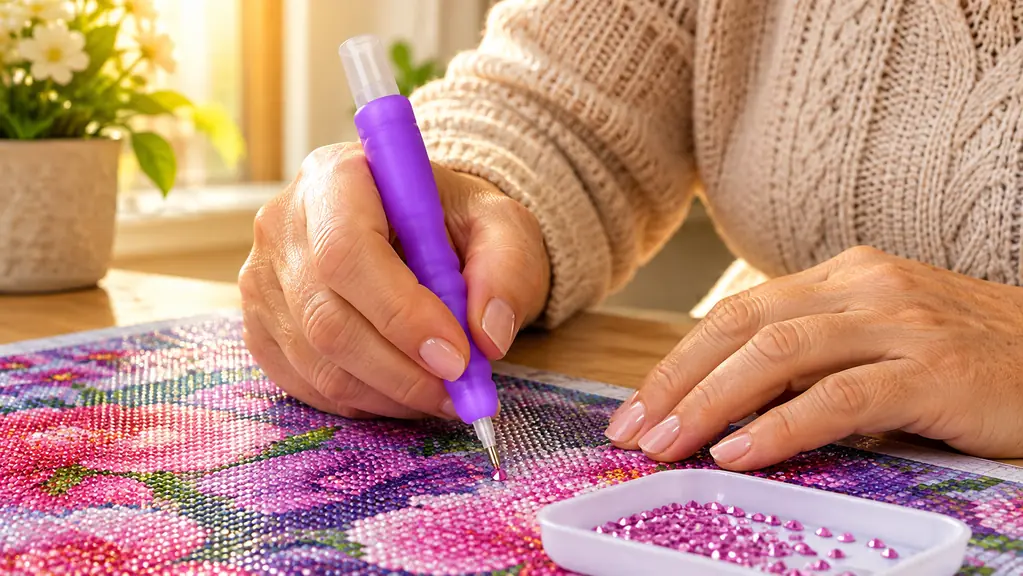
A normal session for me is about an hour, most evenings. I sort the drills from a new kit into my storage container before I start, set the canvas on the light pad, and then the only thing moving for the next sixty minutes is the pen. That is the whole hobby for me. The pen is the one piece of it I touch constantly, thousands of times in an evening, and it took me three years to notice that the cheapest piece of the setup was the one causing the most trouble.
I am a fair test case because I am not gentle with a pen. I have finished around forty canvases in four years, I have mild arthritis in my right thumb, and I wear reading glasses, which means I lean closer to the canvas than I should and hold the pen tighter than I need to. If a tool is going to fail on someone, it usually fails on me within a month. I have had this kit for about a year.
The pen lives in its case on the left side of the folding table, next to the wax. I open it, screw in whichever tip suits the evening, and close the lid. At the end of the session the tip goes back into its slot and the case closes again. That small routine is the reason the barrel still looks the way it did in the first month, because it is not rolling around loose with metal tips knocking against it. Ray has stopped asking why there is a small case permanently on the table.
What's Actually in the Kit
The listing calls it a pen kit, and it is honest about that word. You get one diamond painting pen, six stainless steel metal tips that screw into the end of it, a small roller tool, and a case to keep the lot together. The case measures 6.69 by 3.35 by 0.59 inches, which is roughly the footprint of a paperback, so it drops into the drawer with my wax and my spare trays without any rearranging.
The tips are the part that matters. On a stock pen the metal tube is fixed, and when it clogs or bends you throw the whole pen away. These screw in and out. I have cycled between three of the six over a year of steady use, mostly because different parts of a canvas want different placement, and I have not had a tip work loose mid row or cross thread on me.
The roller is the part I would not miss. It is a small roller and it does what a small roller does, but I bought the EastyGold roller pressing kit at the same time and that is the one I actually roll with. The Praise V Do roller has lived in its slot in the case since about the second week. If you already own a roller you like, treat this one as a spare.
One more honest note before we get into the part that matters. The manufacturer warranty on the listing is thirty days from the date of purchase. That is short. It has not mattered to me because nothing has failed, but if you are the kind of person who wants a long warranty on a small tool, know what you are getting.
The Thumb Problem, and What Changed
Here is the thing about a stock pen. It is a narrow plastic stick with a metal tube at the end, and to hold it you pinch it between your thumb and your first two fingers. Do that a few thousand times in an evening and the pad of your thumb is doing a job it was not built for, over and over, with no give anywhere.
Before I bought this, I tried the cheap fixes first, which is what I do with everything. I bought a pack of foam pencil grips from the drugstore and slid one onto a stock pen. It helped for about a week. Then the foam went soft and started rotating around the barrel, so the pen kept turning in my hand and I kept having to stop and correct it. Next I wrapped a barrel in vet wrap, which is not a sentence I ever expected to type. That was worse. It picked up lint and stray drills and after two evenings it had compressed into a hard lump right where my thumb sits. A rubber band was the last attempt and it lasted one session. All three were me trying to turn a thin pen into a fat pen, and none of them worked, because none of them changed the weight or the balance.
The Praise V Do pen is a different shape in the hand. The barrel is thicker and it has real weight to it, so my fingers curl around it instead of pinching at it. The acrylic body means it does not feel like a toy, and it sits balanced rather than tip heavy, which is where the ache used to start. I noticed the difference inside the first week, and I noticed it most at the fifty minute mark, which used to be the point where I quit.
I want to be careful here, because I am not going to tell you this pen cured anything. My thumb still has arthritis. What changed is that a session no longer ends because of it. I finish the hour I planned to finish, and I have stopped doing that thing where I shake my hand out under the table and pretend I am not doing it.
The Metal Tips, and the Screw Thread
The six tips are stainless steel and they thread into the barrel. That sounds like a small detail. It is not, if you have ever had a stock pen clog with wax in the middle of a session and had no way to clear it except to pick at it with a pin and hope.
I keep one tip in the pen for ordinary single placement, which is most of what diamond painting is. When I want to set a run of drills along an edge or fill a block of one colour, I swap to a different tip, and the swap takes a few seconds. Because they screw in rather than push in, they sit straight and they stay straight. I have had no wobble, which matters more than it sounds like it should when you are trying to land a drill on a symbol the size of a pinhead.
At the end of a session I do one thing that has kept the tips working. I twist the tip out, wipe the wax off the outside with a paper towel, and set it back in the case rather than leaving it in the barrel overnight. That is maybe thirty seconds of work. It means the thread stays clean and the tip does not sit in a cold plug of wax until the next evening. With the stock pens I could not do this, because the tube was fixed and the only option was to dig at it with a pin. If you have ever had a pen stop picking up drills halfway along a row, that thirty seconds is the difference between finishing the row and losing the evening's rhythm.
The thread is also the reason I would buy this again rather than a cheaper pen with a fixed tip. A pen with a fixed tip has one lifespan. This one has six, and the tip I use hardest is still seating drills cleanly after a year.
What the kit does not do is hold drills for you. There is no storage in the case for sorted colours, no little compartments, nothing like that. My drills live in the ARTDOT 60 slot storage container and always will. Do not buy this expecting it to organise a kit, because it will not.

Months In: One Canvas, Then Another
The test I care about is a long one, so here it is. This past spring I worked a full drill hummingbird canvas, 14 by 14 inches, over about three weeks at roughly an hour most evenings. Before that one I had finished around forty kits, all landscapes and florals, so it was my first bird design and my first time doing that much colour blending in one small area.
I used the kit's own canvas, drills and wax. I used my Praise V Do pen for every single drill on it. Three weeks of an hour a night is a lot of placement, and the two things I was watching for were a tip working loose and my thumb giving out before the canvas did. Neither happened. The canvas is framed and hanging in the hallway now, and the pen went back in the drawer and came out again the next evening.
One evening in the middle of that hummingbird I did something I had not done before. I worked a single block of background colour, roughly a two inch square, without leaving my chair or resetting my hand. That is somewhere near ninety drills in one sitting, all the same colour, placed one after another with no pause. On a stock pen that block would have been three sittings with a shake between each one. I finished it, set the pen down, and realised I had not thought about my thumb once in twenty minutes. That is the review, really, more than any of the numbers above.
A year in, the honest summary is that nothing has broken and nothing has worn in a way I can see. The tips still thread cleanly. The barrel still feels the same in the hand. My one complaint is cosmetic and I will say it plainly: the finish on the barrel is not going to stay perfect if you keep it loose in a drawer with metal tips rattling against it, so use the case it comes with.
What I Liked
- Six screw-in stainless steel tips, so a clogged tip is a swap and not a dead pen
- A wider, heavier barrel that stopped my thumb aching at the fifty minute mark
- The tips thread in straight and have not worked loose in a year of steady use
- The case is small enough to live in a drawer at 6.69 by 3.35 by 0.59 inches
Where It Falls Short
- The included roller is the weakest piece. Mine has stayed in its case since week two
- No drill storage in the case, so you still need a container for sorted colours
- A thirty day manufacturer warranty is short for a tool you use every day
- The barrel finish marks if you store it loose instead of in the case
Three weeks on a 14 by 14 inch hummingbird canvas, an hour most evenings, and my thumb never once decided the session was over.
Who This Is For
This is for the person who drills most evenings and has started to notice their hand. If you are still using the free pen from the kit box, this is the upgrade I would make first, ahead of a light pad or a storage box, because it is the tool you touch the most and the one that sets how long you can sit there.
It is also for anyone working bigger canvases, where a session runs long enough for a narrow pen to become a problem. And it is for anyone who has thrown a stock pen away because the tip bent or clogged, since the swappable tips are the whole point of this kit.
Who Should Skip It
If you diamond paint once a month for twenty minutes, the free pen is fine and this will not change your life. If you already own a heavier pen with swappable tips that you like, there is nothing here you are missing. And if what you actually want is a complete setup, remember this is one tool inside it, not the setup. You still need the light pad and the drill storage, and the roller in this case is not the one you will end up using.
A year of evenings, one pen, and no more shaking my hand out under the table
Six stainless steel tips that screw in and stay straight, a barrel wide enough that your fingers curl instead of pinch, and a case that fits in the drawer. If the pen in your kit box is the thin plastic one, this is the swap that changes how long you can sit.
Amazon Check Today's Price on Amazon →