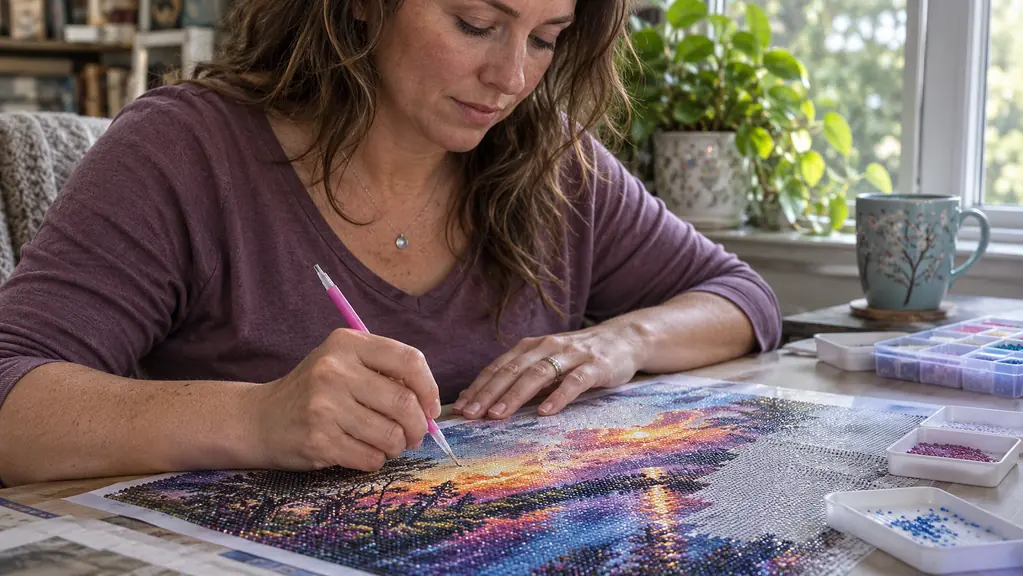
The pen that comes free in a diamond painting kit is a thin plastic tube with a dab of wax in the tip. It works for about twenty minutes. Then the wax picks up fuzz, the tip starts to wobble against the canvas, and my right thumb begins the low ache that made me give up knitting four years ago. I kept using those free pens for three years because I assumed that ache was just what diamond painting felt like.
A year ago I bought the Praise V Do Drill Pen Kit, mostly out of frustration on a Tuesday night. I had a half-finished floral canvas on the folding table in the spare bedroom and a hand that would not stop complaining. This is an honest review of that kit after roughly fifty weeks of use, and it includes the parts I would leave out if I were writing a product listing.
The short version: I still use it every evening, I have not gone back to a free pen once, and I would buy it again. The longer version is that some of what the listing suggests is not quite what the kit delivers, and those parts are worth knowing before you spend an evening learning them the way I did.
The Quick Verdict
A genuinely better pen for anyone whose hand hurts after half an hour. The roller that comes with it stayed in its case, swapping tips takes longer than you expect, and the warranty is short. I have not touched a free kit pen since.
Amazon Check Today's Price →The pen I reach for every evening, one year in
Six stainless steel screw-on tips, an acrylic body that stops your thumb from pinching, and a case that keeps the lot together. Mine has been in weekly use for about fifty weeks.
Amazon Check Today's Price on Amazon →What Actually Comes in the Box
The listing names three components: the pen, the stainless steel metal tips, and a diamond painting roller. What arrives is one pen with a screw thread at the business end, six stainless steel tips in different diameters, the roller, and a small case that holds everything. The kit measures 6.69 by 3.35 by 0.59 inches, which is roughly the size of a paperback, and it slides into the drawer of my craft table without an argument.
The body is acrylic, and that matters more than it sounds like it should. Acrylic has a little give to it. The free pens are thin tubes that flex in the hand and pass every bit of pressure straight down into the pad of your thumb. The Praise V Do body is thicker and it does not flex, so the pressure spreads out instead of landing in one spot.
Two things about the box are worth flagging before you order. The tips are held by a screw thread rather than pushed in, so you have to actually seat them. If you do not seat one all the way, the tip will turn while you drill and you will spend a while working out why your placements are drifting. And the manufacturer warranty runs thirty days from the date of purchase, which is thin for a tool you plan to hold every night. Open the box and use it in the first month rather than setting it aside for a rainy day.
The tips are also not labelled by size. They sit in the case in a row and you learn which is which by holding them next to each other, or you mark them yourself. I put a dot of nail polish on the finest one after a week of squinting at it.
How I've Used It
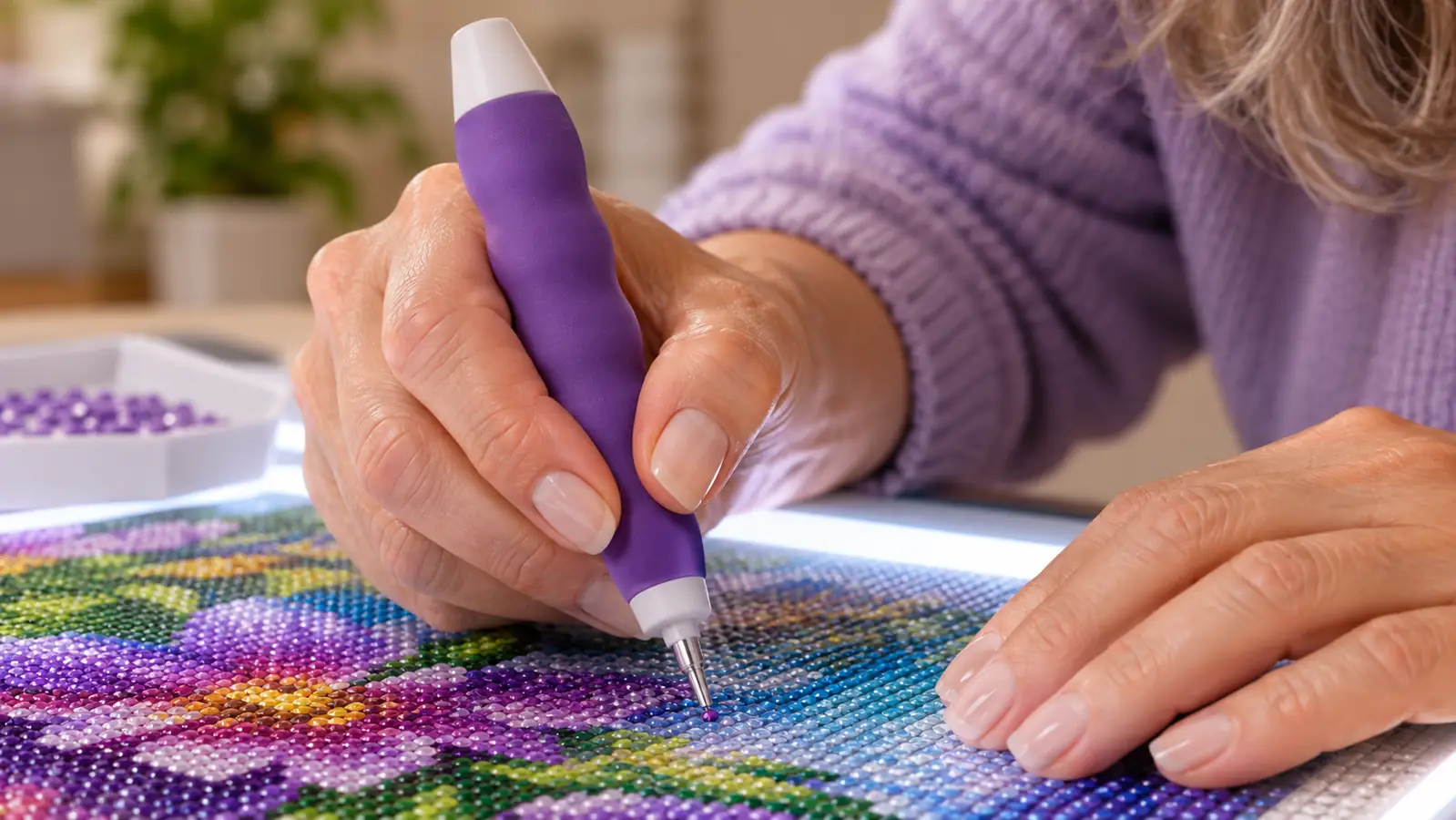
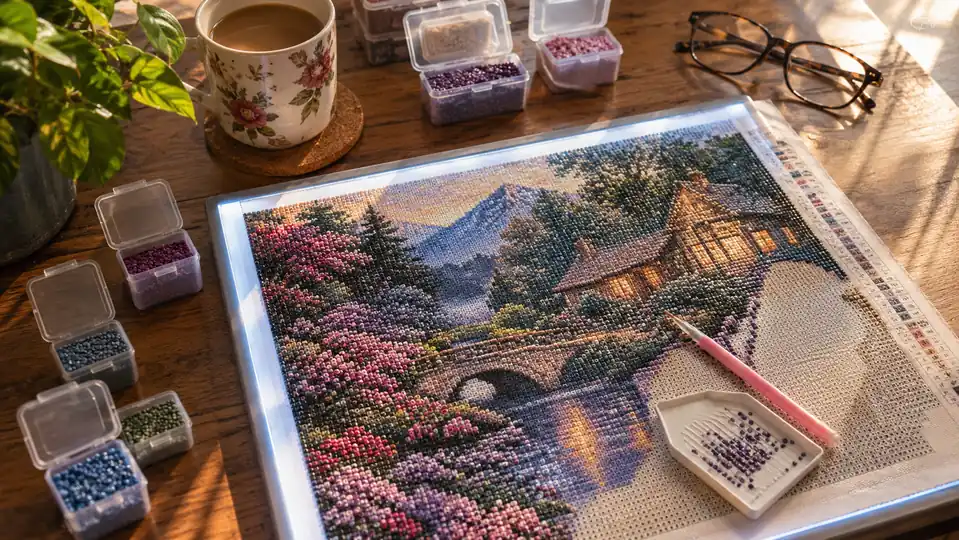
I work on a canvas most evenings for about an hour, longer on weekends, in a craft corner set up in the spare bedroom. My table sits by a north-facing window and I keep an ARTDOT A3 light pad under every canvas, because evening drilling under the ceiling light was giving me headaches two years back. The pen is the tool that picks up a drill and sets it on the symbol. That is its whole job, and it is the one I touch more than any other.
My most recent finished piece was a 14 by 14 inch hummingbird canvas, full drill, worked over about three weeks this past spring. It was my first bird design after roughly forty landscapes and florals, and it is the piece where I finally stopped thinking about the pen at all. That is the test I care about. A tool that disappears while you use it is a tool that works.
Before the Praise V Do I used only the thin plastic stock pens that come free in kits. I still have a handful of them in a cup by the window and I have not used one since the week the new pen arrived. My husband Ray teases me about the drill storage boxes, but he has never once teased me about the pen, which tells you something about how rarely I bring it up.
One thing about working this way for a year is that the pen stops being a decision. The storage box sits to the right of the canvas with the drills sorted, the light pad is already on, and I pick up the pen without looking at it. That kind of familiarity is not something a listing can promise, and it is the honest reason I am writing this instead of just moving on to the next canvas.
The Grip Is the Real Reason I Switched
I have mild arthritis in my right thumb. It is the reason I gave up knitting and the reason the free pens eventually became unbearable. After about half an hour with a stock pen, the joint at the base of my thumb would throb, and I would grip harder to compensate, which made it worse. The Praise V Do pen did not cure anything. It is not a medical device and I am not going to pretend otherwise.
What it does is put more material between my fingers and the canvas. The body is fatter than a stock pen, so my thumb and index finger rest instead of pinching. I still take a break every forty minutes or so. But I can do a full evening now, and for about a year before the switch I could not. If your hand is the reason you are shopping for a pen, this is the paragraph that matters and the rest is detail.
One caveat about the grip. It took me two evenings to stop holding it like the thin pen. The instinct is to choke up near the tip, which defeats the whole point. Once I moved my hand back and let the pen sit in the crook of my thumb, the ache dropped off noticeably. Give it two sessions before you decide it is not for you.
If you have never had hand trouble, this whole section probably reads like a lot of fuss about a plastic tube. Fair enough. Skip ahead to the tips.
The Six Metal Tips, and What They Change
The kit includes six stainless steel tips. Different diameters pick up different drill counts, and stainless holds a cleaner edge than the moulded plastic tip of a stock pen. Metal also wipes clean. With a plastic tip, wax and fuzz build up into a grey ring that you end up picking at with a fingernail. With metal, a quick wipe on a paper towel and you are back to picking up drills.
The screw thread is the part nobody mentions in reviews. Tips are not push-fit, they turn on. That is more secure, and it means a tip never works loose mid-row and dumps drills across the canvas, which happened to me twice with the free pens. It also means swapping tips is a slower job than pulling one off and pushing another on. If you like to change tip size every few minutes, you will notice that. I change mine once at the start of a session and leave it alone.
There is one more thing about the metal. Because the tips are thin and hard, they can scratch a canvas if you drag them. I did it once on a floral piece, a light line across an un-drilled patch that no one else would ever see and that I still see every time I walk past it. Lift the pen between placements rather than sliding it along. That is a technique note and not a product fault, but it is the sort of thing I wish someone had told me in week one.
Sizes matter more than I expected. I keep a middle size on for most of the work and switch to the finest one for the cramped areas near the edges of a design, where the symbols sit close together and a bigger tip cannot land without nudging a neighbour. Having six to choose from means you stop making do with the one that came in the bag.
What Nobody Tells You
The kit comes with a roller. Mine has lived in its case since the first week, and I roll my finished sections with a separate EastyGold roller instead. The little one works fine, it is just narrow, and on a 14 inch canvas you feel every pass. If you already own a roller, treat the one in this kit as a spare for a travel bag.
The pick-up end still needs wax. A metal tip is not sticky on its own. You load it from the wax pad that comes in your kit, and if you overload it the drill will cling and twist instead of sitting square. Less wax than you think. That is true of every pen, but a metal tip gives you less forgiveness for a heavy hand than a plastic one.
The pen is also heavier than what you are used to. Not heavy, heavier. I noticed it for the first three evenings and then I stopped noticing it entirely. I mention it because the first reaction to a chunky tool is often that it is too much pen, and that reaction fades faster than you would guess.
The case is worth a line of its own. It holds the pen, the six tips and the roller, and it closes. That sounds like nothing. It is not nothing. Loose tips in a drawer turn into a scavenger hunt at the exact moment you want to start work.
What the pen will not do is fix a canvas. If your symbols are cramped and your light is poor, a better pen just means you place drills faster in the wrong spot. The order of upgrades in my craft corner was light pad first, then storage, then the pen. That order was correct, and I would give the same advice to anyone starting out.
Where It Falls Short
The tips can freeze in place if you crank them down hard. I did that to the finest tip in the set and spent ten minutes with a cloth and a firm twist getting it back off. Snug is enough. Snug is not tight, and there is no reason to force it.
Thirty days of manufacturer warranty is thin for a tool you plan to hold every night for years. Nothing on my pen has failed in a year of steady use, so I have not had to test the warranty. But it is a short window, and it is worth knowing before the box goes on a shelf for six months.
And there is only one pen in the kit. That sounds obvious because it is, but a full drill canvas with a lot of similar colours is easier with two pens loaded with different tip sizes so you are not swapping mid-section. I have not bought a second one. I have thought about it more than once.
It is also a tool and not a transformation. I finished the hummingbird in three weeks of evenings, and the pen was not why. The pen was why my thumb did not throb at the end of them.
What I Liked
- The fatter acrylic body lets my thumb rest instead of pinching, so I can work a full evening again
- Six stainless steel tips wipe clean instead of building up a ring of wax and fuzz
- The screw thread keeps the tip locked, so nothing works loose and dumps drills mid-row
- The case holds the pen, all six tips and the roller together
Where It Falls Short
- The included roller is narrow and stayed in its case while I used a separate one
- Tips screw in slowly, so switching size mid-session is more hassle than a push-fit pen
- The manufacturer warranty runs only thirty days from purchase
- One pen per kit, when two would suit large canvases with similar colours
I can do a full evening now. For about a year before the switch, I could not.
Who This Is For
If you do diamond painting more than once a week and your hand complains after half an hour, this is the purchase I would make before buying another canvas. It is also the right pick for anyone who has been using the free pens out of the kits and has no idea that the tool is the reason the hobby feels like work by nine in the evening.
It suits people who settle on a tip size and stay there for most of a session, which is how most of us actually work. And it suits anyone handling a wide canvas at the kitchen table, the way I do when a piece is too big for the folding table. A fatter body is easier to hold at an odd angle when you are leaning across a large design.
Who Should Skip It
If you do one small canvas a month and your hands are fine, the free pen is fine. I mean that sincerely. Do not buy a tool to solve a problem you do not have.
Skip it too if you want to swap tips one-handed every few minutes, or if you already own a metal-tip pen that suits your grip. And if you are ordering this expecting the roller to replace a proper one, adjust that expectation now rather than after the box arrives.
The reason I keep coming back to this kit after a year is not that any single feature is spectacular. It is that every evening when I sit down, the tool is not the thing I am thinking about. That is a good place for a tool to land.
If your thumb aches after half an hour, start here
Open the box in the first month so the thirty day warranty window is still open, seat the tips snug rather than tight, and give the fatter grip two evenings before you decide. Mine has been in weekly use for a year.
Amazon Check Today's Price on Amazon →