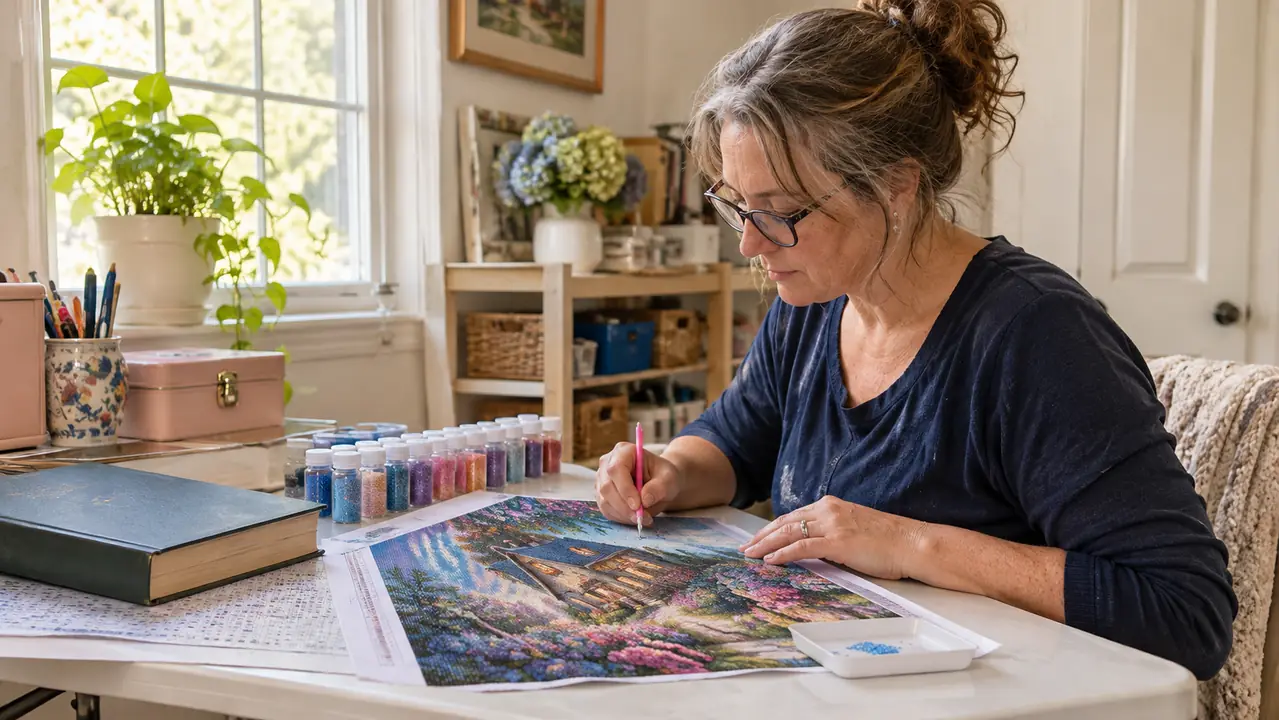
The ziplock bag system works right up until the moment it does not. I kept my drills in sandwich bags inside a shoebox for the first two and a half years of this hobby, and for most of that time it was fine. Then a bag holding two very similar greens came open on the rug, and I spent a whole evening on my hands and knees with a lamp, picking apart a couple of thousand tiny squares by shade. Nothing was ruined. It was just the most tedious hour of my month, and it happened because a plastic bag has no walls, no lid and no address.
That spill is what pushed me toward the ARTDOT 60 slot storage container about eighteen months ago. What I wanted was not a prettier shoebox. I wanted every color to have a fixed home, a lid, and a label I could read without hunting for my glasses, so that setting up a new kit would be a fifteen minute job instead of an evening of sorting. What follows is the routine I actually use, in the order I do it, including the two steps I got wrong on my first kit and had to redo from the beginning.
Sixty slots, sixty labels, and a lid that actually closes
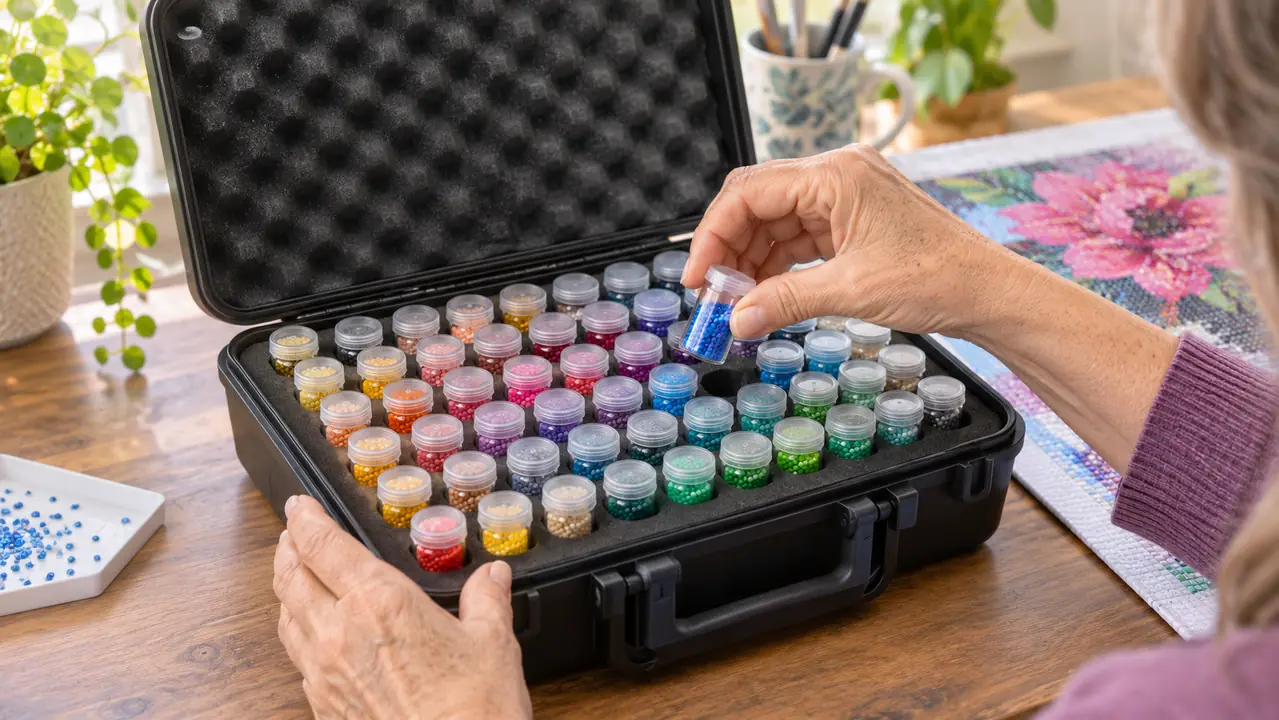
The ARTDOT 60 slot storage container holds 60 bottles of about 10 grams each, nestled in a foam base, with 64 labels, a foldable silicone funnel and 4 pens carrying 3, 6 and 9 drill placers. It is the difference between a fifteen minute kit setup and an evening on your knees.
Amazon Check Today's Price on Amazon →Step 1: Clear one stretch of table and open one kit
The first mistake I made, twice, was treating a new kit as a sorting project for the whole table. Sixty bottles means sixty possible homes, and the temptation is to open every bag at once, tip them into one big pile and start matching. Resist that. What you want is one canvas, one kit's worth of drills, and a clear patch of table about the size of a placemat for the bottles you have already filled. Anything else on the table, the coffee cup, the phone, the second kit you bought on sale, is just something to knock a bottle into.
Open the kit and set out the drills, the wax, the pen and the printed symbol chart. Put everything except the drills to one side. I lay the chart flat under a heavy book for an hour before I use it, because a chart that has been folded in a box since the factory will not lie down, and a chart that curls is the reason people lose their place and start guessing at symbols. Then I count the color codes down the side of the chart. Most kits I buy run between 30 and 55 colors. The ARTDOT case holds 60 bottles, and I have never once filled all 60 from a single kit, which means there is always room to move a color when I change my mind about the order.
One more piece of prep before anything gets poured. I trim the top off the kit bag and keep the bag itself, folded, under the corner of the canvas. Kits almost always ship a few hundred spare drills per color, and having the original bag at hand means I can top up a bottle without digging through the shoebox looking for the source it came from.
Step 2: Number the labels against the chart before you pour anything
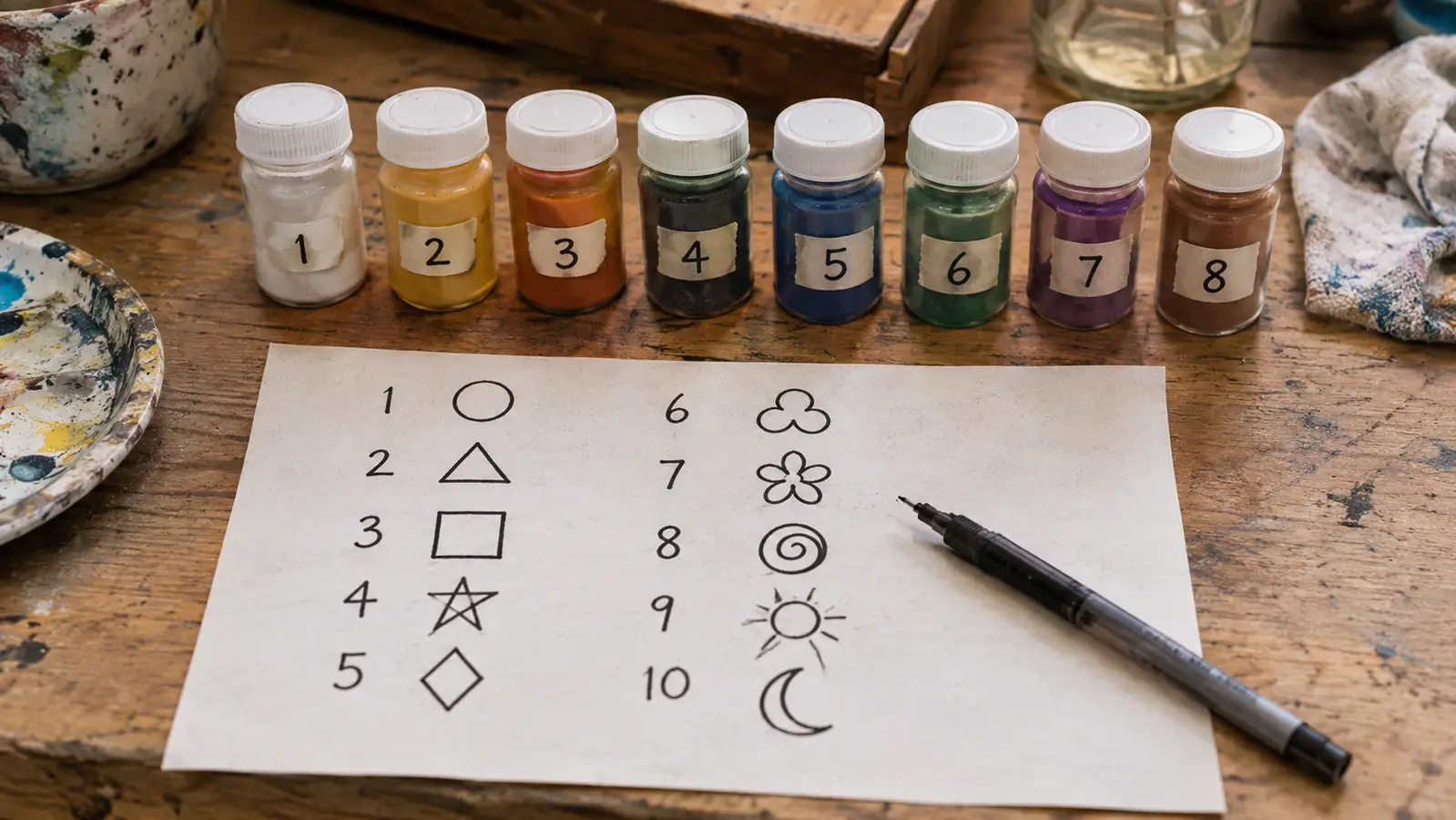
This is the step that saves the most time later, and the one I skipped on my first kit. Before a single drill goes into a bottle, number the labels and write that number beside the matching symbol on the chart. Not the color name. The number. A kit chart lists each color by a code and prints a small symbol next to it, and by the second week the code means nothing to me while the symbol is the thing I am actually hunting for on the canvas. Writing a bottle number beside the symbol turns the chart into a map. I find the symbol on the canvas, read the number, and pick up bottle 34 without stopping to think.
The case comes with 64 labels, and I use a fine-tip permanent marker rather than a ballpoint. A ballpoint smears on label film, and a smeared 8 reads as a 3 for the rest of the kit. If you run out of labels, a strip of painter's tape does the job, though it lifts at the edges after a few weeks of handling. I also keep a scrap of paper inside the case with the kit name and the date I loaded it. That sounds fussy and takes about four seconds.
If a kit has two colors that are nearly identical, and nearly all of them do, mark those two symbols on the chart with a star. When you are tired at nine in the evening and the small symbols start to blur, the stars are what stop you from filling an entire block in the wrong green and having to pick it back out with a pen tip.
Step 3: Fill one bottle per color and tap it down
Filling is the only part of this routine I do slowly on purpose. Each bottle holds about 10 grams, which the listing puts at roughly 2,000 drills, and that is more than enough for a 14 inch canvas with a good number left over. Fill to the shoulder rather than the rim. A bottle packed to the top will not let the drills settle, and you will spend the next three evenings digging them out with the tip of the pen.
Pour through the foldable silicone funnel that comes in the case instead of straight from the bag. It is the single best spill preventer I have found, and it costs about four extra seconds per color. Cap the bottle, tap it twice on the table so the drills lie flat, and set it down into the foam. If a color arrives in a bag much larger than the bottle, keep the excess sealed in the shoebox with the kit name written on it and top the bottle up when it runs low.
One warning from experience: do not fill bottles over an open case. Fill them on the bare table with the case closed beside you, or you will be picking drills out of the foam around 59 other bottles. I learned that one with a pale yellow that went everywhere, and I am still finding it in the seam of the table.
Sixty numbered bottles in one foam base, and a lid that closes: fifteen minutes of setup at the front of a kit instead of an evening on my knees with a lamp.
Step 4: Load the case in symbol order, not color order
Order matters more than people expect. The instinct is to sort by color, all the blues together and all the greens together, because that looks tidy in a photograph. Sort by symbol number instead, in the same order the chart runs down the page, so that bottle 12 is always the twelfth bottle in the case. Your hand learns the geography within two or three evenings. After that you stop reading labels and start reaching, and reaching is faster.
The foam base helps here more than I expected. Because each bottle nestles into the foam rather than rolling around on top of the others, a bottle returned to the wrong slot is immediately visible, and a case that is one bottle short is visible too. That small correction happens in the moment instead of three weeks later, when you have torn the whole craft corner apart looking for a color you already own.
I load left to right, row by row, and I put every bottle back before I close anything, including the two I used for the last five minutes of a session. The one night I skipped that, I closed the case on a bottle lying on its side and had to reseat it before the lid would shut. Nothing broke and nothing spilled, and I have not done it since.
Kits that run past 60 colors, and a few of mine have, get the overflow in numbered bags that match the number the bottle would have carried. That has happened twice in eighteen months and it was fine. The case is not a limit on what you can work on. It is a limit on how much you have to hold in your head at once.
Step 5: At the end of a kit, demote the leftovers instead of dumping them
At the end of a canvas you will have 30 or 50 bottles with a little left in each, and this is where storage systems quietly fall apart, because the next kit arrives and you need the bottles back. I keep a shoebox for leftovers and I do not empty bottles into it. I demote the whole bottle. A strip of tape over the label, the kit name and the color code written on it, and the bottle goes into the shoebox standing up. It takes ten seconds to demote a bottle. It takes twenty minutes to re-sort one you emptied into a pile.
When the new kit has more colors than I have free bottles, which happens about every third kit, I empty the leftovers that are down to the last few drills into a small bag, tape it shut and put the bag in the shoebox instead. Anything under a quarter of a bottle is not worth a slot, because a nearly empty bottle is harder to scoop from than a bag. The bottle gets wiped out with a dry paper towel and goes back into service.
That is the whole system, and it takes about fifteen minutes at the front of a kit and a few seconds at the end of every session. I have loaded roughly a dozen kits through this case in eighteen months without another spill, which is either a good routine or a run of luck I am happy to keep taking credit for.
What Else Helps
Three things do more for this routine than any storage purchase, and I would get them in this order. The first is a light pad. I work with the canvas on my ARTDOT light pad, and it does two jobs at once here. It lights the symbols from underneath so I am not leaning into a desk lamp with my reading glasses on, and it makes the printed grid far easier to follow when the symbols are small and packed close together.
The second is a pen with a grip you can hold for an hour. The thin plastic pens that come free in kits made my right thumb ache after about half an hour, which is a real problem when you have arthritis in it. The larger grip pen in the Praise V Do kit is what I use now, and an hour most evenings stopped being something I had to talk myself into.
The third is a roller. Pressing finished sections flat with the heel of my hand worked for a while and then did not, and a heavy book on a canvas is a good way to crack a drill. I roll each finished area and then the whole canvas at the end with the EastyGold roller, which seats the drills level before a canvas goes into a frame.
And a small thing that comes with the case: the brush. I use it more than I expected, sweeping stray drills off the canvas and back into a bottle instead of pressing them flat with a fingertip. The whole ARTDOT case measures about 11 and a half by 7 and a half inches and stands under three inches tall, so it lives on the shelf above my folding table and comes down when I sit down. That is the test I apply to any storage system now. If getting it out is a chore, the colors end up back in bags by the second week.
None of this replaces the box. The light pad, the pen and the roller all make the drilling itself easier, but not one of them stops two similar greens from meeting on the rug. Storage is the boring part of this hobby and it is also the part that decides whether you finish the canvas or quietly move it to the bottom of the stack.
Every color gets a number, a bottle and a lid
The ARTDOT 60 slot case, with its foam base, 64 labels, foldable silicone funnel and 4 pens with 3, 6 and 9 drill placers, is what turned my kit setup from an evening into a quarter of an hour. It is a storage box, not a shortcut, and it is the one I reach for every week.
Amazon Check Today's Price on Amazon →