
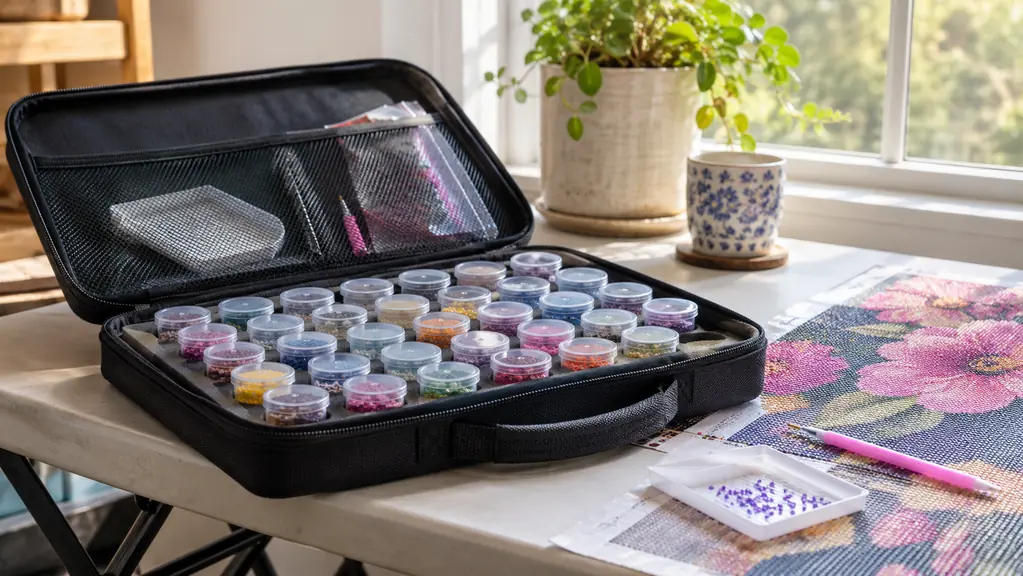
I have owned the ARTDOT 60 Slot Storage Container for about eighteen months, and the honest review I want to read is not the one with the tidy flat lay and the little bottles lined up like soldiers. It is the one that starts with a shoebox. Mine held ziplock bags, and one evening I caught the edge of it with my elbow and two greens that looked identical in the bag but not on the canvas went across the rug together. I sorted them by hand under a lamp and lost an evening. That is the mood I was in when I ordered a real storage case.
So here is the plain version. The ARTDOT case holds sixty small containers in a foam base, and it arrives with four pens, a brush, a foldable silicone funnel and a sheet of labels. It does not sort a kit for you. It does not tell you which of the thirty-nine greens on a full drill canvas is which, and it will not stay organized if you tip a new kit into it on a Tuesday night when you are tired. I know, because I did that twice. The case is good storage. It is not a system. The system is you, a pencil, and about forty minutes you did not plan on spending.
The Quick Verdict
The best drill storage I have used, on one condition: you have to label the containers yourself. Skip that step and sixty slots become sixty small mysteries.
Amazon Check Today's Price →Your drills are not disorganized. They just have nowhere to live.
Sixty containers seated in a foam base, a foldable silicone funnel, four pens with 3, 6 and 9 drill placers, a brush, and a sheet of 64 labels. Mine has been in nightly use for eighteen months and nothing has cracked or spilled since. If you are still digging through bags in a shoebox, this is where the digging ends.
Amazon Check Today's Price on Amazon →What Nobody Tells You Before You Buy Sixty Slots
The thing the listing cannot tell you is that a storage box changes the shape of the mess and not the amount of it. Before the case, my drills lived in bags and the mess was horizontal, spread across the table and the shelf and one corner of the rug. After the case, the mess is vertical and it lives entirely inside my own head, because sixty identical containers under a lid are sixty questions until you label them. That sounds like a complaint. It is not. It is the trade I would make again, but nobody mentioned it to me and I would rather you heard it now.
Capacity is the other thing to think about before you buy. Sixty containers sounds like more than any hobby could need, and then you open a large full drill canvas with a ninety color legend and you are doing arithmetic on a Tuesday. Each container holds about ten grams, which the listing puts at roughly two thousand drills. That is generous for a small kit and right at the edge for one background color in a big one. I have never actually run out mid-project, but I have refilled a container from the bag twice in one evening, and that is a fair picture of what sixty slots means at the top end.
How I've Used It for Eighteen Months
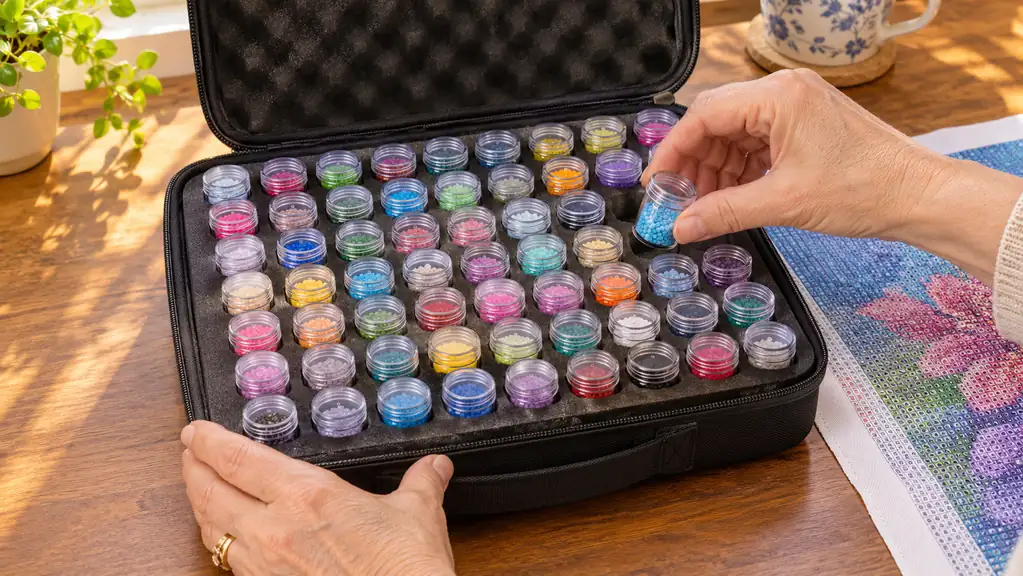
I do diamond painting most evenings, usually an hour, at a folding table in the spare bedroom by a north-facing window. When a canvas is too big for the folding table I move to the kitchen, which my husband Ray believes is a design choice and I believe is a necessity. The case lives on the shelf beside the table, and my routine has not changed since the second week. A new kit comes in, I open the case, I fill one container per color, I label it, and the lid goes back on before I let myself start drilling.
That last part matters more than it sounds. On the first kit I sorted, I filled containers and left the lid open overnight, and the next morning I spent ten minutes working out which unlabeled container held which of two very similar greens. Nothing was lost. It was just ten minutes of my life spent on a problem I had created. Now the label goes on before the next container comes out of the foam. Eighteen months in, I have not come close to a repeat of that rug evening.
The included pens deserve a straight sentence, because they are part of what you get. The case comes with four pens fitted with 3, 6 and 9 drill placers, plus a brush and the funnel. I do not use them. My right thumb has mild arthritis, and about a year ago I switched to a larger grip pen from a different kit and never went back. The four included pens live in the case as spares, and I have given two away to a friend who was starting out. They are perfectly good pens. They are simply not the ones I reach for.
One more note on those pens. If you are brand new, the pens plus the placers plus the brush are the reason you can start the same evening the case arrives, with nothing else on the table. That was not my situation, but I have watched a friend do exactly that. For a beginner this is a starter kit wearing a storage box's clothes, and I mean that as a compliment.
Setting Up a New Kit, Start to Finish
Here is what the routine actually looks like, because I think this is where people either settle into the case or quietly stop using it. I empty the kit onto the folding table and check the legend against the bags. Then I count the colors and decide whether they fit in sixty. If they do, I lift containers out of the foam a few at a time, open a bag, and use the funnel to get the last of the drills in without chasing them across the table. Then I write the symbol and number on a label in pencil and set that container back in the order the symbols appear on the legend.
That ordering is the whole trick and it costs nothing. When the containers go back in legend order, I can find a color by looking instead of hunting, and I stop opening four lids to find one green. The first night of a new canvas runs about forty minutes, and most of it is labeling and pouring rather than drilling. It is not glamorous work. It is the reason the other three weeks of that project stay calm.
I have skipped it exactly once since, on a small kit I told myself I would finish in two evenings. I did not finish it in two evenings, and I spent both of them lifting lids. That is the whole argument for the labels. Everything else about this case is decent plastic and good foam, and the labels are what turn it into something you keep using.
What's Actually Inside the Case
The case measures 11.61 by 7.68 by 2.95 inches, so on my shelf it takes a little more room than a hardback novel and a half. The body is EVA and plastic with a foam base inside, and the foam is doing the real work. Each container sits down into its own cutout, so when I carry the case from the craft corner to the kitchen table, nothing shifts, rattles or pops open. I have carried it down a hallway in a tote bag more times than I can count.
I tested the lid by accident. I had the case balanced on a stack of canvas boxes in the hallway, turned to answer the phone, and knocked it off. It landed on its side. I stood there expecting the worst, then opened it to find every container still seated in its cutout and every lid still on. I am not recommending you drop yours. I am telling you what happened when I dropped mine.
The funnel is the piece I did not expect to use every week. It folds flat, and it is the difference between pouring the end of a bag and pouring the end of a bag badly. Container on the table, funnel open, bag tipped, and the last stubborn dozen drills land where I intended instead of on the rug. Folded, it tucks into the case beside the containers so it does not wander off into the drawer where small useful things go to disappear.
The Labels Do More Work Than the Containers
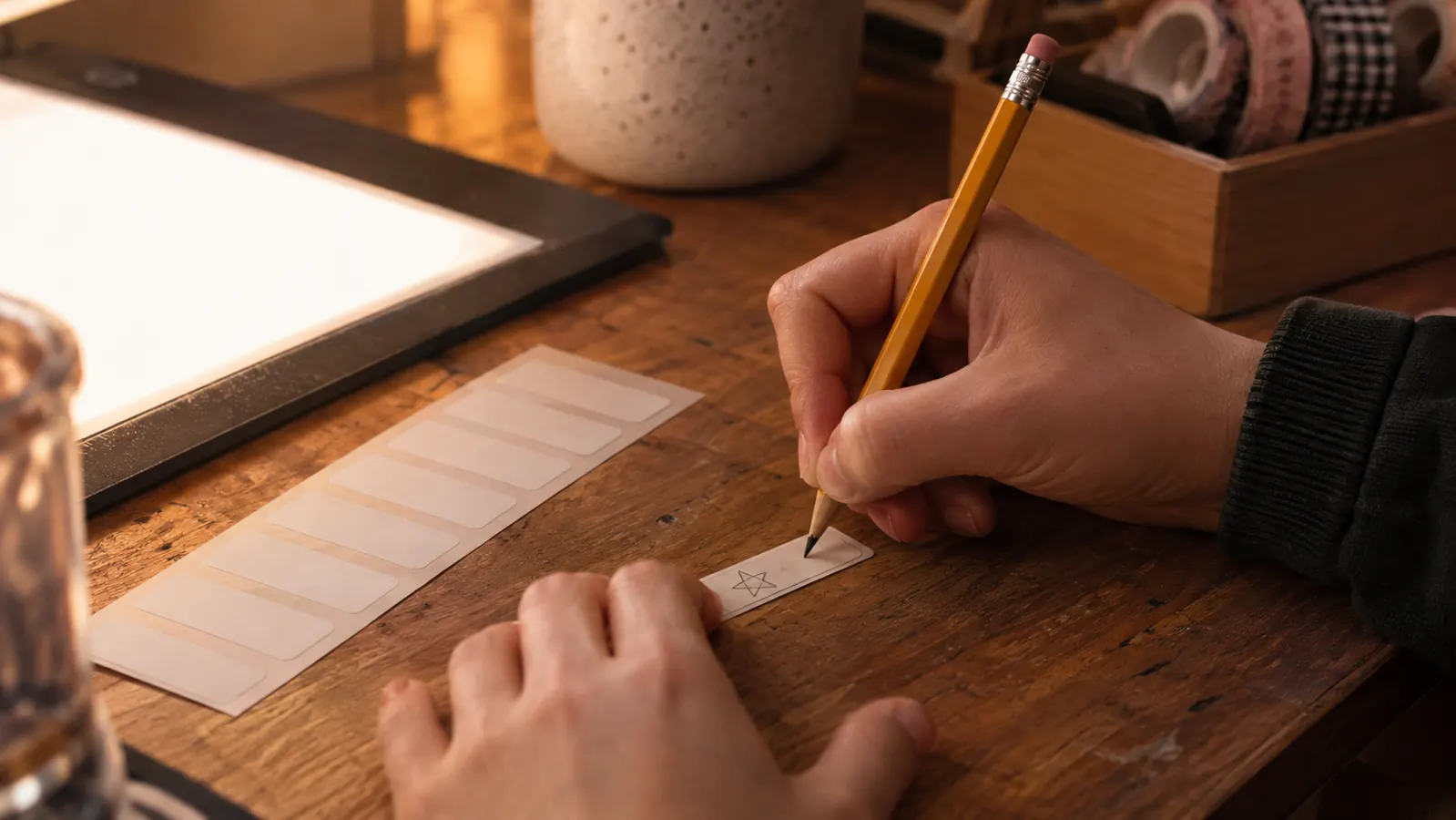
The case comes with sixty-four labels for sixty containers, which means four spares. Four spares sounds like nothing. It is the difference between a box you keep using and a box you stop using, because labels get written wrong, and a case with three mislabeled greens is a case that makes you distrust every container in it.
My system is not clever. On a new kit I write the kit's own symbol and number on the label in pencil, fill the container, and set it back in the foam in legend order. Because it is pencil, I can erase and relabel between kits. A pen would mean peeling labels off small containers, and peeling labels on a Sunday evening is not the hobby I signed up for. This is not a feature of the ARTDOT case. It is what I do with it.
If you will not spend the forty minutes, the case will still hold your drills and you will still dig for the right green. Storage without labels is a shoebox with nicer walls. That is the one sentence I would print on the box if anyone asked me.
What I Liked
- Sixty containers seated in a foam base, and nothing shifts when you carry the case
- Sixty-four labels for sixty containers, so four chances to fix a mistake
- The foldable silicone funnel saves the last stubborn dozen drills in every bag
- Four pens with 3, 6 and 9 drill placers plus a brush, which is a real help for a beginner
- Ten grams per container, roughly two thousand drills, is plenty for most colors
Where It Falls Short
- Sixty slots will not cover a large full drill canvas with a ninety color legend
- Unlabeled containers are useless, so the box only works if you label
- The containers are shallow, right for drills and wrong for anything bulky
- The foam base makes the case bigger than sixty loose containers would be
I lost an evening to two greens on a rug. Eighteen months with this case and I have not lost another.
The Honest Downsides
Sixty is a number, not a promise. A large full drill canvas can run to ninety colors, and on one of those the case holds most of my kit and the overflow sits in bags beside it. That is not a defect. It is the size of the box. But it means this solves everyday clutter and not the largest project on your shelf, and I would rather say so than let you find out in week two.
The containers are shallow, which is right for drills and wrong for much else. I would not use them for beads, charms or anything with bulk, and I would not use the case as a general craft tote. It is a drill box. It does that one job well and it is not pretending otherwise.
The foam base takes up real volume. That is what makes the anti-collision part work, and it also means the case is larger than sixty small containers would need to be if they were loose in a tin. On a cramped table that difference shows up. My folding table is not cramped and I still had to move a lamp by two inches to fit the case at the end of it.
And when the lid is closed you cannot see what is in it. Sixty small containers under one lid all look the same from the outside. The labels solve that, if you label. If you do not, you will open the case and find sixty small mysteries and no way to tell the greens apart except by taking the lids off one at a time.
What Eighteen Months Has and Has Not Changed
The case itself has held up better than I expected. The lid still closes flush, the foam has not torn or gone soft at the cutouts, and none of the containers has cracked, including the two I have knocked off the table. Nothing has broken. I have not had a spill since I moved the drills out of the bags. For a piece of plastic storage that gets opened twice a day, that is the whole report.
What changed is my habits, not the box. I label before I fill. I set containers back in legend order instead of wherever my hand lands. I use the funnel every single time instead of telling myself the bag is nearly empty anyway. None of that came in the case. The case just made it worth doing, because a box that keeps fifty-nine other colors sorted is a box that makes you care about the sixtieth.
I also stopped moving my drills between projects. That sounds small. Before, every new kit meant a hunt through bags, and I would find a shade I already had in a bag from a kit I finished months earlier. Now the labeled containers from an old kit stay put, and when a new kit calls for that exact green, I look and there it is. That is the part I did not anticipate, and it is the part that keeps the case on the shelf.
Who This Is For
This is for the person whose drills currently live in bags. If you have a shoebox, a drawer, or a stack of kits still in their packaging and you are tired of digging, the ARTDOT case is a real upgrade and it will last. It suits anyone working two or three canvases at once, since sixty labeled containers let you keep several kits filled and ready without dumping anything out. And it is a fair first purchase for someone new to the hobby, because the pens, placers, brush and funnel arrive with it and you are not hunting those down separately on day one.
Who Should Skip It
Skip it if you work almost entirely on large full drill canvases with ninety or more colors, because sixty slots will leave you half organized, and half organized is the state you were already in. Skip it if you know in your bones you will not label, because unlabeled the case is just tidier digging. And skip it if you want one case to hold drills and every other small thing on your table, because the containers are shallow and the foam takes the space anything else would have needed.
What I would tell a friend is this. Buy the case, and put a pencil on the shelf next to it the same week. Mine has been in use for eighteen months, it has survived being carried through the house and knocked onto a hallway floor, and it ended the bag digging for good. What it did not do is organize anything by itself. That part was mine, and it runs about forty minutes per kit. Fair trade, as far as I am concerned, for never again spending an evening sorting two greens on a rug.
Eighteen months in, this is still the thing I reach for every evening.
Sixty containers in a foam base, a foldable silicone funnel, four pens with 3, 6 and 9 drill placers, a brush, and 64 labels. Add a pencil and forty minutes per kit and you are done digging for good.
Amazon See Today's Price on Amazon →